
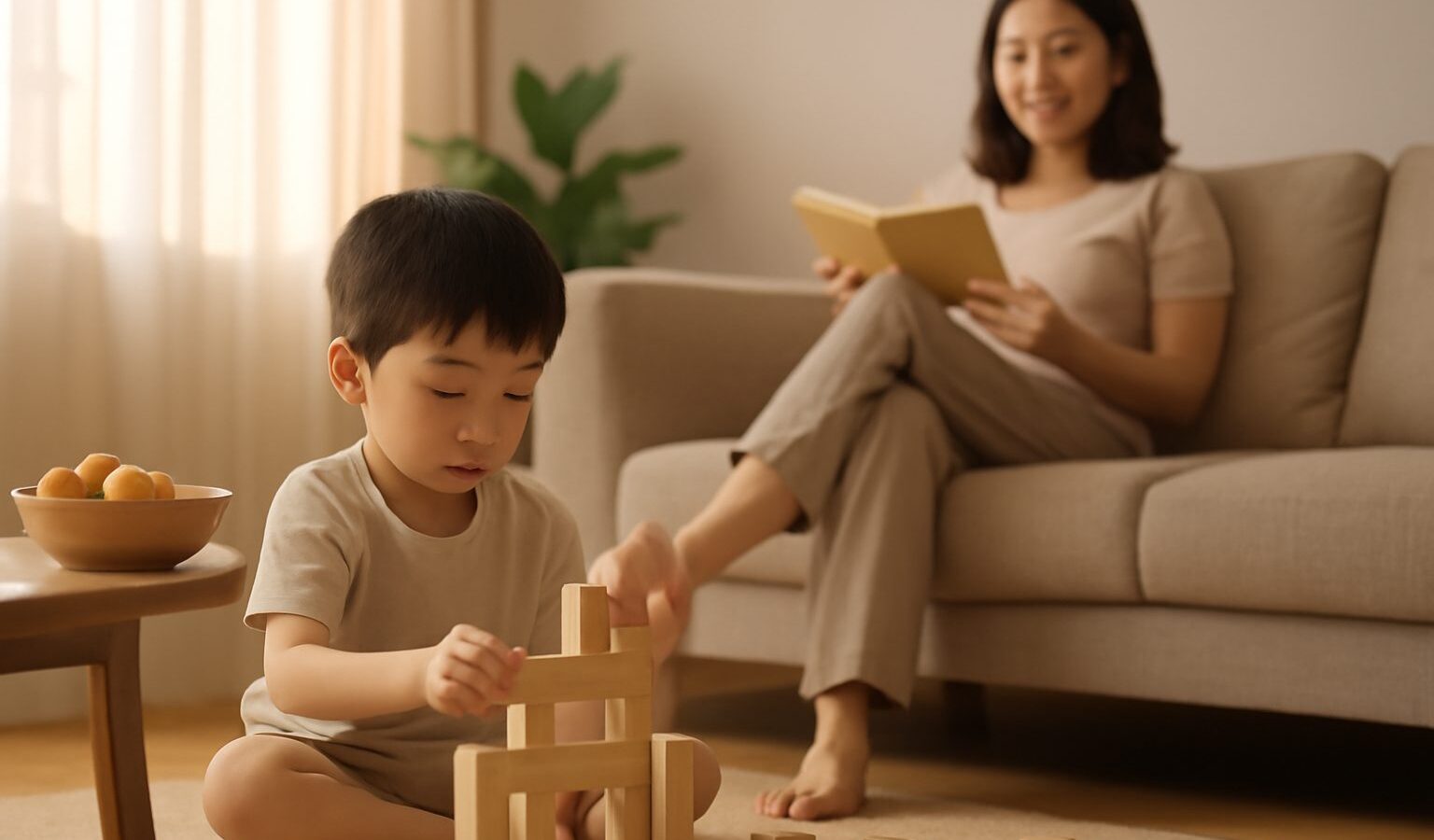
Most advice on independent play is written for toddlers and preschoolers. Yet many Singapore parents find the real challenge arrives later, when a seven or ten year old drifts around the flat saying “I’m bored” the minute homework ends. Building independent play in an older child takes a slightly different approach, because school-age kids have more structured lives, more access to screens and stronger opinions about what counts as fun.
This guide focuses on children aged roughly 6 to 12. If you have a younger child, our article on encouraging independent play in young children covers the earlier stages.
Why School-Age Kids Struggle to Entertain Themselves
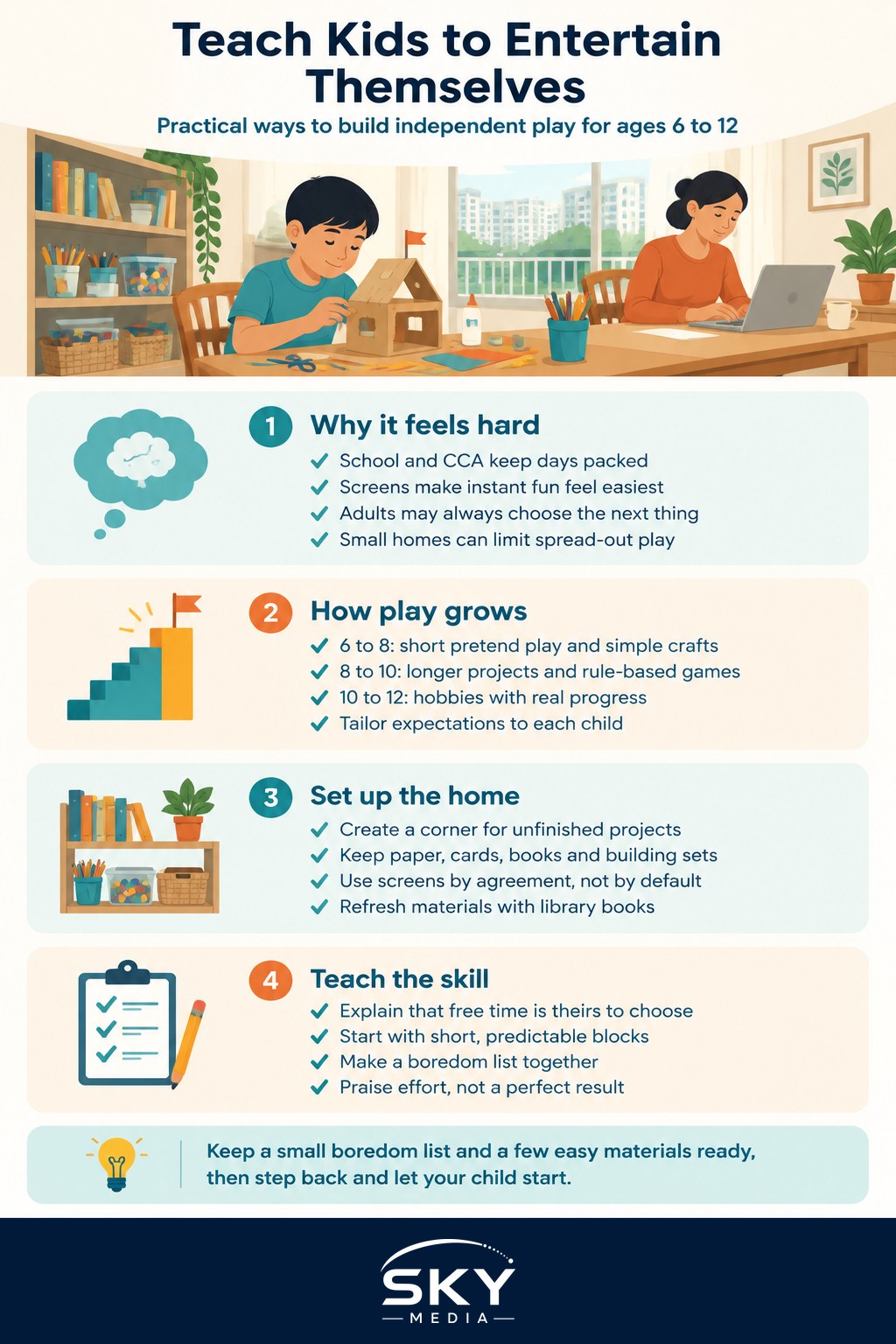
It is easy to assume that older children should naturally know how to fill their time. In practice, several things work against them:
- Heavily scheduled weeks. Between school, CCAs (co-curricular activities), tuition and enrichment classes, many children rarely have long stretches of open time, so they never practise filling it.
- Screens as the default. Tablets and phones offer instant entertainment, which makes slower activities feel dull by comparison.
- Adult-led habits. If an adult has always suggested the next activity, a child may wait to be told what to do.
- Smaller home spaces. In an HDB flat or condo, kids may feel there is nowhere to spread out a project.
- Fear of doing it wrong. Some children, especially perfectionists, avoid open-ended tasks because there is no clear right answer.
None of this means something is wrong with your child. Self-entertainment is a skill, and like any skill it improves with practice and the right setup.
How Independent Play Changes From Toddler to Tween
The goal stays the same, but the shape of independent play shifts as children grow. Knowing what to expect helps you set fair targets.
| Stage | What independent play looks like | Realistic stretch of time | Parent’s role |
|---|---|---|---|
| Early primary, around 6 to 8 | Pretend play, building sets, drawing, simple crafts, outdoor games at the playground | Short stretches that gradually lengthen | Set up materials, check in often, praise effort |
| Middle primary, around 8 to 10 | Longer projects, comics, reading series, inventing games with rules, simple coding or crafts | Longer sessions, with occasional help | Offer choices, step back, help only when stuck |
| Upper primary, around 10 to 12 | Hobbies with real progress, such as instruments, model making, writing stories, cooking simple snacks | Extended sessions on projects they care about | Provide resources and trust, review safety rules |
Every child is different, so treat these as rough guides rather than targets. A child who is deeply absorbed in a project for a short time is doing better than one sitting through a long session feeling miserable.
Setting Up Your Home for Self-Directed Play
The environment does a lot of the work. You do not need a big space, just an inviting one.
Create a project corner
Clear a shelf, a drawer or a section of the dining table where unfinished projects can stay out. Older kids lose momentum if they must pack everything away each evening.
Rotate a few open-ended materials
Keep a small, changing selection of items within reach:
- Paper, markers, tape, scissors and recycled boxes for building
- Card games, puzzles and logic games they can play solo
- A stack of library books, comics and activity books
- Building sets, a simple toolkit for craft work, or a beginner sewing kit
- Ingredients for an easy, supervised snack they can make themselves
Swapping items every few weeks keeps things fresh without buying more. The National Library Board’s public libraries are a free way to refresh books and activity ideas.
Make screens a choice, not the default
You do not need to ban screens. Instead, agree on when they are used, and keep devices out of sight during independent play time so they are not the easiest option. Creative uses, like making stop-motion videos or learning to code, can count as play if they are something your child builds rather than passively watches.
Teaching the Skill Step by Step
Older children respond well when they understand what you are asking and why.
- Name it. Explain that “free time” is a time for them to choose what to do on their own, and that you will be busy with your own tasks nearby.
- Start small. Begin with a short, predictable block, such as after dinner, then lengthen it gradually as they get comfortable.
- Brainstorm a boredom list together. Write down 15 to 20 things they enjoy doing alone and stick it on the fridge. When they say they are bored, point them to the list.
- Resist rescuing. When your child complains, acknowledge the feeling calmly (“Sounds like you are not sure what to do yet”) without immediately offering a solution.
- Let projects be messy and unfinished. Ownership matters more than a neat result.
- Notice and comment. Afterwards, show genuine interest in what they made or discovered. This tells them their independent time is valued.
Some boredom is healthy. That restless, slightly uncomfortable feeling often comes just before a child gets an idea. Research on unstructured play links it with creativity, problem solving and self-regulation, which we explore in the benefits of unstructured play for kids.
Activity Ideas Older Children Can Run on Their Own
Here are open-ended ideas that suit school-age kids and work in typical Singapore homes:
- Build a cardboard city or marble run from recycled boxes and toilet rolls.
- Start a comic or story series with recurring characters.
- Design a board game, complete with rules, a board and pieces.
- Run a mini science lab with safe kitchen experiments from a library book.
- Learn a skill from a book, such as card tricks, origami, knot tying or drawing techniques.
- Plan a family event, like a quiz night, and prepare the questions.
- Keep a nature journal of birds, plants or insects spotted from the window or at the neighbourhood park, with a parent’s agreement on where they can go.
- Practise an instrument or a sport skill in short, self-set challenges.
Let your child pick and adapt these. Interest grows when children feel the idea is theirs.
Handling Common Hurdles
Even with a good setup, you will hit bumps.
- “I’m bored” on repeat: stay calm and consistent. Point to the boredom list and carry on with your own task. It often takes a few weeks for the habit to settle.
- Sibling disputes: agree on separate spaces or turn-taking rules, and step in only for safety or when they cannot resolve it themselves.
- Perfectionism: model making mistakes yourself, and praise effort and creativity rather than polish. Our piece on building a growth mindset in your child has practical phrases to try.
- Exam periods: it is fine to shorten free time during busy school weeks, but try to keep some, as downtime helps children recharge.
If your child seems persistently withdrawn, anxious or unable to enjoy activities they once liked, that is different from ordinary boredom. Speak to their form teacher, school counsellor or family doctor for support.
Keeping the Habit Going Through the School Years
Independent play is not a one-time lesson. Protect a little unscheduled time each week, keep materials accessible and show interest in what your child creates. Over time, the child who once followed you from room to room can become the one who disappears happily into a project, and that ability to direct their own time is a real asset as they head into secondary school.