
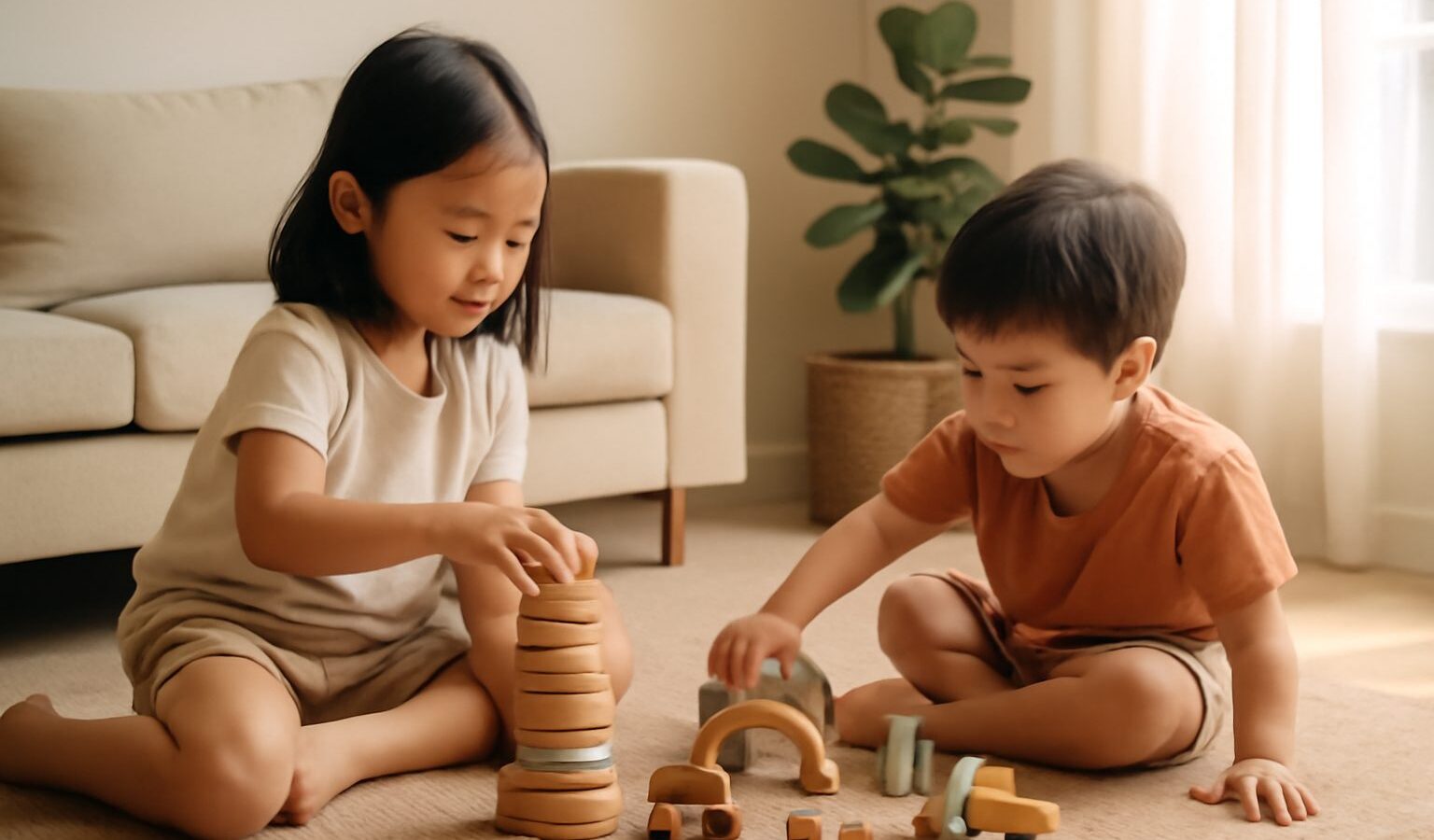
In a city that loves a full schedule, free time can feel almost wasteful. Between school, tuition, enrichment classes, and structured sports, many children have very few hours that are simply their own. Yet some of the most important learning of childhood happens in exactly those unplanned, grown-up-free moments. Unstructured play in Singapore is not a luxury or a gap to be filled; it is a genuine developmental need. This guide looks at why free play matters so much, and how busy families can make more room for it without adding one more thing to the diary.
What Unstructured Play Actually Means
Unstructured play is play that children lead themselves. There is no set goal, no adult directing the action, no worksheet, and no score. It is the child who turns a cardboard box into a spaceship, builds a den under the dining table, digs in the sand for no reason, or invents an elaborate game with rules that change by the minute. The child decides what to do, how to do it, and when it is finished.
This is different from structured activities like a swimming class, a piano lesson, or a coding camp. Those have real value too, but they are adult-designed and goal-focused. Free play is the opposite: open-ended, child-driven, and gloriously “pointless” on the surface, which is precisely where its power lies. When no one tells them what to do next, children have to imagine, decide, negotiate, and adapt entirely on their own.
Importantly, unstructured play does not need expensive toys or special places. A stick, a puddle, some old boxes, or a patch of grass can spark hours of it. Often the simpler the materials, the more inventive the play.
Why Free Play Is So Good for Children
The benefits of unstructured play reach across almost every area of a child’s development:
- Creativity and imagination. With no instructions to follow, children invent worlds, stories, and solutions. This flexible, original thinking is hard to teach directly but grows naturally through free play.
- Problem-solving and independence. When a den keeps collapsing or a game hits a snag, children learn to experiment, fail, and try again without an adult rescuing them.
- Social skills. Playing freely with others means taking turns, sharing, leading, following, resolving disputes, and reading how friends feel. These are the roots of empathy and teamwork.
- Emotional regulation. Play lets children work through big feelings and rehearse real-life situations in a safe, imaginary space. It is a natural stress reliever.
- Physical health. Active outdoor play builds strength, coordination, and balance, and helps children stay healthy in body as well as mind.
- Resilience and confidence. Making their own choices and seeing them through helps children believe in their own capability.
Boredom, so often treated as a problem to be solved, actually plays a helpful role here. When children are not constantly entertained, they are pushed to invent their own fun, and that is where imagination stretches. Learning to sit with a little boredom and turn it into something is a valuable skill in itself.
Making Room for Play in Busy Singapore Life
Between packed schedules and the easy pull of screens, free play can quietly disappear. Reclaiming it usually means doing less, not more. A few practical ideas:
- Leave gaps in the schedule. Deliberately keep some afternoons or weekend mornings unplanned, and resist the urge to fill every one with an activity.
- Let boredom happen. When your child complains of nothing to do, you do not always have to fix it. Given a little space, they will often invent something themselves.
- Offer open-ended materials. Boxes, blankets, dress-up clothes, blocks, art scraps, sand, and water invite far more imaginative play than toys that do only one thing.
- Get outdoors. Void deck spaces, neighbourhood playgrounds, parks, and nature reserves are perfect for free play. Go early or late to dodge the midday heat, and keep sun and hydration in mind.
- Dial down the screens. Free play and heavy screen time compete for the same hours. Protecting play may mean setting gentler limits on devices, an idea explored in our guide to managing your child’s gaming and screen limits.
Pretend play deserves special mention, as it does so much for language, empathy, and creativity. If you would like to nurture it, our guide to encouraging imaginative and pretend play is full of gentle ideas. And because play is naturally active, it dovetails beautifully with the goal of keeping your kids active in Singapore.
Letting Go and Stepping Back
For many parents, the hardest part of unstructured play is resisting the urge to organise it. It can feel uncomfortable to watch a child mill about “doing nothing”, or to see play that looks messy, repetitive, or a little risky. But your restraint is part of the gift. When you step back, you tell your child that their ideas are worth following and that they are capable of leading their own play.
That does not mean disappearing entirely. Younger children still need you nearby and safe boundaries in place. It simply means being a warm presence on the sidelines rather than the director of the action, stepping in only when truly needed.
You do not have to choose between enrichment and free play; the goal is balance. A childhood with room for both structured learning and unhurried, self-directed play tends to raise children who are curious, capable, and content. So the next time your child sprawls on the floor lost in a game of their own making, or turns a laundry basket into a boat, take a breath and enjoy it. That is not wasted time. That is childhood doing exactly what it is meant to do.