

Singapore has a large international school sector serving expatriate and local families, with curricula including the International Baccalaureate (IB), British (IGCSE and A Level), American, Australian, Canadian, Indian, French, German, Japanese and Chinese programmes. That makes it a popular destination for teachers looking to work abroad. International school teacher jobs in Singapore are competitive, though, and the hiring process runs quite differently from local government schools.
This guide explains what international schools typically look for, how the yearly recruitment cycle works and what to consider about work passes. If you are interested in teaching in Ministry of Education (MOE) schools instead, see our guide to becoming a school teacher in Singapore, as that route has its own training and hiring system.
This is general information, not legal or immigration advice. Work pass rules are set by the Ministry of Manpower (MOM) and can change, so always check the current requirements on the MOM website.
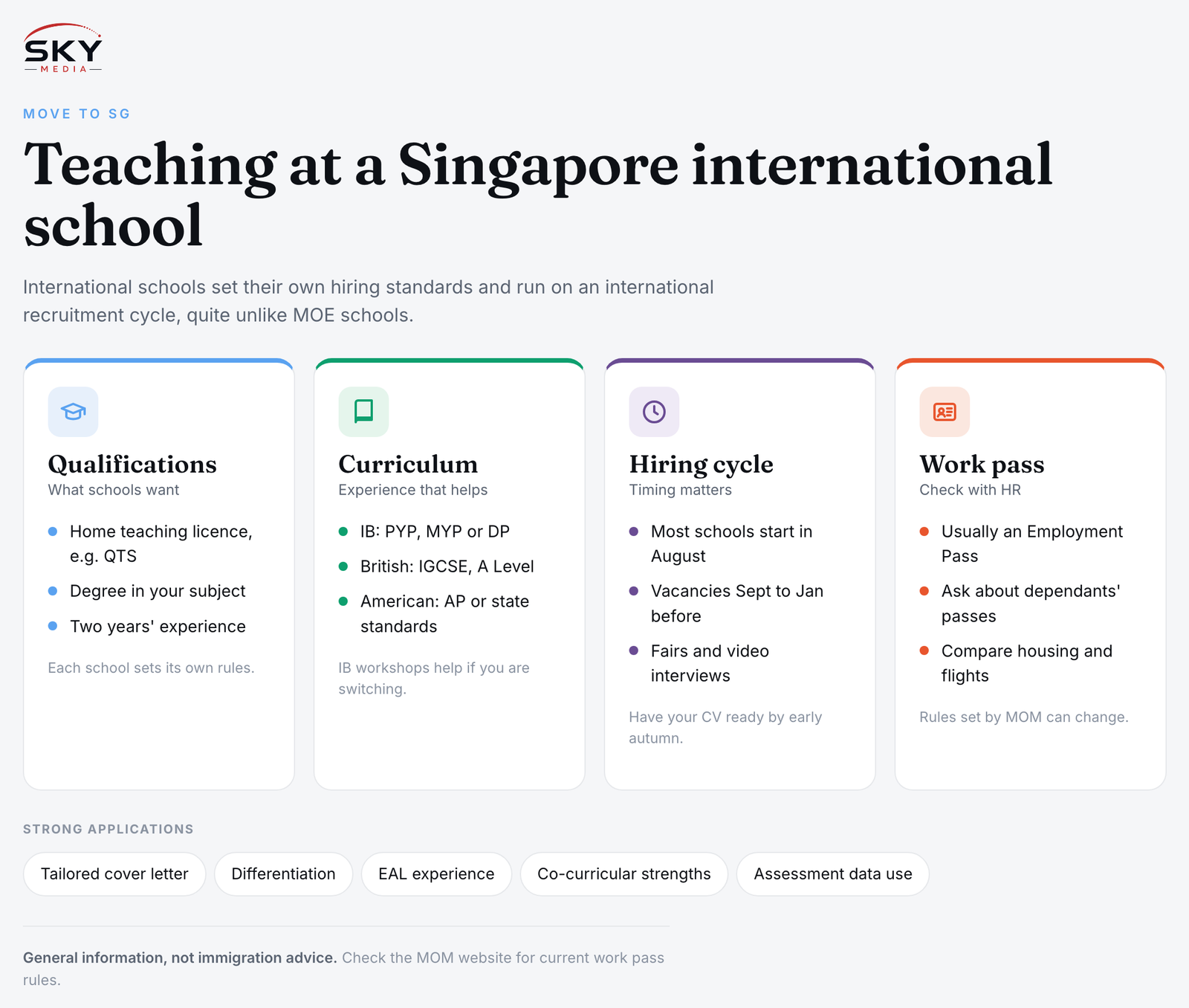
How International Schools Differ From MOE Schools
International schools in Singapore are privately run and set their own hiring standards, pay scales and contracts. They are not staffed through MOE, and their teachers do not go through the National Institute of Education (NIE) training route that MOE teachers usually take.
| Aspect | International schools | MOE schools |
|---|---|---|
| Employer | The individual school or school group | Ministry of Education |
| Curriculum | IB, British, American, national programmes of other countries | Singapore national curriculum |
| Typical qualification expected | Teaching licence from home country plus subject degree | MOE recruitment and NIE teacher training |
| Hiring timeline | Largely driven by an international recruitment season months ahead of the school year | MOE’s own recruitment exercises |
| Work pass for foreigners | Usually sponsored by the school, often an Employment Pass | Depends on MOE’s own hiring policy |
Because each school sets its own rules, expectations vary. A large, long-established school may have stricter requirements than a newer or smaller one. Always read the specific job listing closely.
Qualifications Schools Commonly Look For
There is no single legal teaching licence required across all Singapore international schools, but most established schools expect a recognised teaching qualification from your home system plus relevant experience.
A recognised teaching qualification
Common examples include:
- Qualified Teacher Status (QTS) from England, usually gained through a PGCE or similar route.
- A state teaching licence or certificate from the United States.
- Teacher registration from Australia, New Zealand, Canada, Ireland or another country with a recognised system.
- A Bachelor of Education or a postgraduate teaching qualification from a recognised university.
Schools teaching a national curriculum, such as a British or Australian school, often prefer teachers trained in that system. Schools teaching a non-English programme, such as French, German, Japanese or Chinese curricula, typically look for teachers qualified in that country and fluent in the language of instruction. For Chinese-curriculum options, our guide to international Chinese-curriculum schools in Singapore explains how those schools are set up.
Subject knowledge and a degree
Secondary teachers are usually expected to hold a degree in, or closely related to, their teaching subject. Primary and early years teachers typically need a degree plus training in their phase.
Curriculum experience
Experience with the school’s curriculum is often a strong advantage, sometimes a requirement.
- IB schools look for experience in the Primary Years Programme (PYP), Middle Years Programme (MYP) or Diploma Programme (DP). IB-run workshops and training can help if you are moving from a national system.
- British curriculum schools value experience with IGCSE, GCSE and A Level teaching and exam board specifications.
- American and Canadian schools often look for experience with Advanced Placement (AP) courses or state standards.
Typical extras
Many schools also look for at least two years of post-qualification teaching experience, clean safeguarding and background checks, strong references from recent headteachers or principals, and willingness to run co-curricular activities or trips.
The Recruitment Cycle
International school hiring follows a predictable rhythm, and timing matters a lot.
- Most Singapore international schools start their academic year in August. Some schools follow a January start, particularly those with Australian or certain Asian national calendars.
- For August starts, hiring often begins the previous autumn. Many schools ask current staff to confirm whether they will stay by late in the calendar year, then advertise vacancies from around September to January for the following August.
- Recruitment fairs run by international recruitment agencies, and online interviews, are common ways schools meet candidates. Many interviews now happen by video call.
- Late vacancies do appear in spring and summer when staff leave unexpectedly, but there are fewer of them.
If you want a Singapore role, it helps to have your CV, references and documents ready by early autumn the year before you hope to move.
Where vacancies are posted
Schools advertise on their own careers pages, on international teacher recruitment platforms and through specialist agencies. Be wary of anyone asking you to pay a fee to secure a teaching job.
Work Passes and Practical Considerations
Foreign teachers at international schools are generally employed on a work pass sponsored by the school, most commonly an Employment Pass (EP), which is for professionals, managers and executives. Whether you qualify, and which pass applies, depends on MOM’s current criteria, which consider salary and, under the Complementarity Assessment Framework (COMPASS), other factors. These rules change from time to time, so check MOM’s website and ask the school’s HR team how they handle applications.
Points worth clarifying with the school before you sign:
- Who applies for the pass, and what documents you must provide, such as degree certificates and, in some cases, verification of qualifications.
- Whether dependants are covered. If you have a spouse or children, ask whether the school supports Dependant’s Pass applications and whether your salary meets MOM’s current threshold for dependants. MOM’s website lists the current requirements.
- Whether a dependant spouse may work. This depends on MOM rules for the pass they hold, so check before planning around a second income.
- Tuition benefits for teachers’ children, as international school fees are a significant cost. Our guide to international school waitlists, debentures and application fees explains how families usually navigate those costs.
Comparing contract packages
Packages vary widely between schools and between local hire and overseas hire contracts. Typical items to compare include:
- Base salary and any annual increments.
- Housing allowance or provided housing.
- Flights home and relocation support.
- Medical, dental and insurance cover for you and dependants.
- Retirement or gratuity arrangements, since foreign staff generally do not contribute to the Central Provident Fund (CPF).
- Contract length, notice period and renewal terms.
Housing in Singapore is expensive, so check carefully whether the housing component realistically covers rent in areas near the school.
Tips for a Strong Application
- Tailor your cover letter to the school’s curriculum, mission and student population.
- Show evidence of differentiation, as many classes include students with diverse language backgrounds.
- Highlight experience with English as an Additional Language (EAL) learners and inclusion.
- Mention co-curricular strengths such as sport, music, debate or outdoor education.
- Prepare examples of how you use assessment data and work with parents.
- Ask about professional development support, including IB training budgets.
Before You Accept an Offer
Take time to read the full contract and ask questions. Speak to current or former staff if possible, look into the school’s leadership stability, and consider commute time from neighbourhoods you might live in. A good fit between your experience and the school’s curriculum tends to matter more than salary alone in whether you enjoy your years teaching in Singapore.