

Good compromise in relationships is one of those quiet skills that holds a couple together, yet almost nobody teaches it. Two people who love each other will still want different things: different weekends, different budgets, different ideas about how often to see the in-laws. Compromise is how you honour both people without either one disappearing. Done well, it does not feel like losing. It feels like teamwork. This guide looks at how to give and take fairly, so that both of you walk away feeling heard rather than defeated.
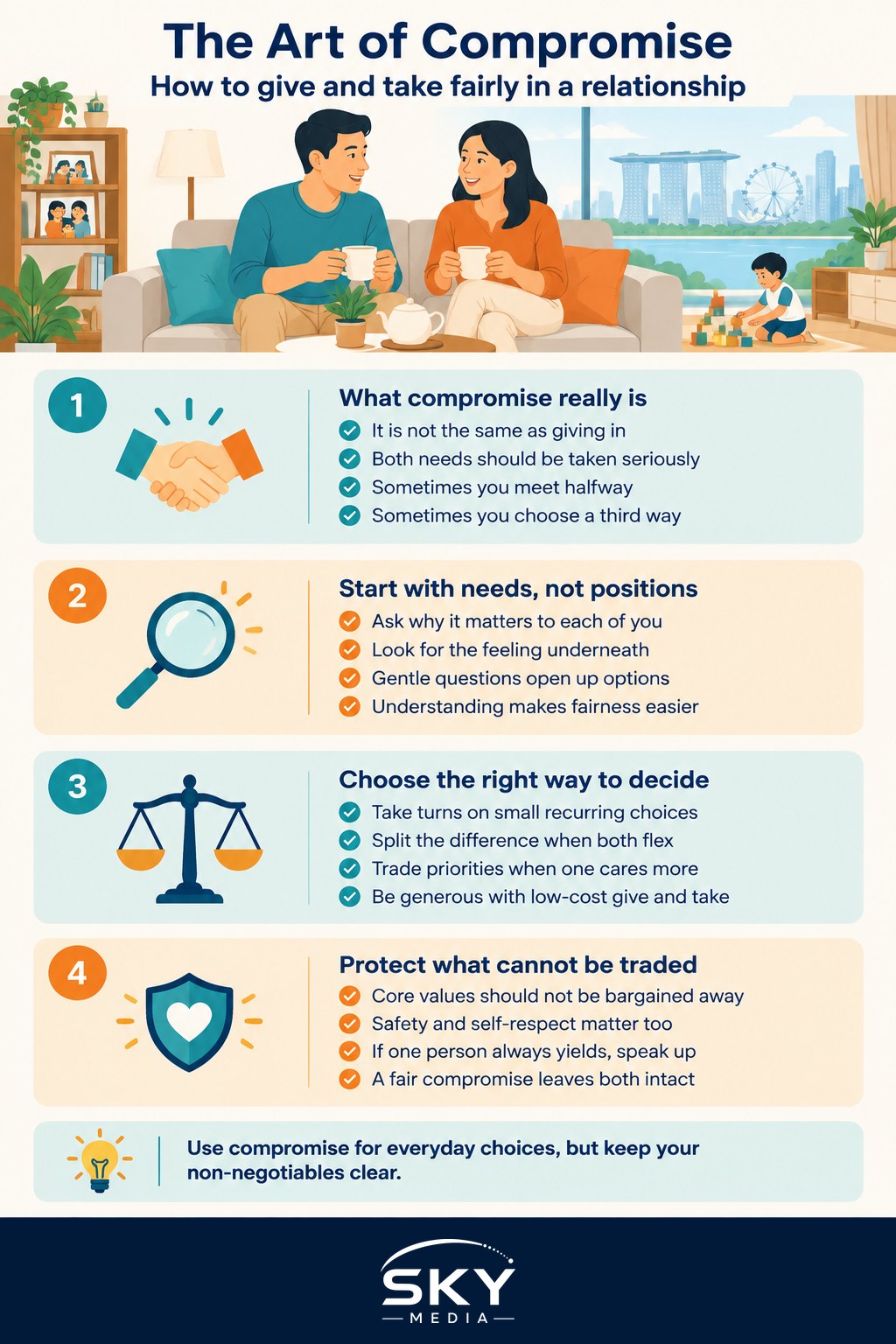
Compromise Is Not the Same as Giving In
There is a common myth that compromise means meeting exactly in the middle every time, or that the more agreeable partner should simply yield to keep the peace. That is not compromise. That is one person slowly shrinking. When someone always gives way, the resentment builds quietly until it leaks out somewhere else, often over something small that is not really the point at all.
Real compromise starts from a different place. It assumes both people have valid needs, and that the task is to find a path that respects as much of both as possible. Sometimes you meet in the middle. Sometimes one person gets their way this time because it matters more to them, and the other gets their way next time. Sometimes you invent a third option neither of you had thought of. The measure of a healthy compromise is not perfect symmetry. It is whether both people feel their needs were taken seriously.
This matters in Singapore, where couples often navigate tight practicalities together: which side of the island to look for a BTO, how to split time between two sets of parents during the festive seasons, or how to manage money when one earns more than the other. These are not small choices, and they benefit hugely from fair give and take.
Understand What You Each Really Want
Most standoffs are really two people arguing about positions when they should be talking about needs. A position is the specific thing you are demanding. A need is the reason underneath it. When you only trade positions, you get stuck, because they often clash head on. When you understand the needs beneath them, room to move usually appears.
Say one partner wants to spend every Sunday with their family, and the other wants Sundays free for the two of you. The positions collide. But underneath, one person may need to feel like a loyal child who has not abandoned their parents, while the other needs to feel like a priority in the relationship. Once that is clear, options open up: perhaps one Sunday a fortnight with family, a proper weeknight dinner with parents, and a protected date night that is just yours.
To get there, ask each other gentle, curious questions. Why does this matter so much to you? What are you worried will happen if we do it the other way? What would help you feel okay about this? Listen for the feeling underneath the request. Understanding does not commit you to agreeing, but it almost always makes a fair solution easier to find.
How to Meet in the Middle Fairly
Once you both understand what is really at stake, you can work towards something that holds. It helps to remember that not every decision deserves the same weight. Some things you genuinely do not mind either way, and those are easy gifts to give. Others touch something core to who you are, and those deserve to be protected. Knowing the difference, for yourself and for your partner, is the heart of the art.
Here is a simple way to see the range of approaches and when each one fits.
| Approach | What it looks like | Best used when |
|---|---|---|
| Take turns | You choose this time, I choose next | Recurring small decisions, like plans |
| Split the difference | We each get part of what we want | Both care moderately and can flex |
| Trade priorities | You win this, it matters more to you | One person clearly feels more strongly |
| Invent a third way | A fresh option neither first suggested | Positions clash but needs can both be met |
Whichever you choose, keep two habits close. First, be generous about the things that cost you little. A partner who gives easily on small matters earns real goodwill for the times that count. Second, never treat a compromise as a scorecard to be weaponised later. “I gave in last time, so you owe me” turns generosity into a debt and poisons the goodwill you were building.
Protect the Things You Cannot Trade
Healthy compromise has limits, and knowing them is part of doing it well. Some things are not up for negotiation, and pretending otherwise leads to quiet harm. Your core values, your sense of safety, your close friendships, your faith or lack of it, whether you want children, and your basic self-respect are not bargaining chips. A relationship that asks you to trade these away is not asking for compromise. It is asking you to disappear.
There is a useful test here. A fair compromise leaves both people still recognisably themselves, just more considerate of each other. An unfair one slowly erases one person for the comfort of the other. If you notice that you are the one always giving way on things that genuinely matter to you, that is worth paying attention to. It may be a sign to speak up more clearly, and if the pattern runs deep, to talk it through with a trusted friend or a counsellor.
Keeping a clear sense of your own non-negotiables is not selfish. It is what makes your compromises meaningful, because a yes only counts when you were free to say no.
Making Compromise a Habit, Not a Battle
The couples who do this well are not necessarily the ones who argue less. They are the ones who have made give and take a normal, low-drama part of daily life. They decide small things quickly and kindly, they flag the bigger ones early rather than letting them build, and they treat a disagreement as a shared problem to solve rather than a contest to win.
You can practise this in ordinary moments. Take turns choosing the dinner spot without a fuss. Notice when your partner gives way and thank them for it. When a bigger decision looms, sit down together before it becomes urgent, and approach it as two people on the same team facing a puzzle, not two opponents across a table. Over time, these habits build a deep trust that whatever comes, the two of you can work it out.
That, in the end, is what the art of compromise offers: not a life of endless splitting the difference, but a partnership where both people feel free to be themselves and confident they will be met halfway. It takes patience and a bit of humility, but it is one of the surest ways to build a relationship that lasts.
Explore more
Fair give and take is easier when you can talk openly, so pair this with having difficult conversations with your partner and, for a common flashpoint, dividing household chores fairly. When a compromise goes wrong and feelings get hurt, how to apologise after a fight helps you find your way back to each other.
Frequently Asked Questions
How do we compromise when our families want different things? Start by agreeing on what each of you needs from your own family, then look for fair patterns such as alternating festive visits. Present decisions to both families as a united couple. Avoid making one partner the messenger, and revisit the plan as circumstances change.
What if one partner always gives in to keep the peace? That is a pattern worth naming kindly, because quiet giving-in builds resentment. The one who yields should practise stating preferences, and the other should ask what they really want. Aim for decisions both feel were genuinely theirs, not just agreed to.
How do couples decide who gets their way on big issues like relocating? Big issues deserve a longer conversation about needs, finances and what each person gives up. Consider a trial, a time limit or a trade, rather than a simple win. If you cannot find a way forward, a couples counsellor can help you talk it through.
Is it a bad sign if we keep disagreeing about the same thing? Not always, since many couples have a few lasting differences. It becomes a problem when the same argument loops without understanding. Look for the underlying need, agree on a workable arrangement and accept that some differences are managed rather than solved.
How can I compromise without feeling like I lost? Think of it as a shared win where the relationship benefits, not a contest. Ask for something that matters to you in return, and acknowledge what your partner gave. If a compromise leaves you resentful, say so calmly and revisit it.