

If you have been reading about secondary school options, you have probably come across two terms that sound similar but mean different things. Understanding through-train and affiliated schools singapore parents often ask about can save a lot of confusion later, especially when it is time to make choices about the next stage of your child’s education. This guide explains the general ideas behind both, so you can have a clearer conversation with your child and with the school itself.
What a through-train pathway means
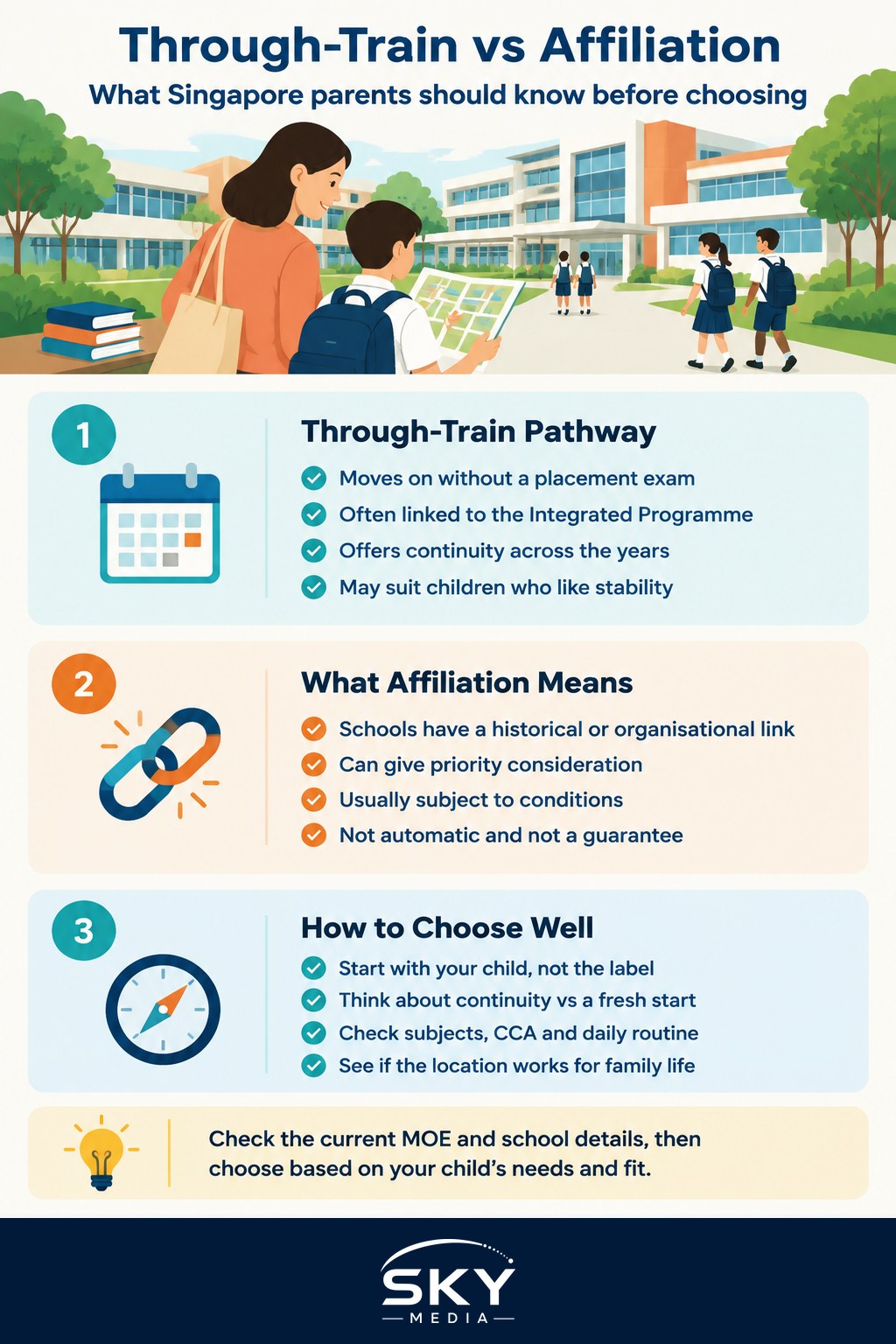
A through-train arrangement generally lets a student continue from one stage to the next within the same school or a linked programme, without sitting a national placement examination in between. The best known example is the Integrated Programme, where students move from secondary level towards a later qualification along a continuous track, rather than taking the intermediate national exam that other students take.
The appeal is easy to understand. A through-train can offer stability, a settled peer group, and a curriculum designed to flow across the years rather than pausing for a major exam. For some children that continuity suits them well. For others, the milestone of a national exam is actually a useful checkpoint and a chance to reset. Neither is better in the abstract, it depends on the child.
If you want a fuller picture of one common through-train route, our guide to the integrated programme ip explained singapore goes into more detail. The key thing to remember is that the exact structure, entry requirements, and which schools offer these programmes are set by MOE and the individual schools, and can change, so treat this article as a starting point and confirm the current details with the official sources.
What affiliation means
Affiliation is a different idea. Some schools have a historical or organisational link with another school, often a primary school affiliated to a secondary school, or a secondary school affiliated to a junior college. In an admissions context, affiliation can give a student some form of priority consideration when moving to the affiliated school, subject to conditions.
That word conditions matters. Affiliation priority is usually not automatic and not a guarantee. There are generally criteria a student needs to meet, and the details, including any minimum requirements and how priority is applied, are set by MOE and the schools involved. They can and do change over time. So if affiliation is part of your thinking, the sensible move is to ask the specific school directly and read the current MOE guidance, rather than relying on what worked for a friend’s older child a few years ago.
How to weigh these pathways for your child
Start with the child in front of you, not the label on the pathway. A through-train or an affiliated route can be wonderful for a student who is settled, motivated, and happy in that environment. It can feel limiting for a student who would thrive on a fresh start or a different mix of subjects. There is no single right answer, and families genuinely choose differently for good reasons.
A few questions help. Does your child value continuity and a familiar community, or do they perk up at the idea of a new setting? Do the subjects and co-curricular activities on offer genuinely fit their interests? And practically, how does the location and daily routine work for your family over several years?
It also helps to keep the bigger map in view. These pathways are only part of a wider system with many good routes through it, and no single one closes off the others for good. Our overview of the singapore school system explained puts the pieces together, and if you are still comparing options, choosing a secondary school in singapore offers a calmer way to weigh fit over reputation.
Whatever you lean towards, resist the pressure to chase a pathway just because it sounds prestigious. The best outcomes usually come from a school where your child feels supported and engaged, wherever that sits on the map. Talk to the schools, read the current MOE details, and then trust your reading of your own child. That, more than any label, is what tends to serve them well over the long run.
Frequently Asked Questions
Is a through-train programme better than taking the national exam? Neither is better in general, because it depends on the child. A through-train offers continuity and a settled peer group, while a national exam can act as a useful checkpoint and a chance to reset. Think about how your child copes with change and exam pressure.
Does affiliation guarantee my child a place in the secondary school? No, affiliation usually gives some form of priority, but it is not automatic or guaranteed. There are generally criteria your child must meet, and MOE and the schools set the details, which can change. Ask the school directly and read the current MOE guidance.
What is the difference between an affiliated school and a through-train school? A through-train lets a student move to the next stage in the same school or a linked programme without sitting a national placement exam in between. Affiliation is a historical or organisational link between schools that may give priority when applying. One is about the route, the other about admission priority.
Can my child still switch pathways later if we choose a through-train route? Possibly, but this depends on the school, the level and current MOE policy, so ask the school before you commit. Remember that the system has many good routes, and no single choice usually closes off the others for good.
What should I ask the school before choosing one of these pathways? Ask how the programme is structured, what entry requirements apply, which subjects and co-curricular activities are offered, and what happens if your child wants a change later. Also think about daily travel over several years, and whether your child values continuity or a fresh start.
Official sources: Ministry of Education (MOE)