
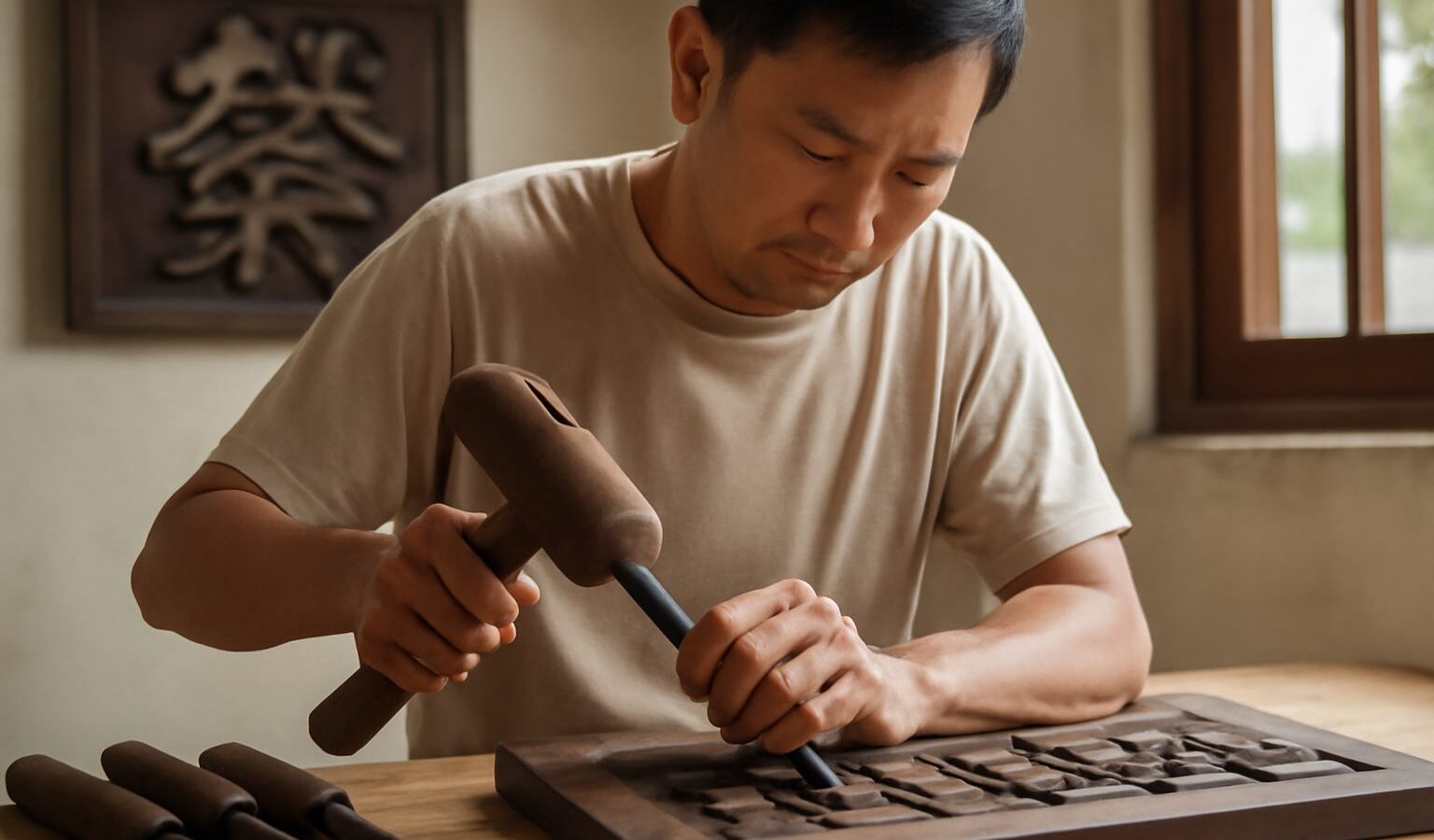
Look up along an old shophouse street and you may still spot them: long wooden boards above the doorway, deeply carved with bold Chinese characters, often lacquered black and touched with gold. These are the work of traditional signboard carving, a craft that once announced the name of every shop, clan hall and medicine dealer in the old town. Signboard carving is a quiet meeting of calligraphy, woodwork and gilding, and in Singapore it has become one of the island’s vanishing trades. This guide explains what the craft is, how a signboard is made, why it faded, and where a curious newcomer can still see and appreciate it.
What Traditional Signboard Carving Is
A traditional shop signboard, known in various Chinese dialects by terms that translate roughly as a name plaque, is a horizontal or vertical board bearing the name of a business or institution. Before printed and neon signs, a carved wooden board was how a shop presented itself to the street. The characters were not simply painted on but cut into the wood, giving them depth, shadow and a sense of permanence that suited a family business meant to last generations.
The craft draws on several skills at once. First comes the calligraphy, since the characters must be well proportioned and balanced, often written by a calligrapher before the carver begins. Then comes the woodwork, selecting a suitable timber and cutting the characters cleanly. Finally there is the finishing, with lacquer, paint or gold leaf applied to make the sign durable and striking. A good signboard was a considered object, its wording sometimes chosen for auspicious meaning as much as for the shop’s name.
While the most familiar signboards carry Chinese characters, carved and painted signage belonged to Singapore’s other communities too, from shophouse businesses of every background to temples and associations. The Chinese carved plaque is simply the most visible survivor of a broader street culture of handmade signs.
How a Signboard Is Made
Making a carved signboard is patient, sequential work. The general stages look like this:
- Choose the wood. A solid, stable timber is selected and prepared, cut to size and smoothed so it will not warp.
- Set the calligraphy. The characters are written or traced onto the surface, sized and spaced so the whole board reads well from a distance.
- Carve the characters. Using chisels and gouges, the carver cuts each stroke, following the calligraphy so the brushwork’s energy survives in the wood.
- Prime and colour. The board is sealed and painted, often in a deep base colour, with the recessed or raised characters picked out.
- Gild and finish. Gold leaf or gold paint is applied to the characters for contrast and prestige, then the whole board is protected with lacquer.
The result can be read two main ways. In some boards the characters are cut into the surface as recesses, while in others the background is cut away so the characters stand proud in relief. Either way, the play of light on carved strokes gives the sign a presence that a flat printed board cannot match. A single board could take considerable time and skill, which is exactly why it signalled that a business was established and serious.
Why the Craft Faded
Signboard carving declined for reasons familiar to many handmade trades. Printed vinyl, moulded plastic, backlit boxes and neon made signs faster and cheaper to produce, and modern shopfronts favoured them. As older shops closed or modernised, and as fewer young people took up the long apprenticeship, the number of working carvers thinned. Much of the knowledge lived in the hands of individual craftsmen and small family workshops rather than in books, so each retirement carried skills away with it.
Urban change played a part too. As streets were redeveloped and businesses relocated, many old boards were taken down, and not all survived. What remains is therefore precious, both as design and as social history, a record of who traded where and under what name.
It would be wrong, though, to write the craft off entirely. Interest in heritage trades has grown, and carved signboards are increasingly valued as art and as part of Singapore’s conservation story. Some remaining practitioners take on restoration and commissions, and heritage bodies document the trade so it is not forgotten.
Old Signs and New Signs Compared
To see what was lost and gained, it helps to compare the traditional carved board with the modern signage that replaced it. These are general contrasts rather than absolute rules.
| Feature | Traditional carved signboard | Modern printed or neon sign |
|---|---|---|
| Material | Solid timber, lacquer, gold leaf | Plastic, vinyl, acrylic, lighting |
| Making | Hand carved by a skilled craftsman | Machine printed or fabricated |
| Time to make | Slow, often days of work | Fast, often same day |
| Lifespan | Decades if cared for | Varies, often replaced sooner |
| Character | Depth, shadow, individuality | Bright, uniform, easily reproduced |
Where to See Signboard Carving Today
You do not need special access to appreciate this craft, only a habit of looking up as you walk. The best hunting grounds are the conserved shophouse districts, where old boards survive above doorways.
- Chinatown and the surrounding conserved streets, where clan associations, temples and long-running shops still display carved and gilded boards.
- Other heritage shophouse areas across the island, where medicine halls, provision shops and family businesses sometimes keep their original signs.
- Temples and clan halls, whose plaques and inscribed boards show the craft at its most formal, always to be viewed respectfully.
- Museums and heritage exhibitions, which occasionally feature signage, calligraphy and the tools of the trade among Singapore’s vanishing occupations.
To understand the wider streetscape these signs belong to, our guides to other endangered crafts are worth a look. See joss paper and effigy craft and traditional lantern making, two more trades where handwork, ritual and commerce meet. The National Heritage Board and Singapore’s conservation efforts document many such trades, and are good starting points for anyone who wants to dig deeper.
Why It Still Matters
A carved signboard is more than a label. It carries the calligrapher’s hand, the carver’s patience and the values a family wanted to project, whether prosperity, longevity or trust. Read together, the surviving boards of an old street tell you who lived and worked there and what they cared about. Keeping some of them, and keeping the skill to make and restore them alive, means keeping a thread of that story legible for the next generation.
For a newcomer, the pleasure of this craft is that it rewards slow walking. Wander a conserved street, look above the doorways, and let the gilded characters remind you that even a shop sign can be a small, enduring work of art.