

Signing up for a half marathon in Singapore is one of the most satisfying goals a runner can set. At 21.1km, it is long enough to feel like a real achievement, yet close enough that most reasonably fit people can build up to it in a few months. The trick is not raw talent or speed. It is consistent, sensible training that respects our tropical heat and gives your body time to adapt. This guide walks you through how to train for a half marathon Singapore style, from your first long run to the finish line.
A quick and important note before you lace up. This article is general information, not medical or coaching advice. Please consult a doctor before starting a new exercise programme, especially if you have a health condition, are older, or are returning after a long break. Warm up, build up gradually, and listen to your body.
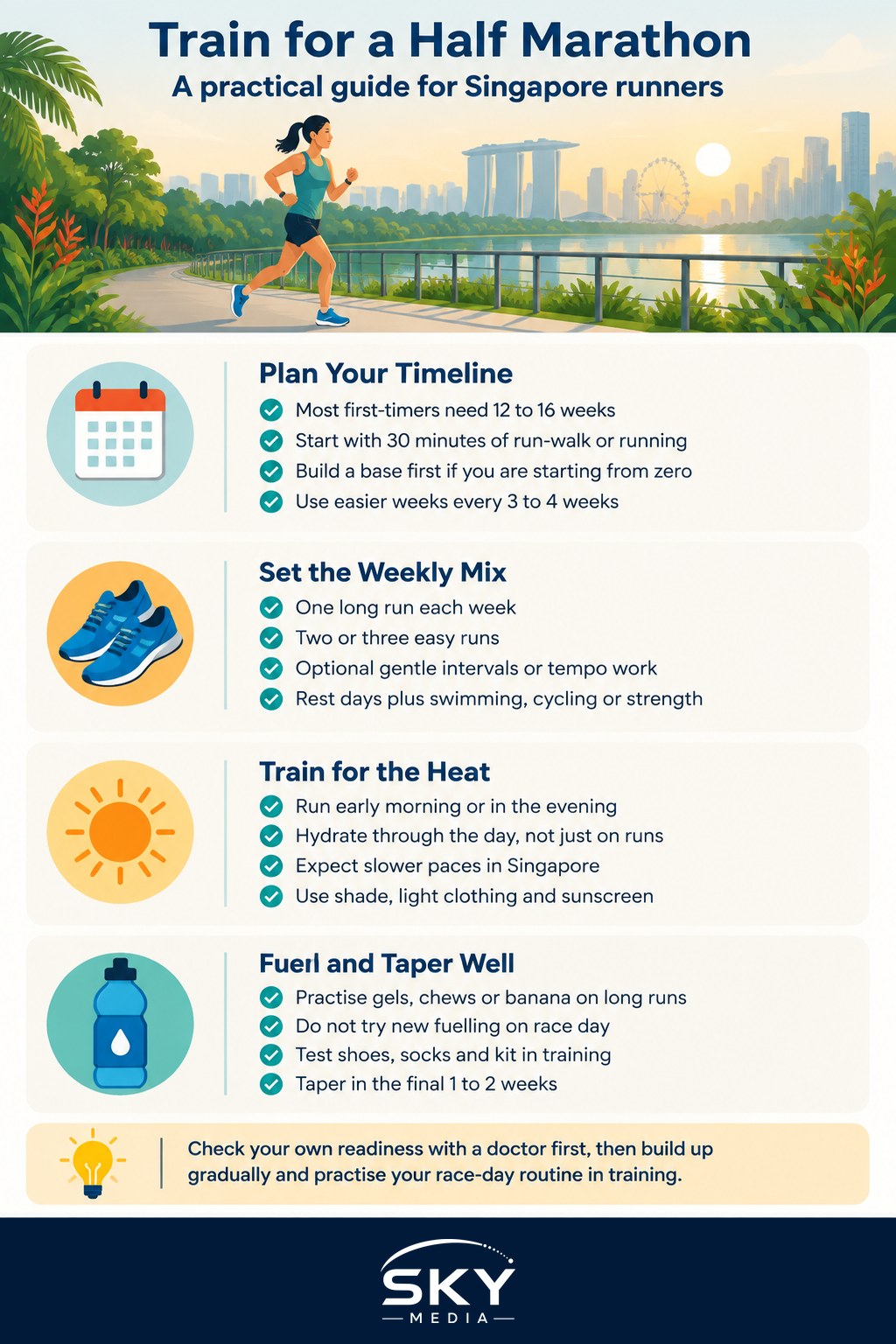
How Long You Need to Prepare
Most first-timers do well with roughly 12 to 16 weeks of structured training, assuming you can already run or run-walk for about 30 minutes without undue strain. If you are starting closer to zero, give yourself more runway and build a base first before you begin a half marathon block.
The core idea is simple. You gradually increase the distance of one weekly long run, keep two or three easier runs during the week, and rest properly in between. A common rule of thumb is to avoid increasing your total weekly distance by more than roughly ten percent from one week to the next, and to schedule an easier week every three to four weeks so your body can absorb the work. Progression, not punishment, is what gets you to the start line healthy.
Here is a rough sense of how the pieces fit together across a training block.
| Phase | Weeks | Main goal | Longest run guide |
|---|---|---|---|
| Base building | Weeks 1 to 4 | Build a comfortable running habit | Up to about 8km |
| Building distance | Weeks 5 to 9 | Extend the weekly long run steadily | Up to about 14km |
| Peak | Weeks 10 to 13 | Reach near race distance once or twice | Up to about 18 to 19km |
| Taper | Final 1 to 2 weeks | Rest, stay sharp, arrive fresh | Short and easy |
Treat these numbers as illustrative rather than fixed targets. A plan that flexes around your life, work and recovery will always beat a rigid one you cannot sustain.
Structuring Your Training Week
A balanced week usually mixes a few different types of running so you build endurance without overloading any one system.
- Long run: The cornerstone. One run each week that gradually gets longer, run at an easy, conversational pace. This teaches your body to keep going.
- Easy runs: Two or three shorter runs at a relaxed effort. These build aerobic fitness and should feel comfortable, not gruelling.
- One quality session (optional): Once you have a base, you might add gentle intervals or a steady tempo effort to build strength and pace. Beginners can skip this entirely and still finish well.
- Rest and cross-training: At least one or two full rest days, plus optional swimming, cycling or strength work to support your running and reduce injury risk.
Strength training, even two short sessions a week focusing on legs, hips and core, helps you hold form late in a race and protects against common overuse niggles. You do not need a fancy gym; bodyweight squats, lunges, bridges and planks at home go a long way.
Training in Singapore’s Heat and Humidity
Our climate is the single biggest thing that sets half marathon Singapore training apart. Heat and humidity raise your heart rate, slow your pace and increase fluid loss, so a run that feels easy in cooler weather can feel much harder here.
A few practical habits make a real difference:
- Run early or late. Early mornings before sunrise, or evenings after the heat eases, are far kinder than the midday sun.
- Hydrate around your runs. Drink through the day, not just during your run, and take small sips on longer efforts. On long runs, plan a route past water points or carry your own.
- Respect the pace. Expect to run slower than you would in a cooler country, and judge effort by how you feel rather than only by the numbers on your watch.
- Watch for warning signs. Dizziness, nausea, chills, or stopping sweating are signals to slow down, get into shade and rehydrate. Stop and seek help if symptoms are severe.
- Dress light. Breathable, moisture-wicking clothing, a cap and sunscreen help on exposed stretches.
Singapore’s Park Connector Network and parks such as East Coast Park, the Rail Corridor and MacRitchie give you shaded, traffic-light routes to build distance safely. ActiveSG stadiums and tracks are handy for measured, flat running when you want to gauge effort.
Fuelling and Long-Run Practice
For runs beyond about 90 minutes, your body starts to appreciate a little extra fuel. Many runners use gels, chews, or simple options like a banana or diluted sports drink, taken in small amounts on the move. The golden rule is to practise your fuelling and hydration during training, never to try something new on race day.
Nutrition needs are individual, and this is general information rather than a diet prescription. If you have specific dietary needs or health conditions, speak to a doctor or a dietitian. In the days before a long run or the race, most runners simply eat normally with a slight emphasis on familiar carbohydrates, and avoid heavy or unfamiliar meals the night before.
Your long runs are also dress rehearsals. Use them to test your shoes, socks, kit, and anti-chafe strategy, and to learn how your stomach handles fuelling in the heat. Small problems solved in training become non-issues on race morning.
Tapering and Race Day
In the final week or two, you deliberately cut back your distance while keeping a little intensity. This taper lets fatigue drain away so you arrive fresh. Resist the urge to cram in extra mileage; the fitness is already banked.
On race day, keep it boringly familiar. Wear tested kit, eat a breakfast you have practised, and arrive early. Start slower than feels natural, since the adrenaline and crowd make it easy to go out too fast in the first few kilometres. Take water at the stations, settle into a rhythm you can hold, and save a little for the final stretch. Check current race details, start times, road closures and fees directly with the organiser or ActiveSG, since these change from event to event.
Most of all, enjoy it. Finishing your first or fastest half marathon in Singapore is a milestone worth savouring, and the training habit you build along the way is a gift that lasts long after the medal goes on the shelf.
Explore more
Ready to build toward that distance step by step? If you are newer to running, start with our guides on how to start running in Singapore and training for your first 5K in Singapore. To stay healthy through a long training block, read our tips on avoiding running injuries in Singapore.
Frequently Asked Questions
Can I go straight from a 5K to a half marathon? It is possible, but give yourself a longer runway than the usual training block. Being able to run comfortably for about 30 minutes is the usual starting point, so spend extra weeks building a base first. Jumping distances too quickly is a common route to niggles.
Is it okay to walk during a half marathon? Yes, plenty of finishers use planned walk breaks and still reach the line strongly. Walking at water stations is a popular way to sip properly in the heat. Practise whatever pattern you choose on your long runs so it feels natural on race day.
Do I need to run the full 21.1km before race day? Most plans do not ask for it. The longest training run usually stops short of race distance, and the crowd, adrenaline and taper carry you the rest of the way. Your coach or plan can adjust this if you are a slower runner who will be on the course for longer.
How should I recover after finishing a half marathon? Take a few easy days with walking or gentle swimming, eat and drink normally, and sleep well. Return to running gradually rather than jumping into a hard session. Aches that linger beyond ordinary soreness are worth showing to a doctor or physiotherapist.
Further reading: Race-Week Checklist for Your First Marathon in Singapore · Carb Loading for Endurance