

Getting your travel documents in order is the least glamorous part of a trip and the part that quietly decides whether it happens at all. A missing signature, a passport that expires too soon, or a visa you assumed you did not need can end a holiday at the check-in counter. This travel documents Singapore checklist is built for the way we actually travel from here: short regional hops out of Changi, the occasional long-haul, and everything packed the night before. Work through it once, save it somewhere you can find it, and reuse it for every trip.
The golden rule sits at the top: entry rules, passport requirements and visa conditions differ by destination and change often. Treat this article as a framework for what to check, not a source for the actual rules. Always verify current requirements with the destination country’s embassy or consulate, and check ICA for anything to do with your Singapore passport or leaving Singapore, before you book or pay.
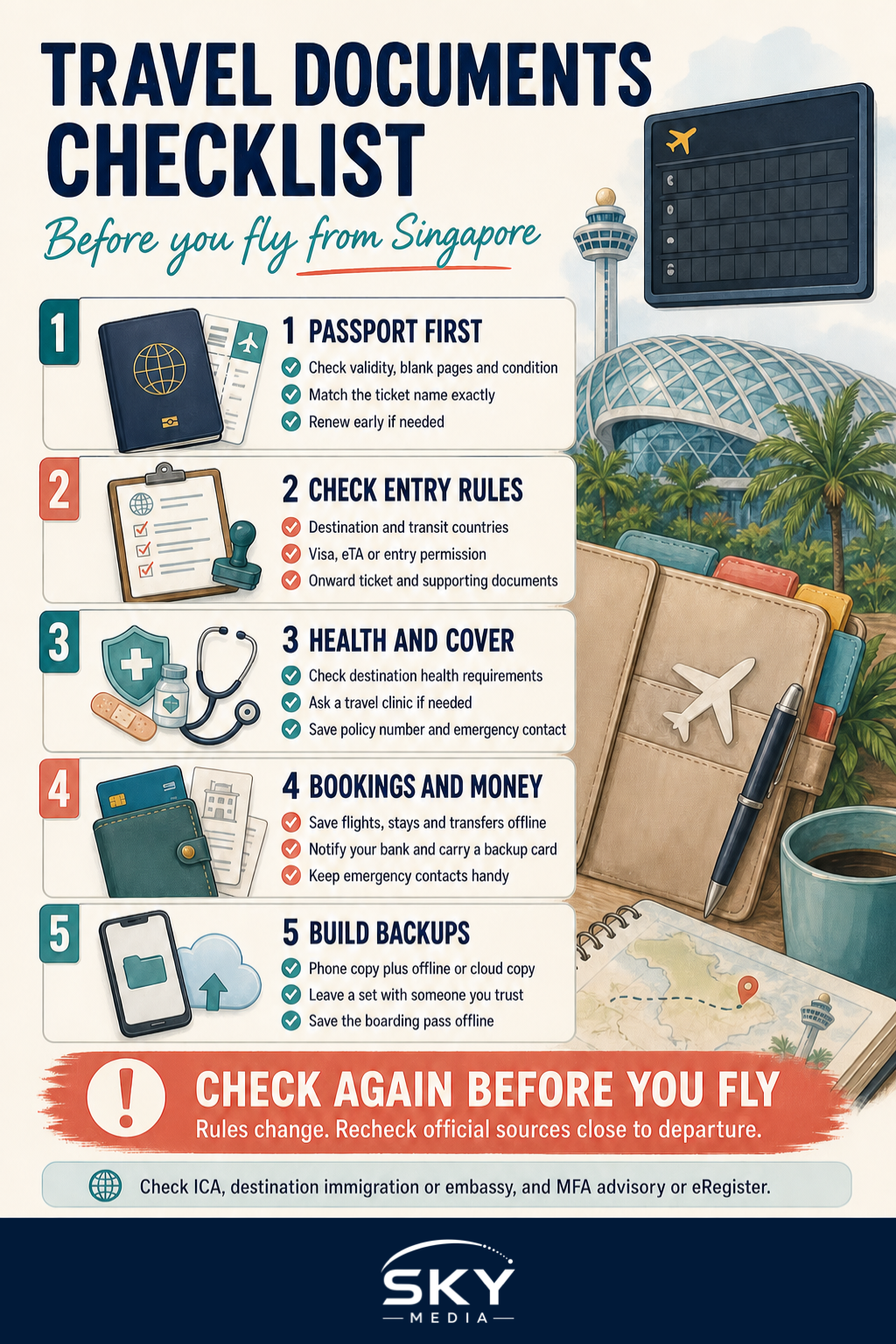
Start With Your Passport
Your passport is the one document nothing else can replace, so check it first, not last. Two things matter: that it is genuinely yours to use, and that it has enough life left in it.
- Validity. Many countries expect your passport to be valid for a set period beyond your travel dates, and some also want blank pages. The exact rule varies by destination, so confirm it with that country’s embassy. If your passport is anywhere near expiry, renew it through ICA well ahead of time rather than gambling on a tight margin.
- Condition. A water-damaged, torn or heavily worn passport can be refused even when the dates are fine. If yours looks rough, sort it out before booking.
- Name matching. The name on your ticket should match your passport exactly. A booking made under a nickname or a maiden name can cause problems at check-in.
If you are renewing or replacing a Singapore passport, ICA is the authority for timelines and procedures. Do not assume a renewal will be instant, and never book non-refundable travel around a passport you do not yet hold.
Visas and Entry Permissions
The Singapore passport is strong and opens many doors, but visa-free access is never guaranteed and is never something to take for granted. Some destinations need a visa arranged in advance, some offer visa-on-arrival or an electronic travel authorisation, and some ask for nothing beyond a valid passport. These categories shift, and a country that waved you through last year may not this year.
So the checklist item is not “do I have the right visa” but “have I checked”. For every destination, and every country you merely transit through, confirm the current requirement directly with that country’s embassy, consulate or official immigration portal. Watch especially for:
- Transit rules. A layover can require its own transit visa even if you never leave the airport.
- Onward or return proof. Some borders want to see a ticket out.
- Supporting documents. Proof of funds, accommodation, or an invitation letter is sometimes requested.
Give yourself a buffer. If a visa needs processing, start early, because official timelines are estimates and not promises.
Health, Insurance and Money Documents
Beyond passport and visa, a second tier of documents smooths the trip and protects you if something goes wrong.
Travel insurance is the big one. Buy a policy that genuinely fits your trip, read the wording so you know what is and is not covered, and carry the policy number and the insurer’s emergency contact somewhere you can reach without a signal. This is general guidance, not financial advice, so compare plans and check the actual cover yourself rather than assuming.
Some destinations ask for proof of vaccination or have health entry requirements, and these change. This is general information and not medical advice, so see a doctor or a travel clinic well before departure for anything destination-specific, and keep any health certificates with your travel papers.
| Document | Why it matters | Before you go |
|---|---|---|
| Passport | Primary ID and proof of nationality | Check validity and condition; renew via ICA early if needed |
| Visa or entry permit | Legal entry, varies by destination | Verify current rule with the embassy; apply with a buffer |
| Travel insurance | Cover for medical, delays, loss | Read the wording; save policy number and hotline |
| Health certificates | Some borders require proof | Ask a travel clinic well ahead of departure |
| Booking confirmations | Flights, hotels, transfers | Save offline; note any onward-ticket requirement |
| Payment cards | Access to money abroad | Tell your bank; carry a backup card |
On money, notify your bank that you are travelling so a foreign transaction is not flagged and blocked, carry a backup card kept separately from your main one, and hold a small amount of local currency or SGD for the first hour on the ground.
Copies, Backups and the Boarding Pass
Documents fail at the worst moments, so build redundancy before you leave.
- Photograph or scan everything. Passport photo page, visas, insurance policy, key bookings. Store them in a phone folder and in cloud storage you can open on any device.
- Keep an offline copy. Screenshots and downloaded files work when the airport wifi does not.
- Leave a set at home. Share copies with someone you trust in Singapore who can help remotely if a document is lost.
- Separate the physical from the digital. If your phone and passport are stolen together, a copy in the cloud and a copy with family still gets you to the nearest Singapore mission.
For the flight itself, check in early through the airline app, save your boarding pass to your phone and take one printout as a fallback. Confirm the baggage allowance so nothing is a surprise at the counter. If you are connecting at Changi with time to spare, Jewel is a pleasant place to wait, but keep an eye on your gate rather than the waterfall.
A Simple Pre-Departure Routine
Turn all of this into a habit you run the same way every trip. A week out, confirm passport validity and that every visa or entry permission has been checked with the right authority. A few days out, buy or confirm insurance, tell your bank, and make your copies and backups. The night before, check in online, save the boarding pass, and lay out passport, cards and phone together so nothing is hunted for at 5am. Done in this order, the paperwork stops being a source of stress and becomes the quiet, reliable part of leaving.
Explore more
Once your documents are sorted, pair this with a wider run-through in our pre-travel checklist so nothing else slips. Since so much here rides on your cover, read travel insurance explained before you buy a policy, and if the worst happens on the road, our guide to handling a travel emergency abroad walks you through the first steps.