

When your parents fly in from the mainland to spend a few weeks or months with you, the last thing you want is a medical bill that overshadows the whole visit. Singapore’s healthcare is excellent, but for visitors it is paid at private rates and can be costly. Arranging travel insurance visiting parents can rely on before they board turns a worry into a simple, planned step. This guide explains why it matters, what to look for, and how to compare options sensibly.
This is general information for newcomer families, not financial or medical advice. Coverage, exclusions and prices vary by insurer and by your parents’ health, so read the policy wording and confirm details with the insurer before buying.
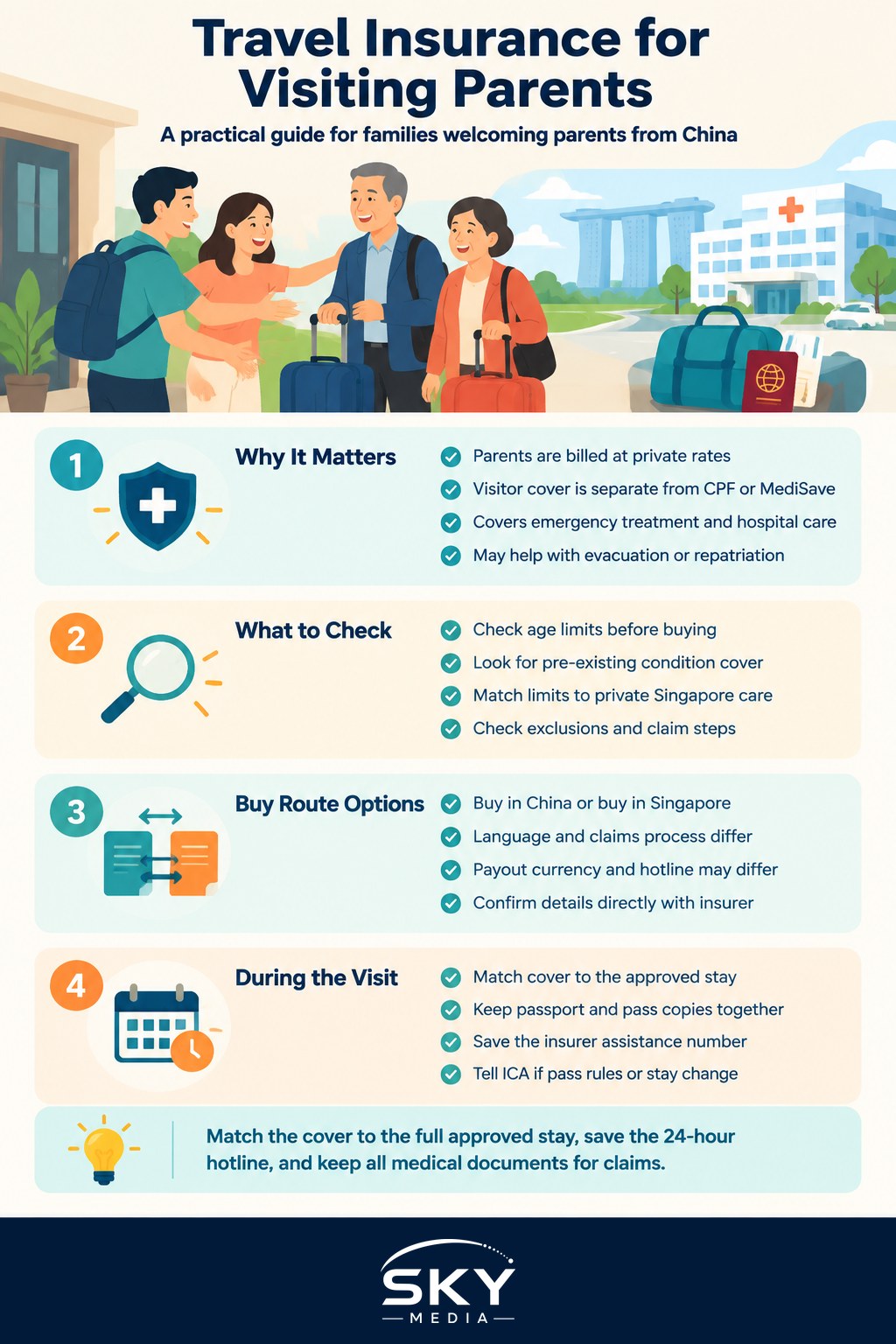
Why Visitors Need Their Own Cover
Your CPF, MediSave and any local health insurance are for you, not for visiting relatives. Your parents arrive as short-term visitors, and if they fall ill or have an accident here, they are billed as private patients with no local subsidy. A slip in a wet market, a flare-up of an existing condition, or a sudden illness can lead to an emergency-department visit, a hospital stay, scans and follow-ups that add up quickly.
Travel insurance taken out before the trip is designed exactly for this. Good plans cover emergency medical treatment, hospitalisation, and in serious cases emergency evacuation or repatriation back to China. Some also cover trip cancellation, delays and lost baggage, but for visiting parents the medical portion is the part that truly matters.
A quiet reassurance for adult children: having cover in place means that if something happens, you are focused on care, not on how to pay for it.
What to Check Before You Buy
Not all plans are equal, and the cheapest is rarely the right one for older travellers. Work through these points:
- Age limits. Many plans cap the age of the insured or charge more above a certain age. Confirm your parents qualify.
- Pre-existing conditions. This is the big one for older parents. Standard plans often exclude conditions like hypertension, diabetes or heart disease. Look for plans that specifically cover pre-existing conditions, and declare everything honestly.
- Medical and hospitalisation limits. Check the maximum payout for treatment and daily hospital cover, and make sure it is realistic for private Singapore care.
- Emergency evacuation and repatriation. For serious cases, cover to fly a parent home for treatment, or to bring a companion, is valuable.
- Trip length. Make sure the policy length matches the full stay, including any extension of a visit pass.
- Direct billing or reimbursement. Understand whether the insurer settles with the hospital or whether you pay first and claim back.
- Exclusions and claim steps. Read what is not covered and how to make a claim, including the emergency assistance hotline.
Declaring health conditions truthfully is essential. A claim can be rejected if a condition was hidden, which defeats the whole purpose.
Buying in China or in Singapore
You generally have two routes, and each has trade-offs. Some families buy a plan from a mainland insurer before departure; others buy an inbound visitor plan from a Singapore insurer. The comparison below is a general orientation to help you ask the right questions; confirm specifics with each insurer.
| What to check | Bought in China | Bought in Singapore |
|---|---|---|
| Policy language | Chinese, familiar terms | English, may need translation help |
| Claims for SG treatment | May need documents sent home | Often handled locally |
| Pre-existing cover | Varies by insurer | Some plans specialise in this |
| Currency of payout | Renminbi | Singapore dollars |
| Assistance hotline | China-based | Local or regional |
| Where to confirm | Mainland insurer | Singapore insurer |
Neither route is automatically better. What matters is that the medical cover is adequate, pre-existing conditions are handled, and the claims process works smoothly from Singapore.
Coordinating With Their Visit Pass
Insurance and immigration are separate, but they interact. Parents usually enter on a short-term visit pass, and longer stays may involve an extension or, in some cases, a Long-Term Visit Pass sponsored by you. The rules and eligibility are set by the Immigration and Checkpoints Authority (ICA), so confirm the current position with them and do not assume a fixed length of stay.
Practical tips:
- Match the insurance period to the actual approved stay, and update it if the pass is extended.
- Keep copies of their passport, entry details and pass alongside the policy, so everything is on hand in an emergency.
- Note the insurer’s 24-hour assistance number and save it in your phone and theirs.
Handling the pass side with ICA and the cover side with the insurer keeps both clean.
If a Medical Situation Arises
Even with the best planning, illness can happen. Stay calm and organised:
- For emergencies, go to a hospital A&E or call for an ambulance; treatment comes first.
- Contact the insurer’s assistance line early, as many require notification within a set time and can guide you on approved hospitals or direct billing.
- Keep every document: diagnosis, bills, receipts, referral letters and payment proof, as claims depend on them.
- For non-urgent issues, a GP or polyclinic visit may be enough and far cheaper than A&E, though visitors still pay unsubsidised rates.
Medical decisions belong to the treating doctor. Your job is to get your parent to care quickly and keep the paperwork tidy for the claim.
Give Everyone Peace of Mind
Sorting out travel insurance visiting parents will actually use is one of the kindest, most practical things you can do before they fly. Focus on real medical and hospitalisation cover, take pre-existing conditions seriously, match the policy to the full length of their approved stay, and read the wording rather than the headline price. Handle the visit pass with ICA and the cover with the insurer, save the assistance hotline, and you turn a stressful “what if” into a simple, settled part of the trip so everyone can enjoy the time together.
Explore more
While your family is here, keep your own finances on safe, regulated ground with our guides on avoiding illegal money changers and underground banks and, if you are settling for the long term, using CPF to buy your first home as a new PR.
Frequently Asked Questions
Is travel insurance compulsory for parents visiting Singapore? It is generally not a condition for entering Singapore as a visitor, but entry rules can change, so check the Immigration and Checkpoints Authority for the latest requirements. Even if it is optional, visitors are billed at private rates for medical care, which is why most families still buy cover.
When should I buy insurance for my parents’ trip? Buy it before they leave China, ideally as soon as their flights are booked. Cover usually starts from the policy’s start date and cannot be bought after an illness or accident has already happened. Buying early also gives you time to compare plans and read the wording.
Are government hospitals cheaper than private hospitals for visiting parents? Not by as much as many people hope. Visitors do not get the subsidies that citizens and residents receive, so they pay unsubsidised rates even at public facilities. Ask for a cost estimate before non-urgent treatment, and call the insurer’s assistance line early.
Is insurance worth it if my parents are only visiting for a short stay? Usually yes, because a single emergency visit or hospital night can cost far more than a policy. Short stays carry less time for things to go wrong, but accidents and sudden illness do not follow a schedule. A modest plan with solid medical cover is often enough.
What papers should I keep ready in case my parents need to claim? Keep the policy document, the insurer’s 24-hour assistance number, and copies of their passports and visit passes together. If treatment happens, collect the diagnosis, itemised bills, receipts and referral letters. Insurers usually ask for these, and missing paperwork is a common reason for delays.
Further reading: Things to Do in Singapore With Parents Visiting From China · How Visiting Parents From China Can Claim the GST Tourist Refund