

Many Singapore credit cards advertise “free” travel cover as a perk, and it is tempting to skip buying a policy because of it. Credit card complimentary travel insurance can be useful, but it is usually narrower than people assume, and it often only kicks in if you meet specific conditions when you book. Before you fly off for the year-end holidays, it is worth checking exactly what your card gives you and where the gaps are.
This guide explains what card-linked cover typically includes, the conditions that commonly apply, and how it compares with a travel policy you buy yourself. It is general information, not financial or insurance advice. The only document that decides a claim is your card’s insurance terms and the policy wording from the insurer behind it.
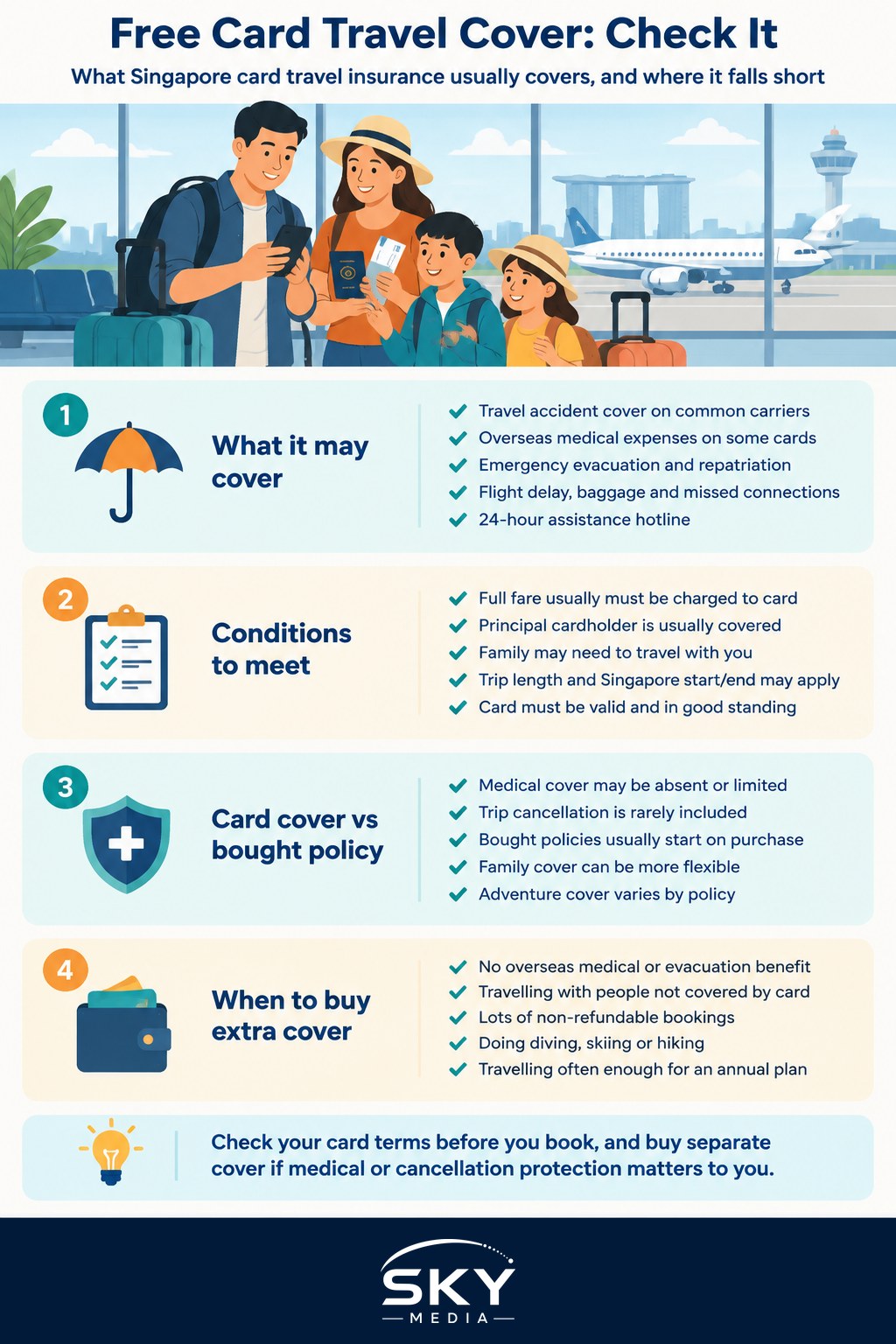
What Card-Linked Travel Cover Usually Includes
Card benefits differ widely, even between cards from the same bank, so treat this as a list of things to look for rather than a promise of what you have.
- Travel accident cover. This is the most common feature. It pays a lump sum for accidental death or permanent disablement while travelling, often only while on a common carrier such as a plane, ferry or bus. On some basic cards, this is the only cover provided.
- Overseas medical expenses. Some premium cards include medical cover abroad, but many entry-level cards do not. Where it exists, the limit may be modest compared with a bought policy.
- Emergency evacuation and repatriation. Sometimes included, sometimes not. This is one of the most expensive things that can go wrong overseas, so check it carefully.
- Travel inconvenience benefits. Flight delay, missed connection, delayed or lost baggage. These are more often found on higher-tier cards and usually come with fixed payouts and waiting periods.
- Assistance hotline. Many cards give access to a 24-hour assistance service, which can help you find a hospital or arrange support even if the actual costs are not covered.
The key point is that “travel insurance” on a card may mean only accident cover. If your card summary mentions death and disablement but says nothing about medical expenses, assume you have no medical cover until the insurer confirms otherwise.
The Conditions That Decide Whether You Are Covered
Card cover is usually triggered by how you paid, not by simply holding the card. Common conditions include:
- Charging the full fare to the card. Many cards require the entire airfare or travel package to be paid with that card. Splitting payment across two cards, or paying partly with air miles, may void the cover. Some terms accept miles redemptions if taxes and surcharges are charged to the card, but you must check.
- Covered persons. The principal cardholder is usually covered. A spouse and children may be covered only if travelling with you and if their fares were charged to the same card. Supplementary cardholders may or may not count.
- Trip length limits. Cover often applies only to trips up to a maximum number of days. A long working stint or extended family visit can fall outside it.
- Round trips from Singapore. Some terms require the journey to start and end in Singapore.
- Card status. The card must normally be valid and in good standing at the time of the trip and the claim.
- Activation or registration. A few cards require you to register the trip or opt in. Most do not, but read the terms.
If you are choosing a card partly for its travel perks, our guides on how to choose a credit card in Singapore and whether to get a supplementary card or separate credit card explain how these benefits fit into the bigger picture.
Card Cover Versus a Policy You Buy
Here is how a typical card benefit compares with a standalone single-trip or annual policy. Your specific card and policy may differ, so use this as a checklist.
| Feature | Typical card complimentary cover | Typical bought travel policy |
|---|---|---|
| Overseas medical expenses | Often absent or limited on basic cards | Core benefit, usually with a meaningful limit |
| Trip cancellation before departure | Rarely included | Commonly included for covered reasons |
| Activation | Usually tied to charging the full fare to the card | Starts on purchase, regardless of payment method |
| Family members | Often only if travelling with you and fares paid on the card | Can name each traveller, including those travelling separately |
| Pre-existing medical conditions | Generally excluded | Generally excluded unless you buy a plan that covers them |
| Adventure activities | Often excluded | Varies; some plans offer add-ons |
The biggest practical gaps are usually medical expenses abroad and trip cancellation. A hospital stay or medical evacuation overseas can be very costly, and cancellation cover is what protects your money if you fall ill before you leave.
Common Gaps People Discover Too Late
These are the situations where card cover most often disappoints:
- You booked flights with miles or on another card. The cover may never have started.
- You booked flights and hotels separately. Some terms only cover trips where the main transport was charged; hotel spending alone may not count.
- Your parents are travelling with you. They are often outside the card’s definition of family.
- You fell ill before departure. Card cover rarely refunds non-refundable bookings.
- You need treatment for an existing condition. Usually excluded on both card and bought cover, unless you arrange specific cover.
- You are travelling for work. Some cards exclude business trips or certain occupations. Your employer’s arrangements may help; our piece on employer group insurance and cover gaps explains what workplace cover typically does and does not include.
How to Check Your Card’s Cover in 15 Minutes
- Find the benefit terms. Look on your bank’s website for the card’s travel insurance terms, or the “certificate of insurance”. Download it rather than relying on the marketing page.
- Note the insurer. The bank usually arranges cover through an insurer, and claims go to that insurer, not the bank.
- List what is covered and the limits. Write down medical, evacuation, accident, delay and baggage benefits, and the maximum payout for each.
- Check the trigger conditions. Confirm how the fare must be paid and who counts as a covered person.
- Check the exclusions. Look for pre-existing conditions, activities, destinations and trip length.
- Call the bank or insurer if unclear. Ask specific questions, such as “Am I covered for overseas hospitalisation if I paid the airfare in full with this card?”, and keep a note of the answer and date.
Deciding Whether to Buy a Separate Policy
Card cover can be a reasonable top-up, but for most travellers it is not a replacement for a proper policy. You may want to buy your own cover if:
- your card has no overseas medical or evacuation benefit,
- you are travelling with elderly parents, young children or anyone not covered by the card,
- you have paid a lot in non-refundable bookings and want cancellation protection,
- you are doing activities such as diving, skiing or hiking at altitude, or
- you travel often enough that an annual plan makes sense.
If you do buy a policy, you generally cannot claim the same expense twice. Where both card and bought cover apply, insurers usually coordinate under the policy terms, so declare other cover honestly when you claim.
Making a Claim on Card Cover
If something goes wrong, contact the assistance hotline early, especially for hospital admission, because some benefits require pre-approval. Keep receipts, medical reports, police reports for theft, airline letters confirming delays, and your card statement showing the fare was charged. Submit within the insurer’s stated deadline. Claims can be rejected simply because supporting documents are missing, so collect them while you are still overseas.
Explore more: Choosing a Credit Card in Singapore.
Frequently Asked Questions
Am I covered if I paid for my flight partly with air miles? It depends on the card’s terms. Splitting payment across two cards, or paying partly with miles, may void the cover, although some terms accept miles redemptions if taxes and surcharges are charged to the card. Read the insurance terms or ask the insurer.
Are my parents or children covered by my card’s travel insurance? Often only if they travel with you and their fares were charged to the same card. Parents are frequently outside the card’s definition of family, and supplementary cardholders may or may not count. Check the certificate of insurance.
Does card travel cover refund me if I fall ill before the trip? Rarely. Trip cancellation before departure is seldom included on card cover, while a bought travel policy commonly covers it for listed reasons. Consider your own policy if you have paid a lot in non-refundable bookings.
Who do I claim from if my card’s travel insurance applies? The insurer behind the card, not the bank, usually handles claims. Contact the assistance hotline early, especially before hospital admission, since some benefits need pre-approval. Keep receipts, medical or police reports and a card statement showing the fare charged.
When should I buy a separate travel policy despite card cover? Consider your own cover if your card lacks overseas medical or evacuation benefits, you travel with elderly parents or young children, you want cancellation protection, you plan adventure activities, or you travel often enough for an annual plan.
Further reading: Ringgit Cash, Wise or Credit Card: The Best Way to Pay on JB Trips