

Few topics stir up as much hope and worry at the same time as artificial intelligence and jobs. Headlines swing between promises of effortless productivity and predictions of mass unemployment. The reality is calmer and more useful than either extreme. If you are thinking about the ai future of work singapore workers face, the honest answer is that things will change, some of it gradually, and that staying adaptable matters more than trying to predict exactly how. This guide takes a balanced look at what may shift, what tends to stay the same, and what you can do now.
What is likely to change
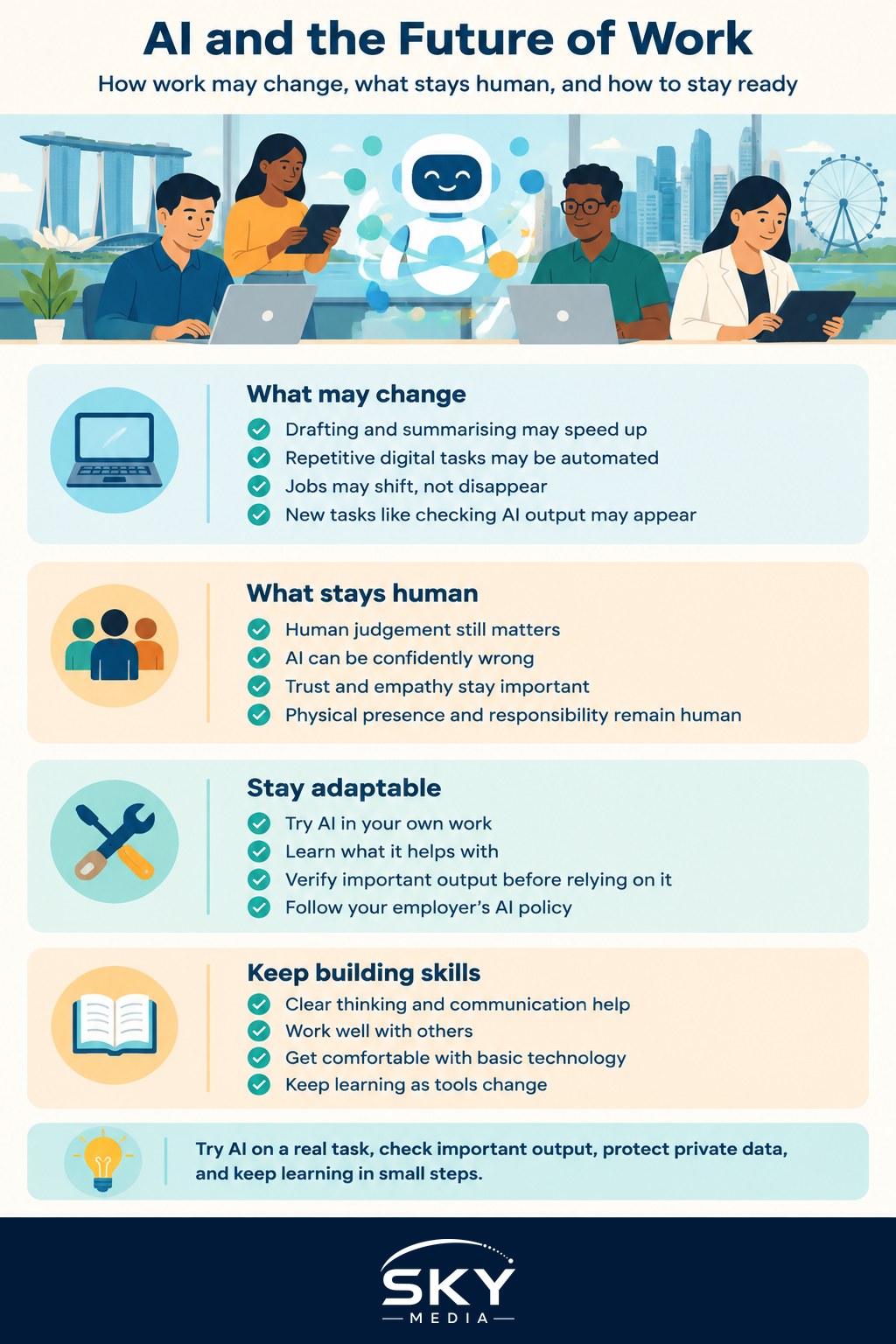
AI is already good at certain kinds of work: drafting text, summarising long documents, answering common questions, sorting information, and handling repetitive digital tasks. Where a job involves a lot of that, AI is likely to change how the work gets done. Often this looks less like a job disappearing and more like parts of it being sped up or automated, freeing time for other things.
Many roles will absorb AI as a tool rather than be replaced by it. A marketer might use AI to draft first versions faster, then spend their energy on judgement and strategy. An administrator might automate routine paperwork and focus on the trickier cases. In this sense, AI often shifts the mix of a job rather than deleting it outright. New tasks also appear, such as checking AI output, writing good prompts, and managing where these tools are used well. Our guide to AI tools for small business shows how this plays out in practice for smaller teams.
It is fair to acknowledge the harder side too. Some tasks will be automated in ways that reduce how many people are needed for them, and that can be genuinely disruptive for individuals, even when the overall picture is one of change rather than collapse. Pretending otherwise helps no one. The sensible response is not panic, but preparation.
What tends to stay the same
It helps to remember what AI is not good at. It does not truly understand the world, it can be confidently wrong, and it has no accountability. That means work involving human judgement, trust, empathy, physical presence, and responsibility for outcomes remains firmly in human hands. Caring for people, resolving a delicate dispute, leading a team, building relationships, and making a call that someone must answer for are not things you can hand to a chatbot.
Skills that travel well across change are worth investing in: clear thinking, communication, working with others, and the ability to learn new tools without fear. Basic comfort with technology is increasingly part of almost every job, and our guide to essential tech skills everyone should know is a good place to shore that up. Knowing how these tools actually work also removes a lot of the mystery, and our explainer on how large language models work helps with that.
Staying adaptable in Singapore
Singapore has leaned into helping workers keep pace with technology through national skills and training support, and using those opportunities is a practical step rather than a grand gesture. You do not need to become a technologist. You need to stay curious and willing to try new tools in your own field.
A few grounded habits go a long way:
- Try AI in your own work. Use it for a real task, notice where it helps and where it falls short. Hands-on experience beats worrying from a distance.
- Verify what matters. AI makes mistakes, so check important output before you rely on it, especially anything with legal, financial, medical, or safety stakes, where a professional should still make the call.
- Protect information. Do not put confidential, financial, medical, or personal data into public AI tools, and follow your employer’s AI policy at work.
- Keep learning. Small, regular upskilling beats waiting for a big change to force your hand.
- Focus on the human parts. Lean into judgement, communication, and trust, which are the parts hardest to automate.
A balanced outlook
It is easy to be swept up in either excitement or dread, and neither serves you well. The more likely path is steady change: many jobs reshaped rather than removed, new tasks appearing, and a growing premium on people who can work alongside these tools sensibly. That has happened with earlier waves of technology too, and while the transition can be bumpy for individuals, adaptability has always been the best insurance.
The ai future of work singapore employees are heading toward is not fixed, and no one can honestly promise you a precise picture. What you can control is your own readiness. Stay open, keep your skills current, use AI as a capable assistant while remembering its limits, and hold on to the human strengths that no tool can copy. Do that, and change becomes something you can meet on your own terms rather than something that happens to you.
Frequently Asked Questions
Which jobs are least likely to be replaced by AI? Work built on human judgement, trust, empathy, physical presence and accountability is hardest to automate. Think caregiving, delicate negotiations and leading teams. Even then, AI may change daily tasks, so no job is entirely untouched.
How can mid-career workers prepare for AI changes? Start by using AI tools on real tasks in your own field to see where they help and where they fall short. Build small, regular learning habits rather than waiting for a crisis. Ask your employer or national skills schemes about training that fits your role.
What skills will matter most as AI spreads at work? Clear thinking, communication, teamwork and the ability to learn new tools quickly tend to stay valuable. Judgement matters too, including checking AI output for errors. Basic comfort with technology is becoming part of almost every role.
Should students pick a different course because of AI? There is no need to panic or switch automatically. Choose fields you can do well in and enjoy, then add skills in using AI tools within that area. Speak to career counsellors and people working in the field about how roles are changing.
Is my employer allowed to monitor how I use AI at work? Employers can usually set rules on which tools staff may use and what data can be shared with them. Read your company’s AI and IT policies first. If you are unsure about your rights, check with HR or refer to MOM’s guidance.
Further reading: Understanding Quantum Computing Basics