

Understanding cadences is a big step towards hearing music the way composers write it. A cadence is a short chord progression at the end of a phrase that tells the listener whether the music has come to rest or is still moving forward. Once you can recognise cadences, you start to feel the punctuation in music, the difference between a full stop, a comma and a cliffhanger.
What a Cadence Is
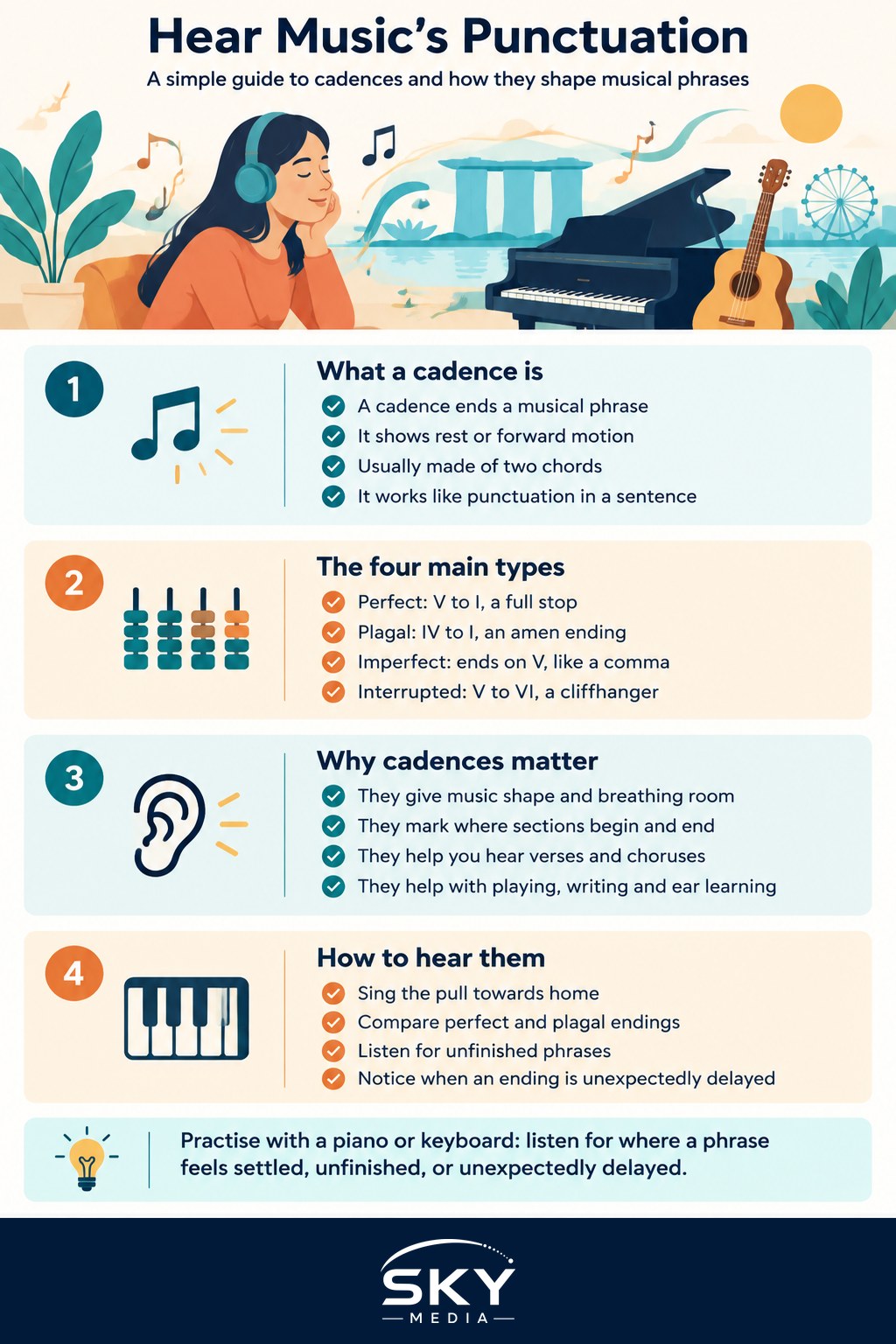
A cadence is the harmonic ending of a musical phrase, usually made of two chords that create a specific sense of arrival or expectation. If a melody is like a sentence, a cadence is the punctuation mark that closes it. Some cadences feel final and settled, others feel unfinished, and each type has its own emotional flavour.
To follow the rest of this guide, it helps to know that chords in a key are numbered with Roman numerals. In a major key the most important ones are the tonic (I), which feels like home, the subdominant (IV), and the dominant (V), which feels tense and wants to resolve back to I. Cadences are largely built from the relationships between these chords.
Why Cadences Matter
Cadences give music shape. Without them, phrases would run into one another with no sense of breathing or structure. They tell the ear where sections begin and end, which is why you can often feel the end of a verse or the arrival of a chorus even without knowing the theory behind it.
For a player or writer, understanding cadences makes it far easier to learn songs by ear, to predict where a progression is heading, and to compose phrases that feel intentional rather than accidental. They are one of the most practical corners of harmony you can study.
The Four Main Cadences
Western harmony has four cadences you will meet again and again. Here they are side by side.
| Cadence | Chords | Feeling | Common description |
|---|---|---|---|
| Perfect | V to I | Strong, complete rest | The full stop |
| Plagal | IV to I | Gentle, settled arrival | The “amen” ending |
| Imperfect | Ends on V | Unfinished, expectant | The comma |
| Interrupted | V to VI | Surprise, avoided ending | The cliffhanger |
Each of these deserves a closer look, because the feeling matters more than the label.
Perfect Cadence
The perfect cadence, sometimes called an authentic cadence, moves from the dominant chord (V) to the tonic (I). It gives the strongest possible sense of conclusion, which is why so many pieces end this way. When you hear a phrase that feels firmly closed and resolved, a perfect cadence is usually the reason.
Plagal Cadence
The plagal cadence moves from the subdominant (IV) to the tonic (I). It also lands on home but with a softer, rounder feeling than the perfect cadence. It is famous as the “amen” heard at the end of many hymns, which is why some people call it the amen cadence. It resolves, but gently.
Imperfect Cadence
The imperfect cadence, also known as a half cadence, ends on the dominant (V) rather than resolving to the tonic. Because V is a tense chord that wants to move on, the phrase feels unfinished, like a comma rather than a full stop. Composers use it to keep the music flowing into the next phrase.
Interrupted Cadence
The interrupted cadence, also called a deceptive cadence, sets you up as if a perfect cadence is coming, moving from V, but then lands on VI instead of I. The ear expects home and gets something unexpected, creating a moment of surprise or emotion. It is a lovely tool for delaying resolution and stretching out a phrase.
How to Hear Cadences
Recognising cadences by ear takes practice, but it is very learnable. Try these approaches.
- Sing the resolution. Play a dominant chord and hum where you feel it wants to go. That pull towards home is the heart of a perfect cadence.
- Compare pairs. Play a perfect cadence and then a plagal cadence back to back. Notice how both arrive home but with different emotional weight.
- Spot the comma. Listen for phrases that feel unfinished and hang in the air. These usually end on an imperfect cadence.
- Catch the surprise. When a passage sounds like it is about to end but suddenly shifts somewhere unexpected, you have probably heard an interrupted cadence.
Working these out at an instrument, rather than only on paper, builds the connection between the theory and the sound far more quickly.
Cadences in Real Songs
Cadences are not just a classical concept. Pop, folk, worship and film music all rely on them constantly. A pop chorus often lands on a strong perfect cadence to feel satisfying. A gentle ballad might favour plagal endings for warmth. A verse that flows straight into the chorus frequently uses an imperfect cadence to avoid stopping too soon. Once you know what to listen for, you will start hearing these shapes in music you already love.
Common Points of Confusion
Beginners sometimes think a cadence is any two chords, but the term refers specifically to the chords that close a phrase. The same two chords in the middle of a phrase do not function as a cadence in the same way, because the sense of arrival depends on landing at a phrase ending.
Another common mix up is between the perfect and plagal cadences, since both resolve to the tonic. The clue is the chord before the tonic. If it is the dominant (V) you have a perfect cadence, and if it is the subdominant (IV) you have a plagal cadence.
Bringing It Together
Understanding cadences turns harmony from a set of rules into a language of tension and release. Learn the four main types, focus on how each one feels rather than just its name, and practise spotting them in songs you enjoy. With time, you will hear the punctuation in music automatically, and that skill will sharpen your listening, your playing and your writing all at once.
Explore more: Understanding chords and progressions · Music theory basics for beginners · Ear training for musicians