
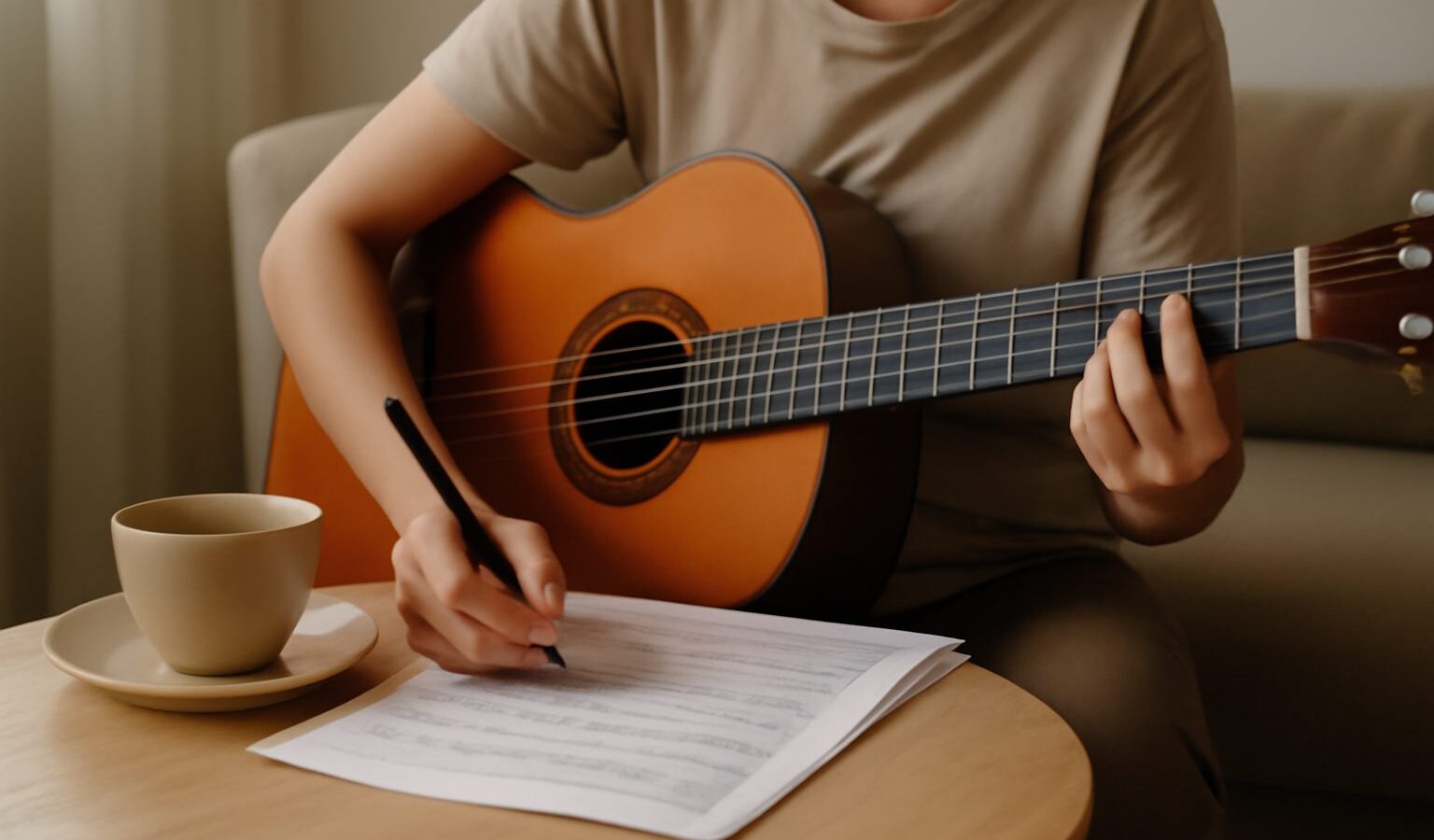
Music theory basics can sound intimidating, as though you need a conservatory degree just to understand a pop song. The truth is far friendlier. Theory is simply a shared language for describing what your ears already enjoy, and learning a little of it makes everything easier: picking up songs faster, jamming with others, writing your own material and talking to fellow musicians. You do not need to read complex notation or memorise dozens of rules to benefit. This guide explains the core ideas in plain language, so you can start using them straight away.
Think of theory not as a rulebook that limits you but as a map. You can make music without it, just as you can find your way around a neighbourhood without a map, but the map helps you get where you want faster and understand why certain routes feel right.
Notes, Pitch and the Musical Alphabet
Everything in music is built from notes, and a note is simply a specific pitch, meaning how high or low a sound is. Western music uses only seven letter names for notes: A, B, C, D, E, F and G. After G, the names start again at A, and that repeat is called an octave, meaning the same note higher or lower.
Between some of these notes are extra pitches called sharps and flats. A sharp raises a note slightly and a flat lowers it, which is why you see symbols like a hash for sharp and a small “b” for flat. On a piano these in-between notes are the black keys. In total there are twelve pitches before everything repeats, and that set of twelve is all popular music uses.
You do not need to memorise this like a school test. Just knowing that notes have names, that they repeat in octaves, and that small steps sit between the letters is enough to make sense of scales and chords later. If you play any instrument, try naming a few notes as you play them so the letters connect to real sounds.
Rhythm, Beat and Tempo
If notes are the “what” of music, rhythm is the “when”. Rhythm is the pattern of long and short sounds in time, and it is arguably more fundamental than pitch, since you can clap a song people recognise without any notes at all.
Underneath rhythm is the beat, the steady pulse you tap your foot to. Beats group into regular sets called bars or measures, and most popular music groups them in fours, which is why you often hear people count “one, two, three, four” before a song starts. The speed of that pulse is the tempo, measured in beats per minute. A slow ballad might sit around sixty beats per minute, roughly one beat per second, while an upbeat dance track moves much faster.
To feel this in practice:
- Put on a song you like and tap along steadily. That pulse is the beat.
- Count the taps in repeating groups of four. Notice how the “one” often feels strongest.
- Try clapping the rhythm of the words in the chorus. That is rhythm sitting on top of the beat.
Getting comfortable with steady time matters more for beginners than any other single skill, because good timing makes even simple playing sound musical.
Scales and Keys
A scale is an ordered set of notes that sounds good together and gives a piece its flavour. The two you will meet first are the major scale, which tends to sound bright and happy, and the minor scale, which tends to sound darker or more emotional. Each is built by following a fixed pattern of steps between notes, but you do not need the pattern memorised to hear the difference; sing a cheerful tune and a sad one, and you are already feeling major and minor.
Closely related is the idea of a key. The key is the home base of a song, the note and scale it centres on and keeps returning to. When a melody feels like it has “come home” and resolved, it has usually landed on the key’s home note. Songs are described as being “in the key of” something, such as the key of C major, which simply tells musicians which family of notes to expect.
Why does this matter for a beginner? Because once you know a song’s key, you know which notes and chords are likely to fit, which makes improvising, singing harmony and writing your own parts far less guesswork.
Chords and How They Fit Together
A chord is three or more notes played at the same time, and chords are the backbone of accompaniment on guitar, ukulele and keyboard. The most common type is the triad, built from three notes of a scale, and just like scales, chords come in major and minor flavours with the same bright or dark feel.
Within any key, some chords naturally belong together, and songwriters lean on a small number of them in a repeating order called a chord progression. A huge amount of popular music runs on just three or four chords looped throughout, which is wonderful news for beginners: learn a handful of chords in one key and you can play hundreds of songs.
Chords also create a sense of tension and release. Some chords feel restful and settled, while others feel like they want to move somewhere. That push and pull is what makes a progression satisfying, and it is the same feeling of “coming home” you get when a melody resolves.
How Deep Should a Beginner Go
It is easy to fall into the trap of studying theory endlessly instead of making music. The best approach is to learn just enough to serve what you actually want to do, then return for more as questions come up. Here is a simple comparison to keep you focused.
| Your goal | Worth learning early | Can wait until later |
|---|---|---|
| Playing songs you love | Chords, rhythm and staying in time | Advanced harmony and modes |
| Singing with others | Keys and finding your comfortable range | Formal ear-training exercises |
| Writing your own songs | Basic scales, keys and chord progressions | Complex chord substitutions |
| Reading notation | Note names and simple rhythm values | Sight-reading fluency and clefs |
| Just enjoying music more | How major and minor feel different | Detailed analysis of pieces |
Putting Theory Into Practice
Theory only sticks when you attach it to sound. Whatever you learn, play it, sing it or clap it the same day, because a concept you have heard and felt is remembered far better than one you have only read. If you are practising at home in an HDB flat, you can explore all of this quietly on an unplugged instrument, an electronic keyboard with headphones, or simply by singing softly, without troubling your neighbours.
Local music schools and exam boards offer structured theory courses if you enjoy a formal path, but plenty of Singapore musicians build a solid working knowledge for free through patient self-study and by playing with others. Aim to understand rather than memorise, and let curiosity lead. Every time a song surprises you, ask why it works, and use these music theory basics to find the answer. Little by little, the map fills in, and music starts to make a satisfying kind of sense.