

Every parent brings their own history, values, and instincts to raising a child, so it is no surprise that families do things differently. Learning about the different parenting styles is not about ranking yourself or judging others. It is a helpful lens for understanding why you respond the way you do, where your approach comes from, and how small shifts might serve your child better. Most parents move between styles depending on the day, their mood, and the situation, and no family fits neatly into a single box. This guide describes the widely recognised styles calmly and fairly, so you can reflect on your own approach without pressure or guilt.
The Two Ingredients Behind Every Style
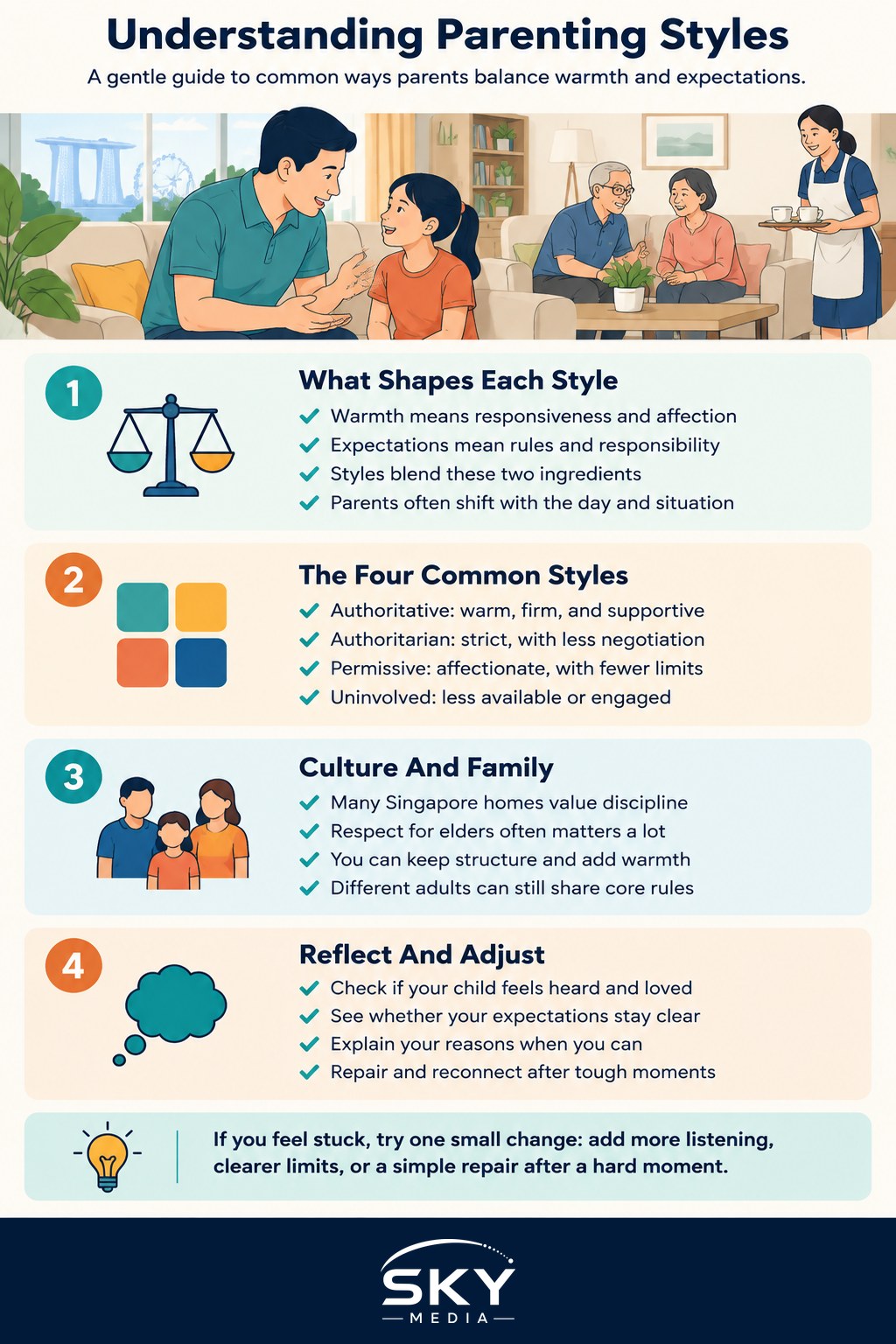
Researchers who study parenting often describe styles using two simple ingredients: warmth and expectations. Warmth is how responsive, affectionate, and emotionally available you are. Expectations are how much you ask of your child in terms of behaviour, responsibility, and rules. Almost every parenting style can be understood as a particular blend of these two.
A parent can be high in both, high in one and low in the other, or low in both. None of these makes someone a bad parent, and most of us shift along these dials as our children grow and as circumstances change. Seeing your approach in these terms can make it easier to adjust gently rather than overhaul everything at once.
The Four Widely Recognised Styles
Parenting is commonly described in four broad styles. Read them as general patterns rather than fixed labels, and remember that culture, family circumstances, and each child’s temperament all shape how a style plays out in real life.
- Authoritative: high warmth and high expectations. These parents set clear, consistent limits while staying loving, listening to their child, and explaining the reasons behind rules. It is often described as a warm and firm balance.
- Authoritarian: lower warmth and high expectations. The focus is on obedience, structure, and respect for authority, with firmer rules and less negotiation. Many families draw on this style, especially where discipline and respect for elders are strongly valued.
- Permissive: high warmth and lower expectations. These parents are affectionate and responsive but set fewer firm limits, often preferring to be a friend and to avoid conflict.
- Uninvolved: lower warmth and lower expectations. Here a parent is less available or engaged, sometimes because of stress, overwork, illness, or their own difficult circumstances rather than a lack of love.
You may recognise a bit of yourself in more than one of these, and that is perfectly normal. Parents also often differ from their own partner, which is worth talking about openly.
How Each Style Tends To Look Day To Day
The table below sums up the general tendencies of each style. It is a simple comparison, not a scorecard, and real families are always more nuanced than any grid.
| Style | Warmth | Expectations | Typical feel at home |
|---|---|---|---|
| Authoritative | High | High | Clear rules with plenty of listening and support |
| Authoritarian | Lower | High | Strong structure, respect for authority, less negotiation |
| Permissive | High | Lower | Affectionate and relaxed with fewer firm limits |
| Uninvolved | Lower | Lower | Distant or stretched thin, less day-to-day engagement |
Seeing the patterns side by side can help you notice which direction you naturally lean, and where you might want to add a little more warmth or a little more structure.
Culture, Family, And Finding Your Balance
In Singapore, many parents grew up in homes that valued discipline, respect for elders, and academic effort, and those values remain meaningful. At the same time, plenty of parents today want to combine that structure with more open communication and emotional warmth. There is no need to reject your upbringing to do this. Often it is about keeping the firm expectations while adding more listening, explaining, and connection.
Grandparents and helpers may also parent differently from you, which can create friction. Rather than insisting everyone match exactly, aim for agreement on the big things, like safety, key routines, and how you speak to the child, while allowing some flexibility on the rest. Children generally cope well with different adults having slightly different styles, as long as the core feels consistent and loving.
Your child’s temperament matters too. A cautious, sensitive child and a bold, strong willed child may each need you to adjust your blend of warmth and structure. What feels firm to one child may feel harsh to another, and what feels warm to one may feel like a lack of guidance to their sibling. This is why the same parent can find that an approach which worked beautifully with an older child falls flat with a younger one. Good parenting is responsive, not rigid, so it is normal and healthy to adapt as you go and as your child grows.
Reflecting Without Judging Yourself
If reading about these styles makes you second-guess your parenting, take a breath. No parent gets the balance right every day, and children are remarkably resilient. What matters most over time is a warm relationship, reasonable and consistent limits, and a willingness to repair after the inevitable hard moments.
A few gentle questions can guide honest reflection:
- Does my child feel loved and heard, even when I say no?
- Are my expectations clear and fairly consistent?
- Do I explain my reasoning where I can, rather than only demanding compliance?
- When I get it wrong, do I reconnect and make amends?
Small, steady adjustments matter far more than any dramatic change. If you are struggling with your child’s behaviour or with conflict at home, or you simply want a sounding board, a family counsellor, your child’s school counsellor, or resources through community and family services can help. Reaching out is a sensible step, not a sign that anything has gone wrong.
Explore More
Understanding your own approach is a great starting point for the more specific challenges of parenting. If your child has a determined streak, you may like our guide to raising a strong-willed child. For a child who feels things deeply, our guide to parenting a highly sensitive child offers warm, practical support.
Frequently Asked Questions
Which parenting style is considered best for children? The authoritative style, which combines warmth with clear, consistent expectations, is often described as the most balanced. Still, no family fits one box, and culture and your child’s temperament matter. The aim is a warm relationship, fair limits and a willingness to adjust, not a perfect label.
What if my partner and I have different parenting styles? This is very common. Talk openly about the big things, such as safety, key routines and how you speak to the child, and aim to agree on those. Smaller differences are usually manageable, and children cope well when the core feels consistent and loving.
Is strict parenting bad for children? Not necessarily. Structure and high expectations can be valuable, especially when families prize discipline and respect. What matters is whether warmth comes with the strictness: listening, explaining reasons and repairing after conflict. Strictness without warmth is the part that tends to cause difficulty.
How do I handle grandparents or helpers who parent differently from me? Agree on a few non-negotiables with them, such as safety, meal and sleep routines and respectful speech, and explain your reasons kindly. Allow flexibility on the rest. Children usually adapt to different adults, provided the core messages stay consistent.
Can I change my parenting style if I feel I have got it wrong? Yes, and small shifts matter more than dramatic overhauls. Choose one thing, such as listening more or explaining rules, and practise it consistently. Apologising and reconnecting after hard moments shows your child how to repair. A family counsellor or school counsellor can help if you want support.
Further reading: A Guide to Parenting Twins and Multiples