
The first time a newcomer is admitted to a public hospital here, one question lands almost immediately: which ward class do you want? For someone used to the mainland system, the choice can be confusing, because the letters and numbers carry meaning that affects both comfort and cost. Understanding hospital ward classes in Singapore, and how subsidies attach to them, helps you make a calmer decision at a stressful moment. This guide explains how the classes generally differ, how subsidy tiers work by residency, and how schemes like MediSave apply, while pointing you to the Ministry of Health for the current figures that only official sources should give.
This is general navigational information, not medical or financial advice. For any specific condition see a doctor, and for exact subsidy rates and eligibility check with MOH, the hospital’s business office, or HealthHub.
What Ward Class Actually Means
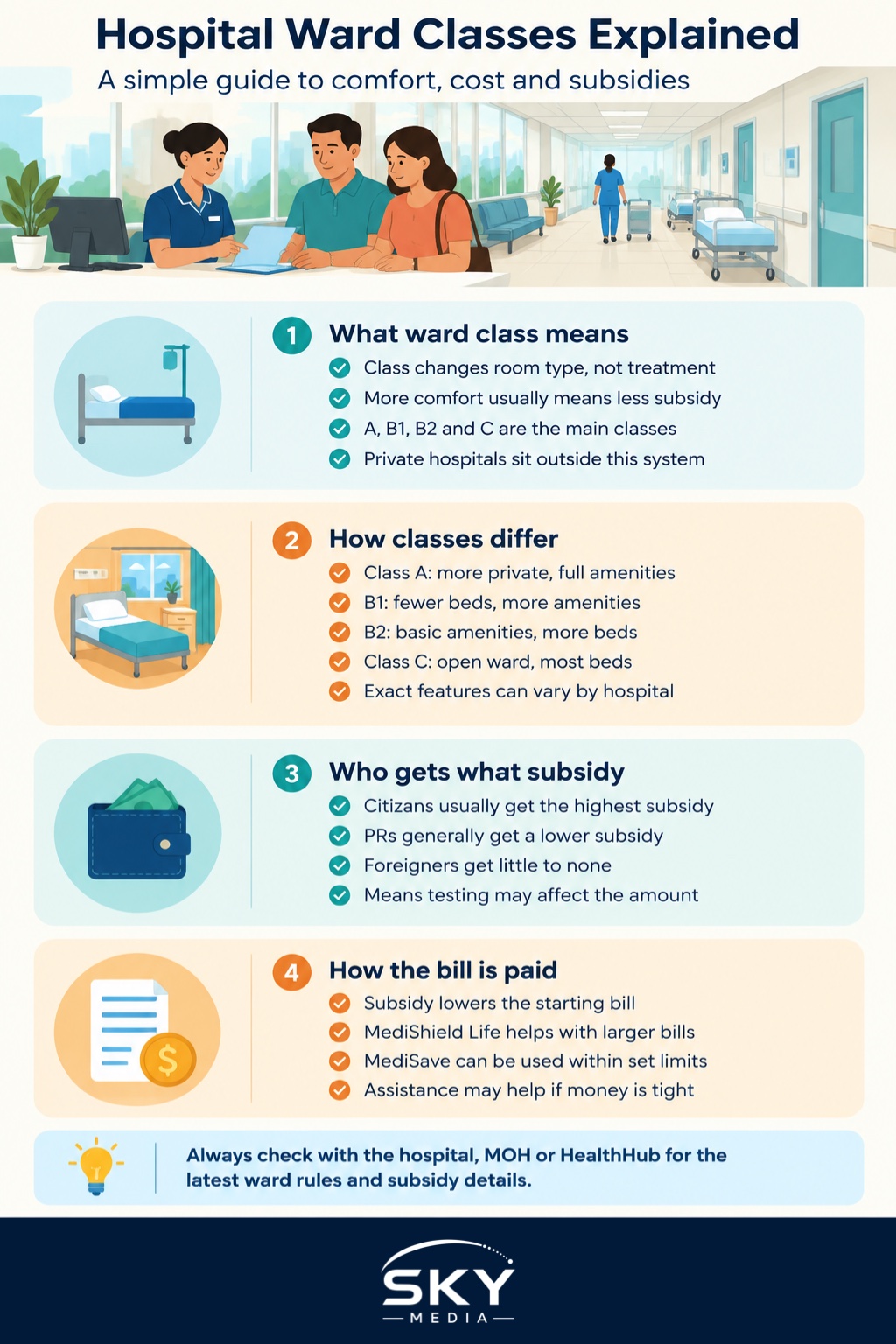
In Singapore’s public, or restructured, hospitals, ward classes describe the type of room and level of amenity, not the clinical care itself. The medical treatment you receive for a given condition is the same regardless of the ward you choose. What changes is the setting, the number of beds in a room, air conditioning, the degree of choice over your doctor, and crucially the level of government subsidy.
The classes are usually described as A, B1, B2 and C. At a broad level, class A rooms are single or more private with full amenities and the least subsidy, while class C rooms have more beds to a room, fewer frills and the highest subsidy for those who qualify. B1 and B2 sit in between. Private hospitals operate outside this ladder entirely and are not subsidised, which is a separate choice with separate costs.
For a newcomer, the key mental shift is this: paying more for a higher class buys privacy and comfort, not better medicine. Many residents choose a lower class precisely because the clinical care is identical.
How Ward Classes Generally Compare
The table below sketches the usual pattern across ward classes. It is a general guide only, and the exact amenities and subsidy treatment can vary by hospital and change over time, so confirm details with the hospital and MOH.
| Ward class | Typical setting | Subsidy level | Who often chooses it |
|---|---|---|---|
| Class A | Single room, most privacy, air conditioned | Lowest or none | Those wanting privacy and doctor choice |
| Class B1 | Fewer beds per room, more amenities | Modest | A balance of comfort and cost |
| Class B2 | More beds per room, basic amenities | Higher | Cost conscious with some privacy |
| Class C | Most beds per room, open ward | Highest | Those prioritising affordability |
Notice that the trade is comfort against cost. Because the underlying treatment does not change, choosing a subsidised class is a perfectly sensible decision that many citizens and PRs make without hesitation.
How Subsidies Differ for Citizens, PRs and Foreigners
This is where residency status matters, and where newcomers most often have questions. Subsidies in the subsidised wards are tiered, and the general principle is that Singapore citizens receive the highest level of subsidy, permanent residents receive a lower level, and foreigners receive little to none in the subsidised classes.
A few points to hold in mind:
- The tiering means a PR admitted to a class B2 or C ward will typically pay more than a citizen in the same bed, but still less than a foreigner or a private patient.
- Means testing can apply to subsidised wards, which adjusts the subsidy according to income and other factors. This is another reason not to assume a single fixed figure.
- MediSave and MediShield Life, the national medical savings and insurance schemes, interact with your bill, and PRs contribute to and use MediSave under their own rules. How much can be withdrawn and claimed depends on the treatment and the scheme limits.
Because all of these figures are reviewed and can change, this guide deliberately avoids quoting amounts or percentages. The right move is to ask the hospital’s business office for an estimate for your specific case and residency status, and to verify the framework with MOH.
How Your Bill Gets Paid Down
The ward class and subsidy set the starting point of a bill, but several layers usually sit on top before you reach the cash portion. It helps to picture them in order, while remembering that the exact rules and limits are set officially.
- Government subsidy reduces the bill first in subsidised wards, according to your class, residency and any means testing.
- MediShield Life is the national insurance that helps with larger hospital bills, designed around subsidised ward costs, with its own claim limits and deductibles.
- Integrated Shield Plans are optional private insurance some people hold on top of MediShield Life, which may cover higher ward classes or private hospitals depending on the plan.
- MediSave is your national medical savings account, which can be used within set limits for parts of a bill.
- Cash or other assistance covers whatever remains, and financial help exists for those who genuinely struggle.
Exactly how these apply to your bill depends on your treatment, your cover and your status, so confirm with the hospital and the CPF Board rather than assuming.
Making the Choice at Admission
When you are admitted, the hospital will ask you to select a ward class, often with an indication of the estimated bill. Here is a calm way to approach it.
- Ask for a cost estimate for your likely length of stay in each class you are considering, based on your residency status.
- Remember that clinical care is the same across classes, so weigh comfort and privacy against what you can afford.
- Check how MediSave and MediShield Life will apply to your bill, and whether means testing affects your subsidy.
- If money is a serious worry, say so. Medical social workers exist to help, and there are assistance avenues for those who genuinely struggle.
- Keep any paperwork and ask questions freely. Staff deal with these choices every day and can explain your options.
If your situation is planned rather than an emergency, you can research and decide in advance, which removes a lot of the pressure. For unplanned admissions, do not feel rushed into the most expensive room. A subsidised ward is a normal, respectable choice.
Frequently Asked Questions
Is the medical care worse in a class C ward?
No. In restructured hospitals the clinical treatment for a given condition is the same across ward classes. What changes with class is the room, amenities, the degree of doctor choice and the level of subsidy, not the quality of care.
Do permanent residents get the same subsidy as citizens?
Generally no. Subsidies in subsidised wards are tiered, with citizens receiving the highest level, PRs a lower level, and foreigners little to none. A PR usually pays more than a citizen in the same bed but less than a foreigner. Confirm the current framework with MOH.
Can I use MediSave to pay for my ward stay?
MediSave can be used within set limits for parts of a hospital bill, and MediShield Life helps with larger bills. How much applies depends on the treatment and the scheme limits, and PRs use MediSave under their own rules, so check with the CPF Board and the hospital.
Can I change ward class during my stay?
Hospitals can sometimes transfer patients between wards depending on availability and circumstances, and this can affect the bill and subsidy for that period. If you are considering it, raise it with the ward staff or business office so you understand the cost implications.
What if I cannot afford my hospital bill?
Tell the hospital. Medical social workers assess situations and there are assistance avenues for those who genuinely struggle. Financial counselling at the hospital can walk you through your options, so speak up early rather than avoiding the conversation.
Where to Verify the Details
Ward class rules, subsidy tiers, means testing and scheme limits are all set and updated by official bodies. For the current picture, rely on the Ministry of Health and HealthHub, on the specific hospital for its amenities and estimates, and on the CPF Board for how MediSave and MediShield Life work for you as a PR. Treat forum posts and old articles, including this one, as background only, and let the official channels give you today’s numbers. This article is general information to help you navigate, not medical or financial advice.
Explore More
Hospital care is one piece of a bigger health and money picture. To make sense of the bill itself, see understanding your hospital bill and financial counselling. If you are managing an ongoing condition, read our guide to managing a chronic illness and medication subsidies as a PR. For visits, our note on hospital visiting etiquette helps, and for a difficult but important subject many families think about, see what organ donation and HOTA mean for PRs in Singapore.
Official sources: Ministry of Health (MOH)
Further reading: Choosing a Hospital for Childbirth