
Panning and stereo width are the tools that let you place instruments across the space between your left and right speakers. Handled well, they turn a flat, crowded mix into an arrangement where every part has room to breathe. This guide explains the stereo field, how to pan with intent, why mono compatibility still matters, and how to widen a mix without it falling apart.
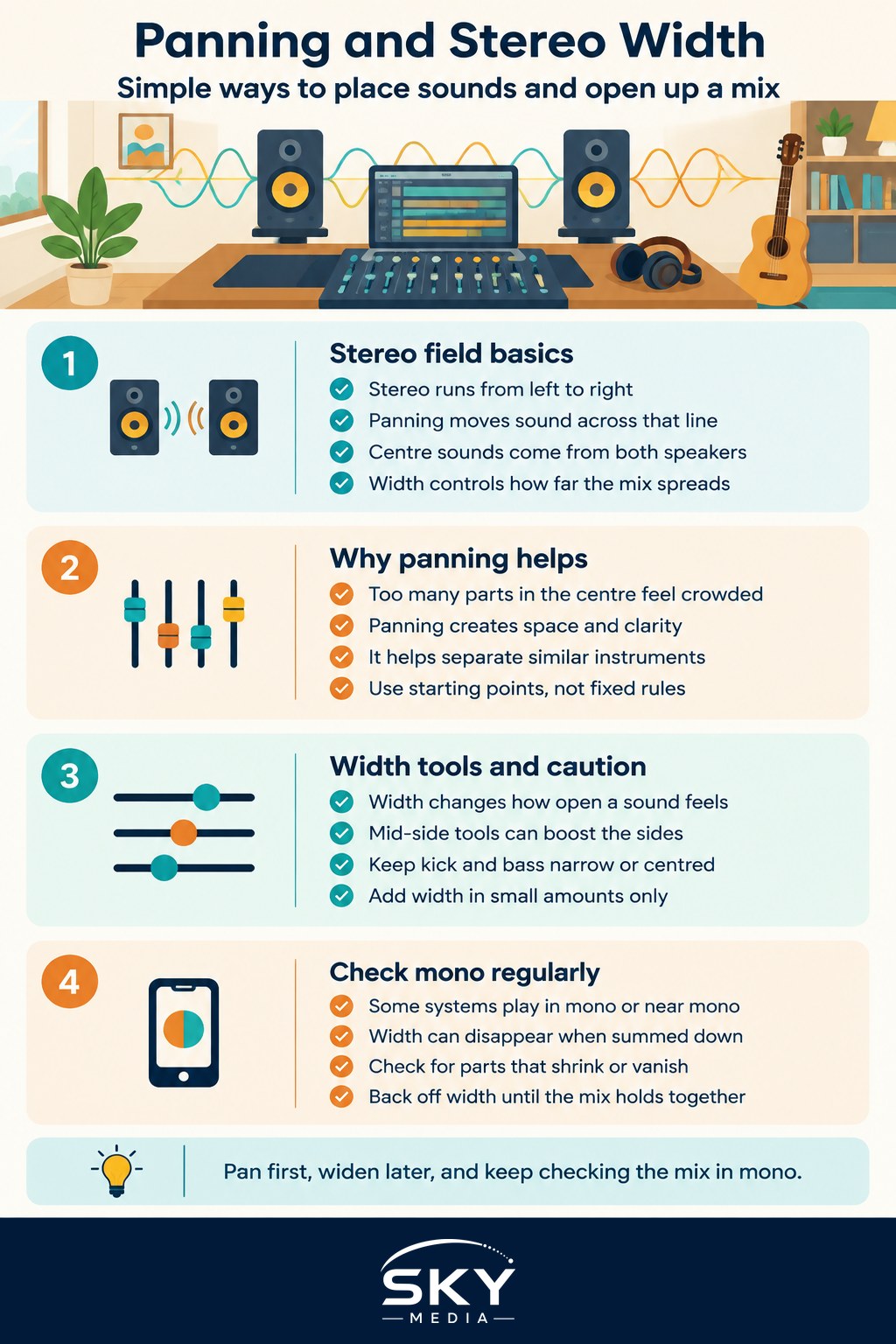
What The Stereo Field Actually Is
When you listen on two speakers or a pair of headphones, your ears receive slightly different signals from the left and the right. Your brain reads those differences and places each sound somewhere along a horizontal line. That line is the stereo field, and it runs from hard left, through the centre, to hard right.
Panning is simply how far you push a sound along that line. A pan control sends more of a signal to one side and less to the other. Set to the centre, a sound sits equally in both speakers and appears to come from directly ahead. Push it fully to one side and it appears to come from that speaker alone.
Stereo width is a related but separate idea. It describes how much a mix, or a single stereo sound, spreads out towards the edges of the field. A narrow mix feels focused and close to the centre. A wide mix feels open and spacious. Panning positions things; width controls how far the whole picture stretches.
Why Panning Matters In A Mix
Most beginner mixes pile everything into the centre. Vocals, bass, guitars, keys and drums all fight for the same tiny space, and the result sounds cluttered no matter how much you adjust the volume. Panning solves this by giving each part its own address.
The idea is separation. If two instruments occupy a similar frequency range, moving one to the left and the other to the right lets your ears tell them apart. You gain clarity without touching an equaliser. Think of it as arranging a room: you would not stack every chair in one corner.
There are a few widely used conventions worth knowing:
- Kick, snare, bass and lead vocal usually stay centred because they anchor the song and carry its low end.
- Overhead drums, hi-hats and toms are often spread to match how a kit sits in front of a listener.
- Rhythm guitars, backing vocals and pads are frequently panned outward in pairs to create balance.
None of these are rules. They are starting points that respect how people expect a mix to feel.
Panning Versus Stereo Width At A Glance
The two controls are easy to confuse, so it helps to see them side by side.
| Aspect | Panning | Stereo width |
|---|---|---|
| What it does | Moves a sound left or right | Spreads a sound or mix outward |
| Typical control | Pan knob on a channel | Width, stereo or mid-side tool |
| Works on mono sources | Yes | Limited, needs processing |
| Main risk | Lopsided balance | Weak centre, mono problems |
| Best used for | Placing individual parts | Adding space and openness |
Read together, the table shows the workflow: pan first to position parts, then reach for width only when the arrangement needs more air.
Building A Balanced Stereo Picture
Start with everything centred and mute all but the most important parts. Bring in the rhythm section, then place supporting instruments one at a time, listening for the moment each part stops fighting its neighbours.
Balance is the goal. If you pan a guitar to the left, consider what fills the right so the mix does not lean to one side. Backing vocals, a shaker, a second guitar or a keyboard can act as a counterweight. Keep an eye on your metering too, because a picture that looks even often sounds even.
Extreme panning, pushing a part fully to one edge, can be effective for doubled guitars or call-and-response ideas. Used everywhere, though, it makes a mix feel unstable on some playback systems. Moderate positions tend to travel better across speakers, earbuds and car stereos.
Understanding And Using Stereo Width Tools
Width tools change the relationship between the shared, centred information in a signal and the differences between the two channels. A common approach is mid-side processing, which splits a stereo signal into a mid component, the part both channels share, and a side component, the part that differs. Boosting the side content makes a sound feel wider; reducing it pulls the sound towards the centre.
Widening is tempting because bigger often feels better at first. The catch is that width lives in those side differences, and pushing them too hard hollows out the centre where your most important elements sit. A widened pad might sound impressive soloed and then swallow the vocal in the full mix.
A sensible approach:
- Keep low-frequency parts such as kick and bass narrow or centred, because wide bass smears the foundation of a track.
- Reserve stronger widening for pads, ambience, effects returns and doubled parts that benefit from space.
- Add width in small amounts and keep checking the full mix, not the soloed channel.
Mono Compatibility And Why It Still Matters
A mix can sound glorious in stereo and then collapse when the two channels are summed to mono. This happens because some width techniques rely on the left and right being out of phase, and summing them causes those parts to cancel out and disappear.
Mono compatibility still matters in daily life. Many phone speakers, Bluetooth speakers, shopping centres, cafes and club systems play in mono or something close to it. If your widened synth vanishes the moment the signal folds down, a large part of your audience hears a gap.
The habit worth building is simple: check your mix in mono regularly. Most setups let you sum to mono with a single control. Listen for parts that shrink or disappear, then dial back the width on the guilty channels until the mix holds together. A track that survives mono almost always sounds more powerful in stereo too.
Common Mistakes To Avoid
A few recurring problems trip people up. Panning the bass or kick away from the centre robs a track of its solid foundation. Widening everything leaves nothing that feels wide by contrast, since width only reads as width against something narrower. Ignoring mono means surprises later, often after a track is finished. And relying on a single pair of headphones hides how the balance really behaves in the wider world.
Bringing It All Together
Panning and stereo width are quietly two of the most useful skills in mixing. Pan with purpose to give each part its own place, widen gently and only where it helps, keep your low end centred, and always confirm the mix survives in mono. Do that consistently and your tracks will sound open, clear and dependable everywhere people press play. Trust your ears, make small moves, and let the space do the work.
Explore more: Mixing basics for beginners · Recording vocals at home · Using virtual instruments in Singapore
Frequently Asked Questions
Should vocals and bass always stay in the centre? Mostly, yes. Lead vocals, kick, snare and bass anchor a song and carry its low end, so centring them keeps the mix solid and balanced. Some styles break the convention for effect. Try moving one part and see whether the mix still feels grounded.
How can I tell if my mix has a mono problem? Sum the mix to mono and listen. If instruments shrink, hollow out or disappear, some stereo widening or phase effects are cancelling out. Reduce the width on those channels and check again. Most mixing tools have a mono button.
What is mid-side processing in simple terms? It splits a stereo signal into a mid part, shared by both channels, and a side part, which differs. You can then adjust them separately, such as brightening the sides for air or keeping the middle focused. Small changes are usually enough.
Does panning work on headphones the same way as on speakers? Not exactly. On headphones, each ear gets only one channel, so panning can feel extreme or disconnected. Speakers blend both channels in the room. Check your mix on both so it holds up either way.
How can I make a mono guitar or synth sound wider? Pan duplicates left and right, use a stereo effect such as a short delay or chorus, or record a second take and pan it opposite. Keep the centre solid and check in mono. Widening works best on parts that are not the main focus.
Further reading: Understanding Mid-Side Processing