

If your child has come home with a note about a spine check, or you have simply heard the word “scoliosis” and felt a flicker of worry, you are not alone. Scoliosis screening singapore is a routine part of caring for growing children, and understanding what it is, why it happens, and what the results mean can turn a moment of anxiety into a calm, sensible next step. This guide walks you through the basics in plain language, so you know what to expect and when it is worth speaking to a doctor. It is general information only and not a diagnosis.
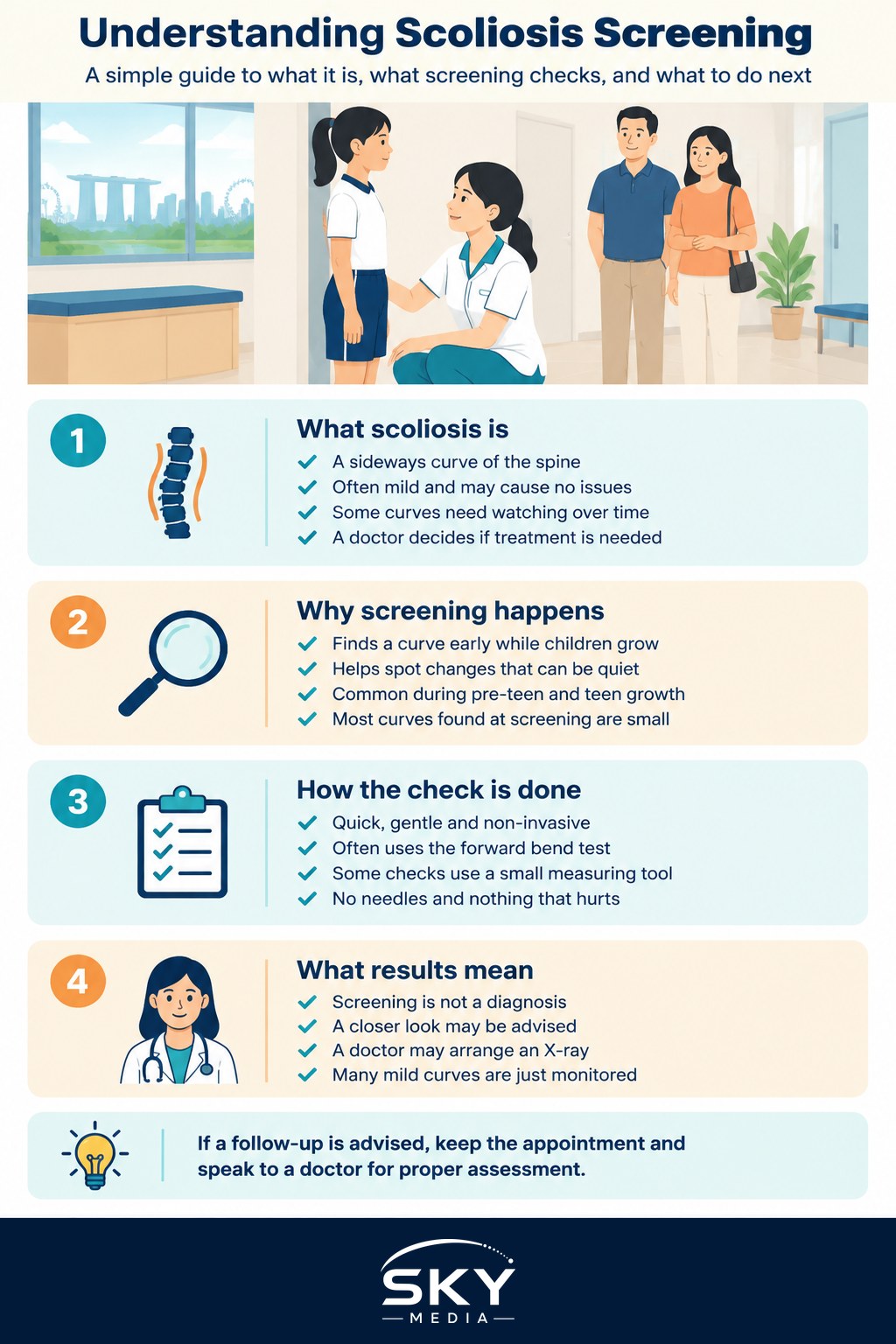
What Scoliosis Actually Is
Scoliosis is a sideways curve of the spine. Instead of running straight down the middle of the back, the spine curves to one side, sometimes in a gentle “C” or “S” shape. Many curves are very mild and never cause any problem at all. Others are larger and need to be watched over time, and a smaller number benefit from treatment guided by a specialist.
The most common type seen in children and teenagers is called idiopathic scoliosis, which simply means the cause is not fully known. It often shows up during the growth spurts of the pre-teen and teenage years, which is exactly why screening tends to happen around that age. It is not caused by carrying a heavy school bag, poor posture, or sleeping in an odd position, even though these worries are common. Reassuringly, most curves picked up at screening are small.
Signs a parent might notice at home include one shoulder sitting higher than the other, one shoulder blade sticking out more, a waist that looks uneven, or the body leaning slightly to one side. These signs are worth mentioning to a doctor, but on their own they do not confirm anything.
Why Screening Happens and What It Involves
The reason for screening is simple. Catching a curve early, while a child is still growing, gives the best chance to monitor it and act early if needed. Because curves can progress quietly during growth spurts, a check at the right age can pick up something a busy family might otherwise miss.
A typical screening is quick, gentle, and non-invasive. A common part of it is the “forward bend test”, where the child bends forward at the waist with arms hanging down while a trained person looks at the back to see whether one side is more raised than the other. Some settings use a small handheld tool to measure the angle of the back. There are no needles and nothing that hurts. In Singapore, spine checks are commonly carried out as part of school health services and reviews, though exact arrangements and age groups can change, so it is always worth checking the current details with your child’s school or the Health Promotion Board.
It helps to explain the check to your child beforehand in a light, matter-of-fact way, so they are not startled. You might say it is a normal part of looking after a growing body, just like a height and weight check.
What the Result Means and Following Up
Here is the part that matters most. A screening is not a diagnosis. It is a first look that flags whether a closer assessment would be sensible. If nothing of note is found, that is reassuring, though you should still mention any changes you notice as your child grows.
If the screening suggests a possible curve, your child will usually be advised to follow up with a doctor. This does not mean something is wrong or that treatment is definitely needed. It means a professional will take a proper look, and if appropriate arrange an X-ray to measure the curve accurately. Only a doctor can diagnose scoliosis and decide what, if anything, to do next.
Depending on the size of the curve and how much growing is still to come, a doctor may simply recommend watching and rechecking over time, since many mild curves stay stable. Larger curves may be managed with approaches a specialist will explain fully. The key message is to follow the advice you are given, keep any review appointments, and ask questions freely. Try not to let worry run ahead of the facts.
Practical Tips for Parents
- Treat a follow-up note as a normal next step, not a cause for alarm.
- Keep the appointment even if your child feels perfectly fine, since scoliosis usually causes no pain.
- Note down anything you have observed, such as uneven shoulders, to share with the doctor.
- Avoid searching for worst-case stories online, which rarely reflect the mild curves most children have.
- Let your child hear a calm tone from you, as they take their cue from how you react.
Looking after a growing child means keeping an eye on all sorts of everyday things, from posture to sleep to general wellbeing. If you would like to read more around children’s health and growth, you might find our guides on choosing a paediatrician in Singapore and growing pains in children helpful, along with our overview of children’s mental health and anxiety if the worry itself is weighing on your family.
A spine check is a small, sensible part of watching a child grow. If your child is flagged for a closer look, follow up with a doctor as advised, ask your questions, and remember that most curves found this way are mild. For any diagnosis or treatment, always see a doctor, and for a medical emergency, call 995 or go to A&E.
Frequently Asked Questions
Does scoliosis always need a brace or surgery? No. Many curves are mild and only need watching over time. Larger curves may be managed with approaches that a specialist explains. Only a doctor can decide what, if anything, your child needs.
Does scoliosis cause back pain in children? Usually it causes no pain at all, which is why screening and follow-up matter even when a child feels fine. Persistent back pain is a separate reason to see a doctor, so do not dismiss it.
Can my child keep playing sports if they have scoliosis? Many children with mild curves stay active, and exercise is generally good for them. Ask the doctor about your child’s own situation, especially if a curve is larger or treatment has begun.
What happens at a follow-up appointment after a positive screening? A doctor examines your child’s back and posture, and may arrange an X-ray to measure the curve accurately. Many mild curves are simply rechecked over time. Bring notes of what you have noticed, and ask questions freely.
Does scoliosis run in families? It can, since a family history raises the chance a little. But most children with scoliosis have no relatives with it. If a parent or sibling has scoliosis, mention it to your child’s doctor.
Official sources: HealthHub