

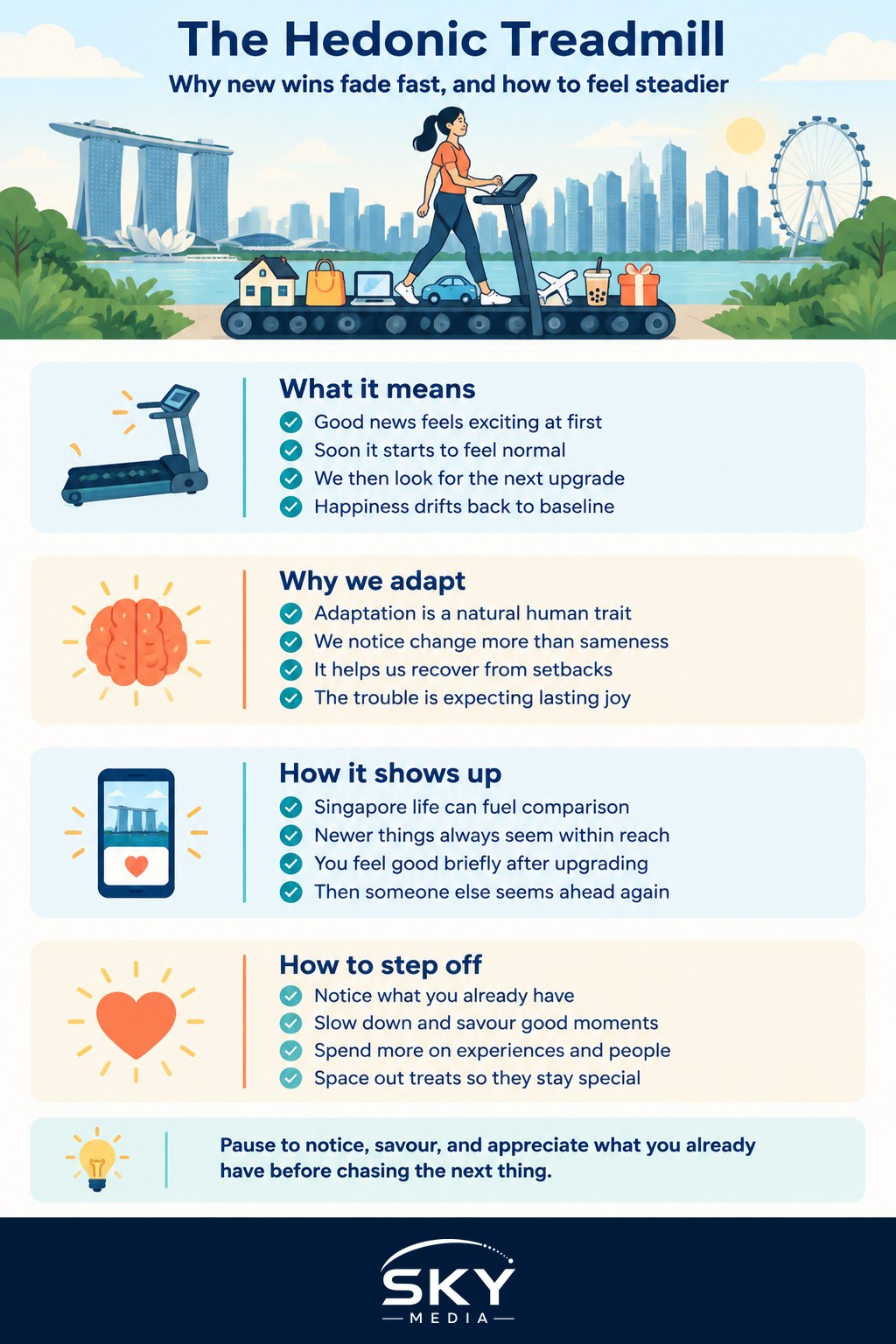
Think back to something you really wanted and finally got. A new phone, a pay rise, a bigger flat, that overseas holiday you saved for. In the moment, it felt wonderful. But how long did the glow last before it became normal, and you started eyeing the next thing? That quiet return to your usual mood, no matter what good or bad happens, is what people call the hedonic treadmill. It describes how we tend to adapt to changes in our lives and drift back toward a familiar baseline of happiness.
The idea is simple but powerful. We chase things believing they will make us lastingly happier, yet we adjust surprisingly quickly, and the new normal soon feels ordinary. Then we set our sights on the next upgrade, and the cycle repeats. Like walking on a treadmill, we keep moving but often end up in roughly the same emotional place.
Why we keep adapting
This adaptation is a natural feature of being human, not a personal flaw. Our minds are built to notice change more than steady states. A cool breeze feels lovely for a moment, then you stop noticing it. The same happens with the good things in life. Once something becomes part of your everyday world, your attention moves on to whatever is new or missing.
There is even a useful side to this. The same ability to adapt helps us cope with hard times. People who face real setbacks often find that, over time, their mood recovers more than they expected. So adaptation is not the enemy. The trouble comes when we forget it exists, and keep expecting the next purchase or achievement to deliver lasting joy that it was never going to provide.
How the treadmill shows up in Singapore
It is easy to feel the pull of the hedonic treadmill here. There is always a newer condo, a better car, a fancier holiday, a smarter gadget on someone’s feed. Comparison runs fast in a small, connected city, and it is tempting to measure your progress against what others seem to have. You upgrade, feel good briefly, then notice someone a step ahead, and the ground shifts again.
None of this means ambition is bad or that you should stop wanting nice things. The point is to see the pattern clearly, so your wanting does not quietly run your whole life. If constant comparison is wearing you down, it can help to read about how to stop comparing yourself to others and gently loosen its grip.
How to step off the treadmill
You cannot switch off adaptation, and you would not want to. But you can build habits that give you steadier contentment rather than a constant chase. Here are a few that genuinely help:
- Notice what you already have. Adaptation makes good things fade into the background. Deliberately bringing them back into view counters that. A simple habit of starting a gratitude practice can make ordinary days feel fuller without changing anything about your circumstances.
- Slow down and savour. Instead of rushing from one experience to the next, let the good moments land. Pausing to enjoy a hawker meal, a walk after rain, or time with someone you love stretches the pleasure and helps it stick.
- Spend on experiences and people. We tend to adapt faster to objects than to experiences and relationships. A shared trip or a meal with friends often gives more lasting warmth than another thing on a shelf.
- Space out your treats. When you enjoy something constantly, it stops feeling special. Giving yourself a little distance keeps small pleasures pleasurable.
Aiming at what actually lasts
Some sources of wellbeing seem more resistant to the treadmill than others. Meaningful work, close relationships, good health, a sense of purpose, and the feeling of growing as a person tend to give more durable satisfaction than possessions do. They are harder to fully adapt to because they keep unfolding and asking something of us.
This is worth remembering when you plan your life and set your goals. If every target is a bigger number or a shinier object, the treadmill will keep you running. If some of your goals point toward connection, contribution, and growth, you build a life that stays meaningful even as you adapt. Learning to cultivate contentment is not about giving up on wanting more. It is about wanting the right things, and appreciating what is already here.
A gentler relationship with wanting
Understanding the hedonic treadmill will not make you immune to it. You will still feel the thrill of new things and the itch for the next one, and that is fine. What changes is your awareness. You start to see the pattern as it happens, which loosens its hold. You can enjoy a good purchase without expecting it to fix your life, and you can pursue goals without pinning all your happiness on reaching them.
Contentment is not a place you arrive at once and keep forever. It is a practice you return to, again and again, in a world that constantly invites you to want more. Step off the treadmill now and then, look around at what you already have, and let that be enough more often than not. That steadier way of living tends to feel a lot better than the endless chase.
Frequently Asked Questions
Does the hedonic treadmill mean money cannot make me happier? Not exactly. The article says we adapt quickly to new possessions, so the glow fades, but it does not say money is useless. Experiences, relationships, health and purpose tend to hold up better. Meeting basic needs still matters.
Is it bad that I keep wanting upgrades like a new phone or car? No, wanting things is human and adaptation is a natural feature. The aim is to see the pattern so your wanting does not run your whole life. Enjoy the purchase without expecting it to fix things.
Why do experiences seem to last longer than things? We tend to adapt faster to objects than to experiences and relationships. A shared trip or meal with friends often leaves more lasting warmth than another item on a shelf. It also stays in your memories.
How do I stop comparing my lifestyle to others on social media? Notice when you are measuring yourself against someone’s highlights, and bring your attention back to what you already have. Limiting scrolling time and keeping a gratitude practice can help. If comparison is wearing you down, speak with someone you trust.
Does adapting to things also help in hard times? Yes, the same ability helps people recover from setbacks, often more than they expected. That is why adaptation is not the enemy. Support from loved ones and professionals still matters when times are really hard.