

If you are hiring foreign staff or moving to Singapore to work, two words come up again and again: quotas and levies. Understanding work pass quotas Singapore employers must manage, along with the levies attached to certain passes, helps you see why some hires are straightforward and others are not. This guide explains the concepts in plain language so both employers and candidates can plan sensibly.
This is general information, not legal or immigration advice. The Ministry of Manpower (MOM) sets and periodically updates quotas, ratios and levy rates, so always defer to MOM and check the current figures before making decisions. This article deliberately avoids quoting specific numbers, since any figure could quickly become outdated.
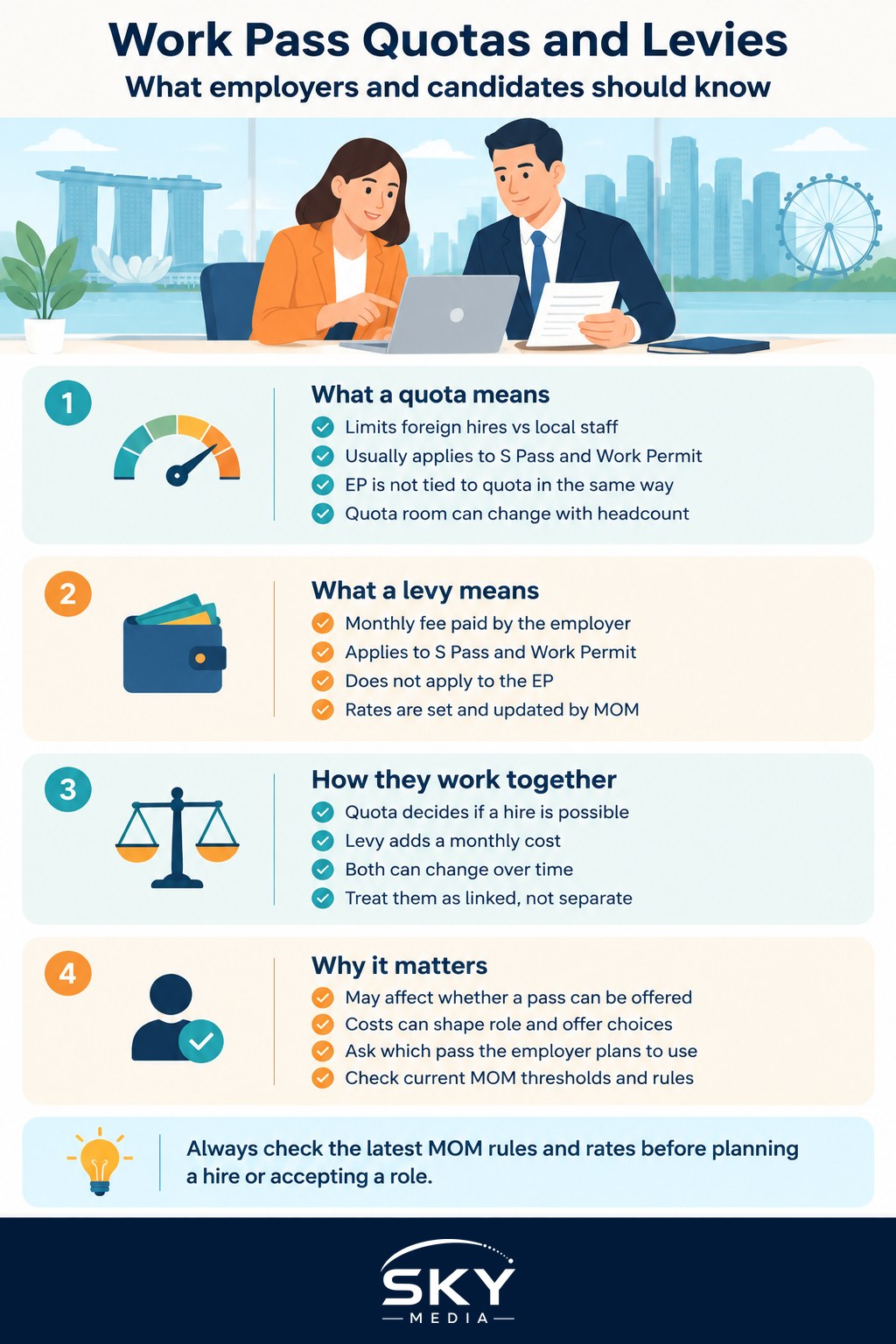
What a Quota Actually Is
A quota, sometimes described in terms of a dependency ratio ceiling, is a limit on how many foreign workers on certain passes a company may employ relative to its local workforce. The idea is to keep a balance between local and foreign employment. Not every pass is subject to a quota. In general, the S Pass and Work Permit holders fall under quota arrangements, while the Employment Pass (EP) is not tied to a quota in the same way.
Because the quota is expressed as a ratio, it moves with your local headcount. If a company grows its local workforce, its room to employ quota bound pass holders generally grows too. If local headcount falls, that room can shrink. This is why a company that could hire an S Pass holder one month might find it cannot the next, even though nothing about the candidate has changed.
What a Levy Is
A levy is a monthly fee that an employer pays to the government for each worker on certain passes, such as the S Pass and Work Permit. It is a pricing mechanism that sits alongside the quota. The levy is the employer’s cost, not the employee’s, and it recurs every month for as long as the pass is held.
Levy rates are set by MOM and can vary depending on the pass type and, in some frameworks, on how many foreign workers a company already employs relative to its local staff. Because these rates change from time to time, an employer should always confirm the current levy that applies to their situation rather than assume a figure. The Employment Pass, by contrast, does not carry a levy.
Quotas and Levies Side by Side
It helps to see how the two mechanisms differ and how they apply to the main passes. Treat the table below as a conceptual guide, not a source of exact figures.
| Aspect | Quota | Levy |
|---|---|---|
| What it is | A limit on foreign hires relative to local staff | A recurring monthly fee per eligible worker |
| Who it affects | Passes such as S Pass and Work Permit | Passes such as S Pass and Work Permit |
| Applies to EP? | Not tied to a quota in the same way | No levy on the EP |
| Who pays or manages | The employer manages the ratio | The employer pays the fee |
| Changes over time | Ratios can be revised by MOM | Rates can be revised by MOM |
The key takeaway is that quotas and levies usually travel together for the same passes. The quota controls how many quota bound workers you may have, and the levy puts a monthly price on each one.
Why This Matters to Candidates
You might think quotas and levies are purely an employer concern, but they affect candidates too. If a company has reached its quota for a particular pass, it may be unable to hire you on that pass even if you are a strong fit. If levies are high for the employer’s situation, that cost can influence how they structure roles and offers. Understanding this helps you interpret an employer’s decisions and ask better questions.
It also explains why some employers steer certain roles towards the Employment Pass, which is not quota bound in the same way and does not carry a levy, while others rely on the S Pass or Work Permit for mid and lower skilled roles. None of this is about your personal worth. It is about how the framework is structured.
Practical Guidance for Employers
If you are the employer, keep a clear picture of your local headcount, since it drives your quota room. Plan hiring in a way that keeps your ratios workable, and budget for levies as an ongoing monthly cost rather than a one off. Because both ratios and rates are revised by MOM periodically, build a habit of checking the current figures before you commit to a hire. Where a role could reasonably sit under more than one pass, weigh the quota and levy implications alongside the skill and salary tier.
Practical Guidance for Candidates
If you are the candidate, it is fair to ask an employer which pass they intend to use and whether quota or levy considerations affect the offer. This is not prying. It shows you understand the landscape. Confirm the salary against the current MOM thresholds for the pass in question, and remember that your pass type can affect wider matters such as sponsoring family members.
The Bottom Line
Quotas cap how many quota bound foreign workers a company may employ relative to its local staff, and levies put a recurring monthly price on each of those workers. The Employment Pass generally sits outside both mechanisms, while the S Pass and Work Permit sit within them. Since MOM revises the ratios and rates over time, always verify the current position with MOM before you plan a hire or accept a role.
Explore more
- S Pass Framework and Levy
- Singapore Work Pass Guide
- Employment Pass Eligibility
- The COMPASS Framework for EP Applicants
Official sources: Ministry of Manpower (MOM)