

If you are new to Singapore and house-hunting, you may notice that some condos seem to skip the 4th, 13th or 14th floor, or that an agent mentions a unit “might be harder to sell” because of its number. Beliefs about an unlucky unit number in Singapore property are real enough to shape some buyers’ choices. The question for you as a buyer or future seller is simple: does it actually change the price, and can you use it to your advantage?
This guide explains which numbers carry negative associations, how that tends to show up in the market, and how to weigh it sensibly against the factors that matter far more.
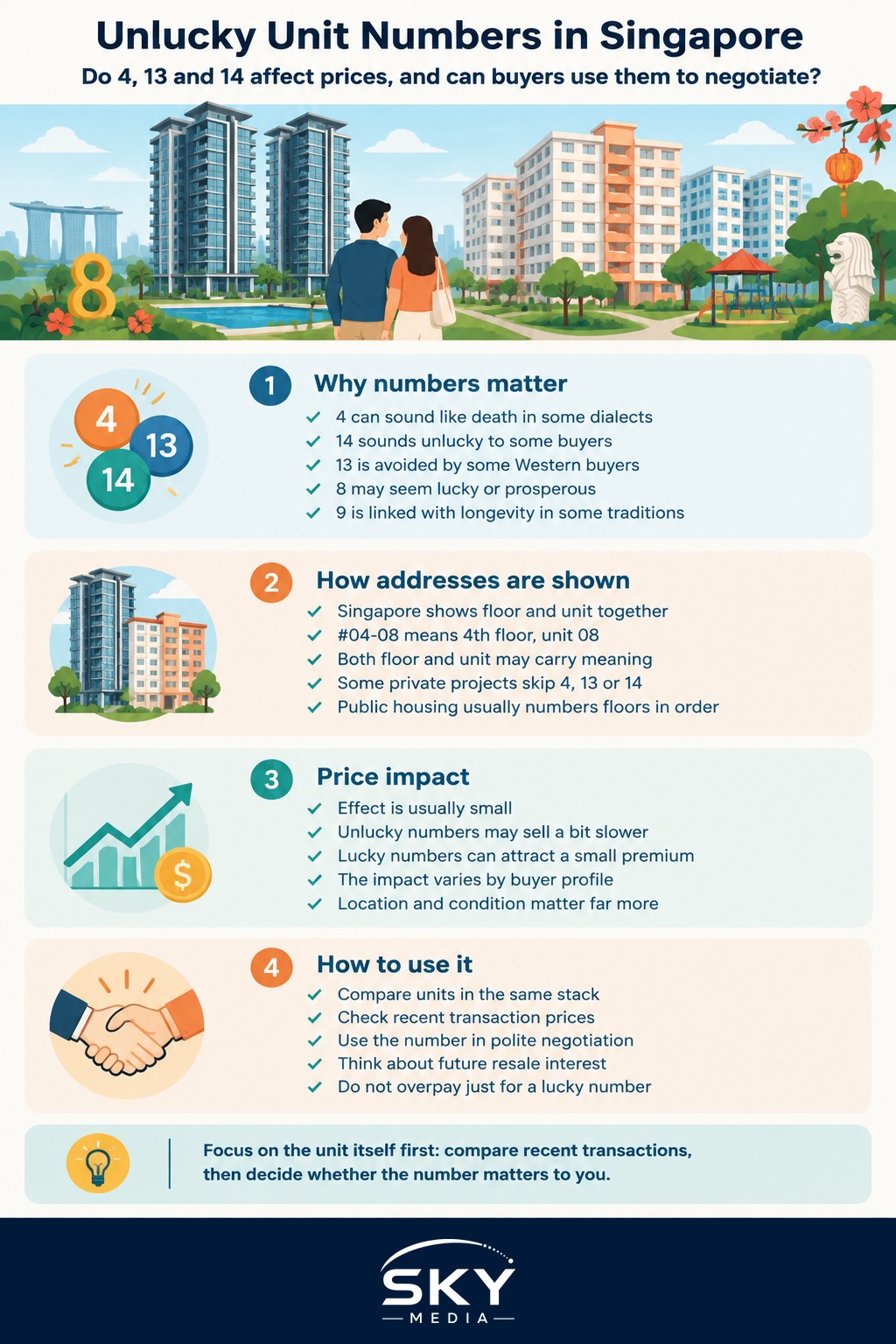
Why Some Numbers Are Considered Unlucky
Singapore is a multicultural city, and number beliefs come from several traditions. They are held by some people, not everyone, and the strength of belief varies a lot between families.
- 4: In Mandarin, Cantonese and several other Chinese dialects, “four” sounds similar to the word for “death”. Some buyers avoid units or floors with a 4 in them.
- 14: Can be read as sounding like “will die” in some dialects, so it is avoided by some.
- 13: Considered unlucky in many Western cultures, which matters to some expatriate buyers.
- Combinations: Numbers such as 24 or 44 can carry similar associations for some people.
On the other side, 8 sounds like “prosper” or “wealth” in Chinese, and units or floors with 8, 88 or 18 are sometimes seen as more desirable. 9 is linked with longevity in some traditions.
Understanding these associations matters even if you do not share them, because they can influence how many buyers are interested in a unit when you sell it later.
How Unit Numbers Work in Singapore Addresses
Singapore addresses usually show the floor and unit together. For example, unit #04-08 means the 4th floor, unit 08. Both parts can carry associations, so a buyer avoiding 4 might skip a whole floor, a whole stack, or just certain combinations.
Some private developments choose not to label floors 4, 13 or 14 at all, using numbers like “3A” or “12A” instead, or simply jumping from 12 to 15. The floors physically exist, they are just numbered differently. Public housing blocks generally number floors in sequence.
When comparing units, look at the actual storey height, not just the label. A unit marked as the 15th floor in a building that skipped two numbers may physically be on the 13th storey.
Do Unlucky Numbers Really Lower Prices?
The honest answer is: sometimes, a little, and much less than other factors.
Some academic studies using Singapore property transaction data have reported that units with “unlucky” numbers tend to sell at a small discount, while units with “lucky” numbers can command a small premium. The effect described is generally modest and varies by development, buyer profile and market conditions. In a quiet market, it can show up as a unit taking longer to sell rather than a clearly lower price.
What this means in practice:
- Location, size, floor height, facing and condition matter far more than a unit number.
- The effect depends on who is buying. In a development popular with buyers who hold these beliefs, it can be more noticeable. In one where most buyers do not care, it may barely register.
- It works both ways. If you buy at a discount, you may also sell at a discount later.
For a fuller picture of the main drivers, see our guide to what affects a property’s value.
Lucky vs Unlucky vs Neutral Units: What to Expect
| Unit type | Possible buyer reaction | Possible pricing effect | What to consider |
|---|---|---|---|
| Unit or floor with 4, 13 or 14 | Some buyers avoid it | May sell for slightly less or take longer to sell | A possible bargain if you do not mind, but expect the same when reselling |
| Unit or floor with 8 or 88 | Some buyers seek it out | May attract a small premium or faster interest | You may pay a little extra, so weigh it against the actual unit quality |
| Neutral number | Few strong reactions | Priced mainly on standard factors | Usually the simplest to compare with recent transactions |
How Buyers Can Use This to Their Advantage
If unit numbers do not bother you, you may find opportunities others pass over.
- Look at the whole stack. In some condos, a “4” floor or stack may have the same layout, view and facing as neighbouring units. Compare them side by side.
- Check recent transactions. Look up past sale prices for the development using official sources, such as the URA (Urban Redevelopment Authority) private property data or HDB resale price data, and see whether unlucky-numbered units sold differently.
- Use it in negotiation, politely. If a unit has been on the market for a while, a seller may be more flexible. Base your offer on comparable prices, not on the number alone.
- Think about your exit. If you plan to sell within a few years, consider how future buyers might see the unit, especially in a development that attracts buyers who care about these beliefs.
- Do not overpay for a lucky number. A premium for “8” only makes sense if the unit is otherwise good value.
Our guide on how to price your property for sale explains how sellers set asking prices, which helps when you negotiate from the other side.
Being a Considerate Buyer and Neighbour
Even if you do not share these beliefs, it helps to be respectful of them. Some neighbours, sellers or family members may feel strongly. Avoid dismissing someone’s preference, and if you are buying with relatives, talk it through early so the issue does not surface at the last minute.
You may also come across related practices, such as consulting a feng shui practitioner on layout or choosing an auspicious date to move in. These are personal choices and do not have to be followed.
Weighing It All Up
Unlucky numbers can nudge price and demand, but they rarely make or break a property decision. Focus on the fundamentals: location, transport, layout, condition, tenure and your budget. Treat the unit number as one small factor, and use it as a negotiating point if it does not concern you.
If you are a foreign buyer, remember that bigger costs such as stamp duties and financing rules will usually outweigh any discount from a unit number, so read up on how property cooling measures affect foreign buyers before you commit. Rules change, so always confirm current details with the relevant government agency.