

You have found the perfect unit: good footfall, fair rent, the right size. But it was an office, and you want to open a café. Or it was a shop, and you want to run a tuition centre, a gym or a clinic. Before you sign, you need to know whether the unit can legally be used for your trade.
In Singapore, how a property may be used is controlled by planning rules administered by the Urban Redevelopment Authority (URA). If your business would use a unit differently from its approved use, you may need a URA change of use approval, formally known as planning permission. This guide explains when that applies, how to check, and what else to line up. It is general information, not legal advice; always confirm with URA and the relevant agencies.
What “Approved Use” Means and Why It Matters
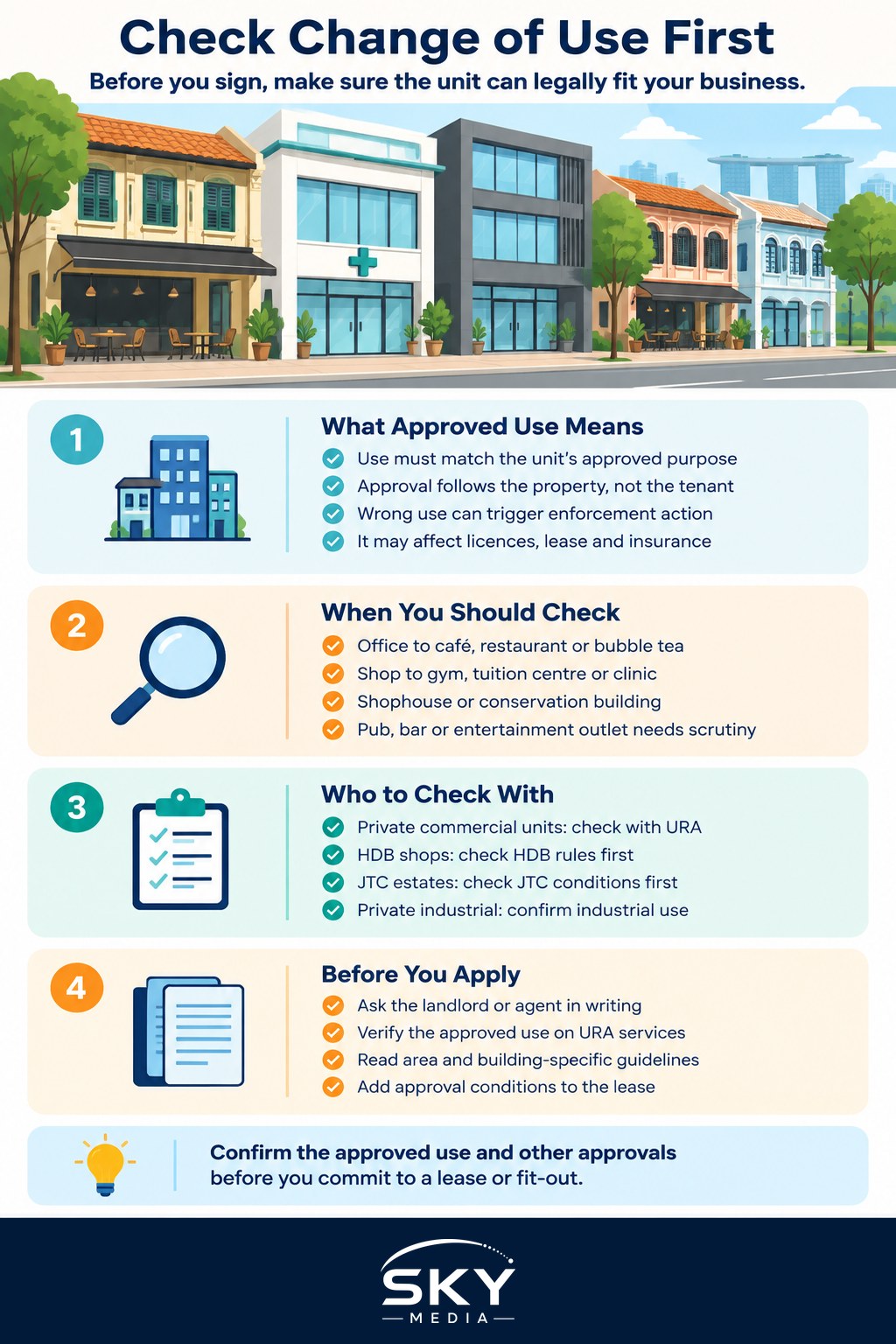
Every private property in Singapore has a use it is approved for under the planning system, such as office, shop, restaurant, industrial or residential. The approved use is tied to the unit, not to whoever happens to occupy it.
Using premises for something different without the necessary permission can lead to enforcement action by URA, and it can also cause problems with other licences, your lease and your insurance. Some changes are minor and may be allowed without a fresh application; others need full planning permission, and some may not be allowed at all at that location.
Planning decisions take into account things like:
- The zoning and planning intention for the area under the URA Master Plan.
- The impact on neighbours, such as noise, smells, traffic and parking.
- Whether the building and the specific unit are suitable for the proposed activity.
- Any specific guidelines for the area, such as conservation areas or particular streets.
If you want to understand the zoning side first, our guide on how to check the URA Master Plan shows how to look up a property’s zoning, and understanding urban planning and the URA explains the bigger picture.
Common Changes That May Need URA Approval
Not every change triggers an application, but these are typical situations where business owners should check carefully:
- Office to food and beverage, such as a café, bubble tea shop or restaurant.
- Shop to restaurant, especially with cooking on site, exhaust and grease traps.
- Shop or office to a gym, studio or fitness centre.
- Office or shop to a tuition or enrichment centre, childcare or student care centre.
- Shop or office to a medical or dental clinic, or a wellness or spa outlet.
- Using a shophouse or conservation building for a new trade.
- Running a pub, bar or entertainment outlet, which often attracts closer scrutiny.
The rules can differ depending on the building, the floor, and the area, so the same change may be allowed in one unit and not in another.
Who Controls What: URA, HDB and JTC
URA is not the only landlord authority, so first work out what kind of premises you are dealing with.
| Type of premises | Who generally controls the use | What to do |
|---|---|---|
| Private commercial buildings, shophouses, malls | URA (planning permission) | Check the approved use and apply to URA if needed |
| HDB shops and commercial units | HDB, under its own rules for HDB properties | Check the permitted trade with HDB before taking the unit |
| JTC industrial estates and buildings | JTC and its allocation conditions | Check with JTC, as uses are tied to the lease terms |
| Private industrial buildings | URA, with industrial use guidelines | Confirm the activity counts as an approved industrial use |
If you are in an HDB or JTC property, URA change of use may not be the main approval route. Check with the relevant agency first.
How to Check the Approved Use Before You Sign
The single most important step is to check before you commit to a lease or purchase.
- Ask the landlord or agent for the approved use in writing. A reputable landlord should know it, but do not rely on assumptions or what the previous tenant did.
- Verify through URA’s online services. URA provides e-services where you can look up the approved use of a property or make enquiries. Check the URA website for the current tools.
- Read the URA guidelines for the use you want, including any area-specific or building-specific rules.
- Talk to a professional where needed. For complex conversions, an architect or other qualified person can advise on whether the change is feasible and what submissions are involved.
- Write conditions into the lease. Ask whether the landlord will agree that the lease is subject to obtaining the necessary approvals, and who bears the cost if approval is refused.
Our commercial lease checklist covers other clauses worth negotiating before you sign.
Applying for Change of Use
If your intended use needs planning permission, an application is made to URA, usually through its online submission system. Depending on the type of change, the application may be made by the owner, or by a tenant with the owner’s consent, and some cases need a qualified person to prepare plans.
What to prepare in general:
- Details of the property and the proposed use.
- The owner’s authorisation if you are the tenant.
- Floor plans showing the layout and the area to be used.
- Any information URA asks for about operating hours, capacity or impact on neighbours.
URA may approve the application, approve it with conditions (for example, limits on operating hours or a time-limited permission), or reject it. Fees, processing times and requirements depend on the case and can change, so check the URA website for the current details rather than relying on what someone else paid.
Other Approvals You Will Likely Need
URA planning permission is about whether the use is allowed at that location. It does not replace other licences and approvals. Depending on your trade, you may also need to deal with:
- Singapore Food Agency (SFA) for food shop licences.
- Singapore Civil Defence Force (SCDF) for fire safety requirements, especially where renovations or changes to occupancy are involved.
- Building and Construction Authority (BCA) where structural or building works are needed.
- Ministry of Health, Ministry of Education, ECDA or the police, depending on whether you are running a clinic, education centre, childcare service or entertainment outlet.
- Your building’s management for house rules, renovation approvals and signage.
Plan the sequence carefully. Many businesses get planning permission first, then move on to renovations and trade licences.
Mistakes to Avoid
- Signing a long lease before confirming the approved use.
- Assuming that because the previous tenant ran a similar business, the use was approved.
- Starting renovations before approvals are in place.
- Underestimating time: build approvals into your opening timeline.
- Forgetting that approvals can come with conditions you must keep to.
A URA change of use check takes a little effort upfront, but it can save you from a costly fit-out in a unit you cannot legally use. Confirm the approved use, line up the right approvals, and only then commit.
Frequently Asked Questions
Can the landlord or previous tenant’s business tell me if my use is approved? Do not rely on that. Ask the landlord or agent for the approved use in writing and verify it through URA’s online services, because a previous tenant running a similar business does not prove the use was approved for that unit.
Can I make my lease conditional on getting change of use approval? You can ask. Write into the lease that it is subject to obtaining the necessary approvals, and agree who bears the cost if approval is refused. This avoids being stuck on a long lease for a unit you cannot legally use.
Do I need URA approval for a unit in an HDB shop or JTC building? URA may not be the main route. HDB controls the permitted trade for its shops under its own rules, and JTC ties uses to its lease conditions. Check with the relevant agency before taking the unit.
What other approvals come after URA planning permission for a cafe? Planning permission only covers whether the use is allowed at that location. A cafe may also need an SFA food shop licence, SCDF fire safety clearance, and BCA approval if there are structural works. Check the building’s management for house rules and signage.
Can URA approve a change of use with conditions? Yes. URA may approve, approve with conditions such as limits on operating hours or a time-limited permission, or reject. Fees, processing times and requirements vary by case, so check the URA website and build the approval time into your opening schedule.
Official sources: URA
Further reading: Shop Signage Approval in Singapore: What Needs a Permit