
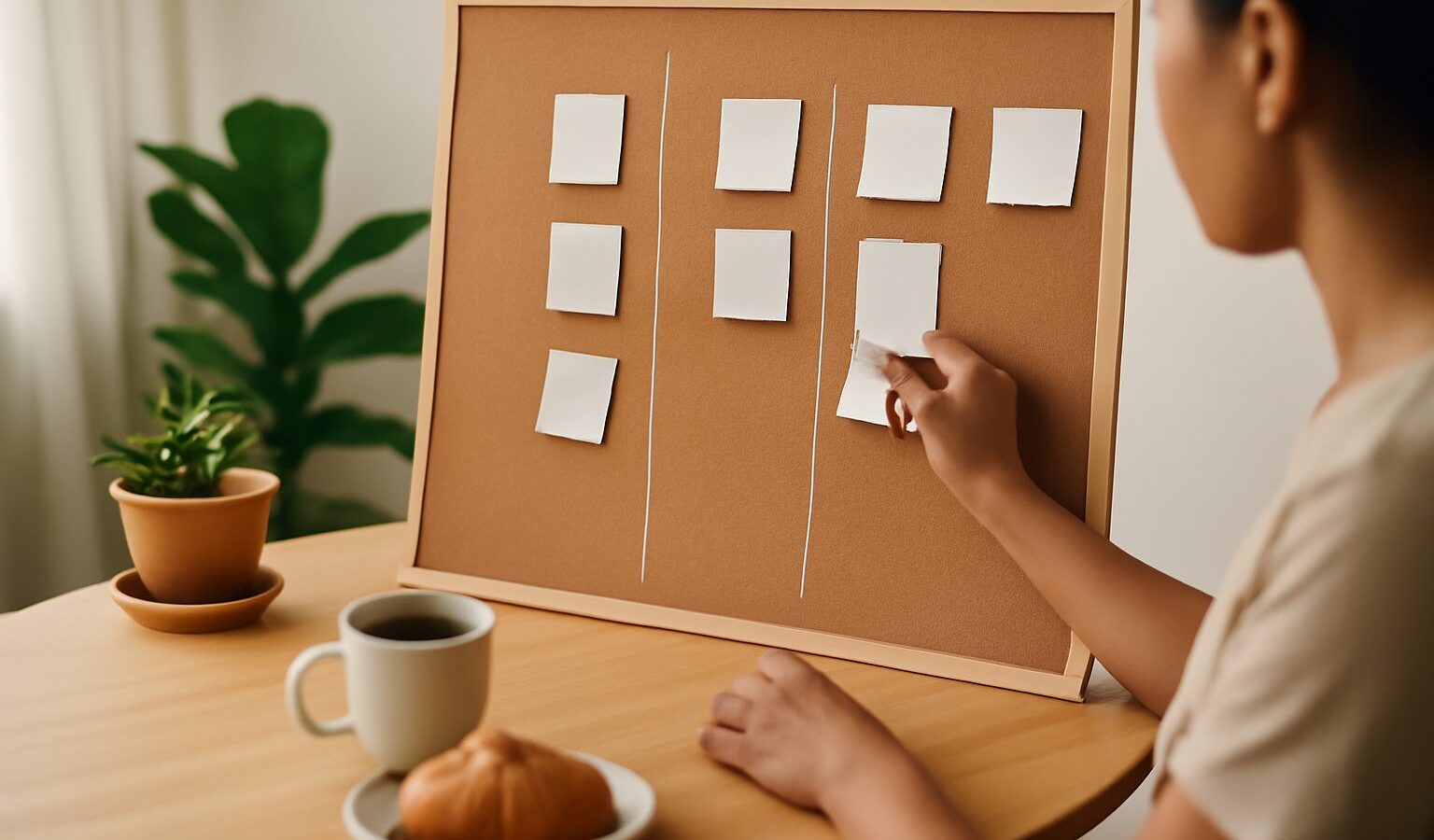
When everything you need to do lives only in your head, it feels far heavier than it is. Tasks blur together, the same worries circle back at 2am, and you can never quite tell whether you are making progress. A personal kanban board is a simple, visual fix for that fog. It takes the invisible pile of work in your mind and lays it out where you can see it, so you always know what is waiting, what you are on right now, and what is already done.
The idea comes from factory floors, where cards moved along a board to show the state of work. Stripped down for one person, it needs nothing more than a wall, a few sticky notes, or a free notes app. This guide explains how it works, how to set one up, and how to use it without it becoming another chore.
What A Personal Kanban Board Is
At its heart, a personal kanban board is a set of columns that a task moves through from left to right. The classic version has just three:
- To Do: everything you have committed to but have not started.
- Doing: the small number of things you are actively working on right now.
- Done: everything you have finished.
Each task is a card, a sticky note or a line, that starts in To Do and slides across to Done as you work. That is the entire concept. Its strength is that it makes two things visible that lists hide. First, it shows the flow of work, not just a static pile, so you can watch things actually move. Second, and this is the real secret, it lets you limit how much sits in Doing at once, which keeps you from scattering yourself across ten half-finished jobs.
How To Build Your Board
You can set one up in ten minutes, and it costs nothing.
- Choose your surface. A cupboard door with sticky notes, a cheap whiteboard, the back of your bedroom door, or a free app if you prefer your phone. Physical boards have a quiet advantage: you walk past them and cannot ignore them.
- Draw three columns. Label them To Do, Doing, and Done. Resist adding clever columns at the start; three is enough to learn on.
- Write one task per card. Keep each card small and concrete. “Plan holiday” is really several tasks; break it into “shortlist three places”, “check flight prices”, “ask leave dates”. Small cards move; big vague ones just sit there.
- Fill To Do, then pull into Doing. Put everything into To Do first to empty your head. Then pull only one or two cards into Doing to start on now.
- Move cards as you go. When a task is finished, physically slide it to Done. That small motion is oddly satisfying, and it is the whole reward system.
Why Limiting Work In Progress Matters
The single most important rule of personal kanban is the one people skip: cap how many cards can sit in Doing at any time. This is called a work in progress limit, and for one person a limit of two or three is usually right.
The reason is that starting is easy and finishing is hard. Without a cap, we keep pulling new tasks into Doing because beginning something feels productive. But every task left half-done takes up mental space and has to be picked up again later, which costs time and focus each time you switch. A pile of started-but-unfinished work is heavier than the same work done one piece at a time.
A work in progress limit forces a healthier rule: finish before you start. When your Doing column is full, you are not allowed to begin anything new until you move a card to Done. This nudges you to complete things, and completing things is what actually clears your plate and your mind. In an always-on messaging culture where interruptions constantly tempt you to start yet another thing, that little cap is a quiet act of self-defence.
Personal Kanban Next To Other Systems
It helps to see how a board differs from a plain list or a calendar, so you use each for what it does best.
| System | What it shows you | Where it shines |
|---|---|---|
| Personal kanban | The state and flow of every task | Seeing your whole workload move and limiting what is active |
| Plain to-do list | A flat pile of everything to do | Quickly capturing tasks out of your head |
| Calendar | Tasks fixed to clock times | Appointments and hard deadlines |
| Doing it all in your head | Nothing, until you forget something | Almost nothing; it just adds stress |
Most people are best off using more than one. A calendar holds your appointments, a quick list captures new tasks as they pop up, and the kanban board is where you decide what to actually work on and watch it move to Done. The board is the deciding and doing layer, not the storage layer.
Fitting A Board Into Singapore Life
A board only helps if it survives contact with a real, busy week, and small flats and long hours shape how you use it.
If you live in a compact HDB flat and do not want sticky notes on the wall, a phone app works just as well; the visibility matters more than the paper. That said, many people find a small physical board by the front door or desk harder to ignore than an app buried behind other icons.
Keep it to one board for everything, or two if work and home genuinely need separating. Splitting into five boards usually means you stop looking at any of them. Simpler survives.
Update it at natural moments rather than constantly. Moving a card or two when you sit down in the morning and again before you finish for the day is enough. On the commute home you might glance at your phone board and clear a Done card or two, so tomorrow starts tidy.
Do not aim for a perfect board. Some weeks it will fall out of date and the columns will drift from reality. That is normal, and a board takes weeks to become a genuine habit rather than days. When it drifts, spend two minutes tidying it rather than abandoning it.
Making The Habit Stick
A board fails when it becomes a museum of tasks nobody moves. A few small habits keep it alive.
Start each session by looking at Doing, not To Do. Ask whether those cards are still the right things to be on, finish or move them, and only then pull in something new. This keeps your focus on completing rather than accumulating.
Empty Done now and then, but not too soon. A full Done column at the end of a hard week is genuine evidence that you did move things forward, which is worth seeing before you clear it. On days you feel you achieved nothing, that column often quietly proves otherwise.
Keep your work in progress limit honest. If you notice five cards have crept into Doing, that is the signal to stop starting and finish something. The limit is not a rule for its own sake; it is the mechanism that turns a messy pile into steady, visible progress.
A personal kanban board will not make your workload smaller, and it does not pretend to. What it does is take the weight of holding everything in your head and put it somewhere you can see, so you spend your energy doing the work rather than worrying about forgetting it. Set up three columns today, cap what you keep active, and let watching cards slide to Done do the encouraging for you.
Explore more: decide which cards deserve your day with the 1-3-5 rule or the Ivy Lee method, protect focused time for your Doing column with timeboxing, and keep the board honest with a regular weekly review.