

Restaurants in Singapore fill up fast on 14 February, set menus tend to cost more than usual, and the roads and MRT are busy with everyone heading to the same few places. For many couples, a Valentine’s Day at home is the calmer choice. It is not a fallback. Done with a little planning, it can feel more personal than any booking, and it gives you something you can repeat and refine every year.
This guide focuses on the planning itself: how to agree on what you both want, how to split the work, and how to turn one evening into a small tradition that belongs to the two of you.
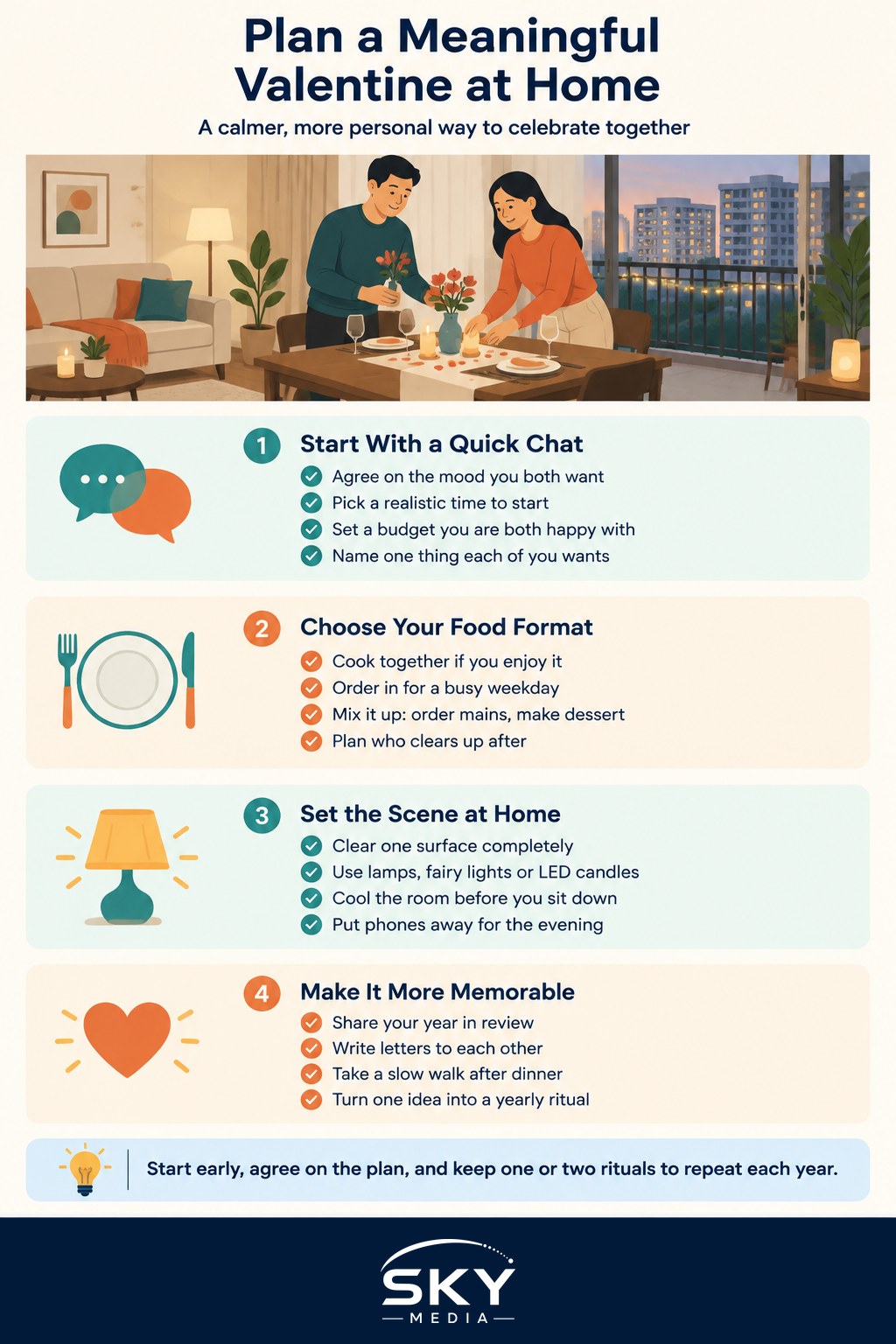
Start With a Short Conversation, Not a Surprise
The most common reason an at-home Valentine’s falls flat is mismatched expectations. One person imagines a candlelit three-course dinner, the other imagines takeaway on the sofa and a film. Neither is wrong, but the gap creates disappointment.
A week or so before, have a five-minute chat. Keep it light and cover:
- The energy you want. Cosy and quiet, playful, or dressed up and formal?
- Time available. Valentine’s Day often lands on a working day. Agree on a realistic start time, or move the main celebration to the nearest weekend.
- Budget. Staying in is not automatically cheap if you order premium food and flowers. Name a comfortable figure so nobody overspends to impress.
- One thing each of you wants. A specific dish, a song, no phones, a long walk afterwards. Write these down.
If you love surprises, you can still keep one element secret, such as a small gift or a handwritten note. The rest works better when you plan it together.
Choosing Your Format: Cook, Order or Mix
Food is usually the centre of the evening, and the choice you make shapes how much time you spend in the kitchen versus with each other.
| Approach | Best for | What to watch out for |
|---|---|---|
| Cook together from scratch | Couples who enjoy cooking as an activity | Pick a dish you have made before; a new recipe under pressure can cause stress |
| Order in from a favourite place | Busy weekday Valentine’s, small kitchens | Delivery platforms are busy that night, so order early or schedule ahead |
| Hybrid: order mains, make dessert | A personal touch without a long cleanup | Keep the homemade part simple, like a no-bake dessert or fruit plate |
| Recreate a meaningful meal | Couples with a “first date” dish or travel memory | Ingredients may need a supermarket or wet market trip a day earlier |
| Picnic indoors | HDB flats and studios with limited dining space | Lay a mat or throw on the floor and keep drinks in spill-proof cups |
Whatever you choose, plan the cleanup too. Agreeing that dishes wait until the next morning, or that one person cooks and the other washes up, removes a quiet source of friction.
Setting the Room Without Buying Much
You do not need a themed decoration kit. A few small changes signal that this evening is different from an ordinary night in:
- Clear one surface completely. Remove laptops, mail and the remote clutter from the dining table or coffee table.
- Change the lighting. Switch off the main ceiling light and use lamps, fairy lights or LED candles. LED candles are a safer choice in small flats and homes with children or pets.
- Control the temperature. Singapore evenings are warm. Turn the air conditioning or fan on a little earlier so the room is comfortable when you sit down.
- Make a playlist together. Each person adds five songs that mean something. It doubles as a conversation starter.
- Put phones away. A basket by the door works well. Agree on a time you will check them again, if needed.
If you share your home with parents, in-laws or children, which is common in Singapore, talk to them early. Many families are happy to give you the living room for a few hours, or you can set up in your bedroom or on a balcony.
Activities That Go Beyond Dinner and a Film
Dinner and a film is fine, but a small activity makes the evening more memorable. Choose one or two, not five:
- A “year in review” chat. Each person shares three good moments from the past year together and one thing they are looking forward to.
- Write letters to each other. Read them aloud or seal them to open next Valentine’s Day.
- Look through old photos. Scroll back to the same month in earlier years and talk about what has changed.
- Learn something together. A short online dance tutorial, a card game, a jigsaw puzzle or a simple craft.
- A slow walk afterwards. A stroll around your neighbourhood park connector or void deck in the cooler evening air can be a nice close.
For couples who also mark Qixi, the Chinese Valentine’s Day that falls in the seventh lunar month, you can borrow ideas from one celebration for the other. Our guide to Qixi in Singapore explains the story and how people celebrate it locally.
Turning One Evening Into a Yearly Tradition
The real advantage of a Valentine’s Day at home is that you can repeat it. Over time, the small rituals become the point.
Some ideas that build year on year:
- A recurring dish. Cook the same meal every year and note how your skills improve.
- A shared journal. Keep one notebook just for Valentine’s Day. Each year, write a page together.
- An annual photo. Take a picture in the same spot of your home. Watching your homes and faces change is surprisingly moving.
- A time capsule note. Write down predictions for the year ahead and read last year’s.
- A small budget envelope. Set aside the money you would have spent eating out and put it towards a trip or experience later in the year.
If you have recently moved in together or held a home solemnisation, these rituals can grow alongside other milestones. Couples planning a small ceremony in their own space may find our guide to solemnisation at home in Singapore useful.
Handling Common Hiccups
Even the best plans meet real life. A few practical safeguards:
- Overtime at work. Agree on a backup date, such as the following Saturday, so a late meeting does not ruin everything.
- Different love languages. One partner may value words, the other gifts or acts of service. Include a small something for each.
- Children at home. Feed them early, plan a quiet activity for them, or move your celebration to after bedtime. Some families include children in an early “family Valentine’s” dessert, then keep the late evening for the couple.
- Feeling the pressure of social media. Your evening does not need to be photographed or posted. If sharing is fun for you, great. If it adds stress, skip it.
- Tight budget. Meaning comes from attention, not price. A handwritten card and a well-cooked simple meal often land better than an expensive gift.
A Simple Planning Timeline
To keep it calm, spread the tasks out:
- One week before: have your expectations chat, choose the format and confirm with anyone you live with.
- Three days before: order anything that needs delivery, such as flowers, groceries or decorations.
- The day before: shop for fresh ingredients, prep sauces or desserts, and chill drinks.
- On the day: set the room an hour before, start the playlist and put phones away.
If you tend to overthink the details, our tips on planning your day without overthinking it apply nicely here too: decide the few things that matter, and let the rest be flexible.
A thoughtful Valentine’s Day at home is less about perfection and more about intention. Talk early, keep the plan simple, and pick one or two rituals you will both look forward to repeating. Next February, you will already have a tradition to build on.
Further reading: Valentine’s Day Gift Ideas in Singapore Beyond Flowers