
Packing up a home in the mainland for a fresh start in Singapore forces a hundred small decisions. Do you ship the sofa? Bring the rice cooker? Pay to freight boxes of winter coats you may never wear again? Working out what to bring moving from China is really about being honest with yourself: what will genuinely serve you in a hot, compact, well-supplied city, and what is just heavy sentiment. This guide sorts the keep pile from the leave pile so you spend your shipping budget wisely.
The guiding principle is simple. Singapore is a modern, high-supply city where almost anything is available to buy. So the question for each item is not only can I bring it, but is it worth the cost and hassle when I could replace it easily here.
The Electrical Reality: Plugs And Voltage
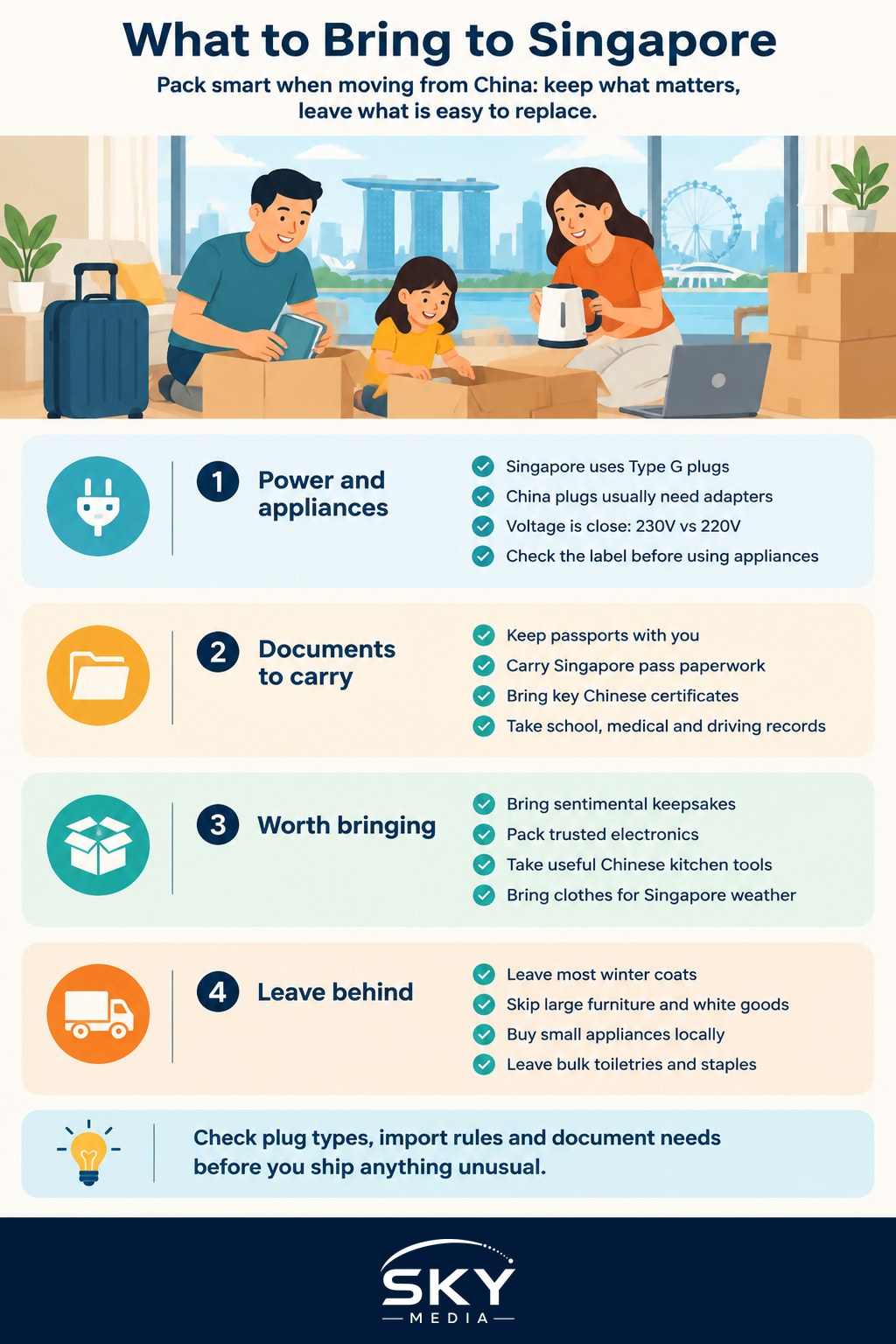
This is the detail that trips up the most newcomers, so it comes first. Singapore uses the Type G plug, the large three-rectangular-pin design, the same as the United Kingdom. Mainland China mostly uses Type A and Type I plugs, which are shaped completely differently and will not fit a Singapore socket.
Voltage is friendlier. Singapore runs on roughly 230V at 50Hz, and mainland China runs on 220V at 50Hz. These are close enough that most Chinese appliances will operate here electrically. That means your challenge is usually the plug shape, not the voltage. For many small devices, a simple plug adapter is enough, though for anything you use daily, buying a version with a local plug is tidier and safer than living off adapters.
A few cautions:
- Check each appliance’s label. If it says 220V to 240V, it will handle Singapore’s supply; if it is strictly 220V only, be more careful.
- Large or fixed appliances such as fridges, washing machines, and air-conditioners are rarely worth shipping. They are bulky, expensive to freight, and easy to buy locally with the right plug and warranty.
- High-heat items such as certain kettles and hairdryers are cheap to replace here, so leave the bulky ones behind.
Documents And Essentials That Should Travel With You
Some things are simply too important to ship in a slow sea container. Keep these in your hand luggage or a personal folder that never leaves your side:
- Passports and any Singapore pass or in-principle approval paperwork.
- Official Chinese documents you may need, such as birth, marriage, and academic certificates, along with any notarised or translated copies.
- Your children’s school records and vaccination or health records.
- Driving licence and any supporting translation, if you plan to convert it.
- A modest set of important financial and identity documents, kept secure.
Because requirements for documents, certification, and translation depend on your situation, confirm what you will need with the relevant Singapore body, such as ICA for immigration matters, and with the Chinese Embassy for anything involving Chinese consular or document certification. Carrying the originals with you avoids a painful wait if a container is delayed.
What Is Usually Worth Bringing
Beyond documents, a sensible keep pile tends to include items that are personal, hard to replace, or genuinely better from home:
- Sentimental and irreplaceable belongings, from photos to a grandparent’s keepsake.
- Compact, high-value items you already own and trust, such as a good laptop or camera, subject to the plug point above.
- Specific Chinese kitchen tools or specialty items you love and might struggle to find, though many are available here.
- Clothing suited to Singapore’s climate, plus one light layer for fiercely air-conditioned offices and malls.
- Any prescription medicines you rely on, after checking they are permitted, since some items allowed in China are controlled here.
Do check import rules before you pack anything unusual. Certain foods, medicines, and products are restricted or controlled, so confirm with Singapore Customs and the relevant authorities rather than assuming.
What Is Usually Better Left Behind
Just as useful is knowing what to let go. This table weighs common categories so you can pack lighter and smarter.
| Item category | Bring or leave | Why |
|---|---|---|
| Winter coats and heavy knits | Leave most | Singapore is hot year round |
| Large furniture and white goods | Leave, buy here | Bulky, costly to ship, easy to replace |
| Everyday small appliances | Mostly leave | Cheap locally, avoids plug and voltage fuss |
| Documents and keepsakes | Bring | Irreplaceable, needed for setting up life |
| Trusted electronics | Bring | High value, just add a plug adapter |
| Bulk toiletries and staples | Leave | Widely available, not worth the weight |
The table is a general guide, not a strict rule, since your budget, family size, and attachment to particular things all matter. Use it to challenge each box before it goes on the ship.
Shipping Smart Versus Buying Fresh
Once you know what stays and what goes, decide how the keep pile travels. Air freight is fast but costly and suited to small, urgent items. Sea freight is far cheaper for volume but slow, so anything you ship by sea should be stuff you can live without for weeks. For many newcomers, the cheapest overall move is to bring only what is personal or high-value and buy the rest after arriving, once you have seen your actual flat and its dimensions.
A short checklist before you commit to a shipping quote:
- Measure your likely space, since a compact flat may not fit mainland-sized furniture anyway.
- Compare the shipping cost of any large item against simply buying it locally.
- Insure valuable shipments and keep an inventory.
- Confirm customs rules for your contents before the container is sealed.
Moving well is less about carrying your old life across the sea and more about choosing which pieces of it truly deserve the journey. Travel lighter than instinct suggests, and Singapore will fill in the rest. For anything involving customs, restricted items, or documents, rely on the current guidance from Singapore Customs, ICA, and the Chinese Embassy rather than this general overview alone.
Explore More
Getting the packing right is only one piece of a good move. To line up your arrival with your family’s calendar, read our guide to timing your move around the school year. And before you consider freighting the family car, see our honest take on shipping your car from China to Singapore.
Frequently Asked Questions
Can I bring Chinese food and herbal medicine into Singapore? Some can be brought in, but certain foods, medicines and products are restricted or controlled. Check Singapore Customs and the Singapore Food Agency before you pack anything unusual, and keep prescription medicines in original packaging with a doctor’s note. Leave doubtful items at home.
Will my Chinese phone work in Singapore? Most modern unlocked phones work with a local SIM, so you can usually switch over after arrival. Check that your phone is not locked to a mainland carrier and supports the local network bands. If unsure, ask the phone maker or a local telco before you fly.
How early should I ship my belongings before I arrive? Sea freight is slow, so send things you can live without for several weeks, and time the shipment to your housing plans. You may need somewhere to receive the boxes. Ask your freight company about transit time and any storage while you settle.
Do I need to declare items when I arrive at Singapore’s airport? You must declare goods that are dutiable, controlled or prohibited, and it is best to check the rules before travelling. Carrying items you did not declare can lead to penalties. Singapore Customs publishes the current guidance on what is allowed and what must be declared.
What should I bring for my children when moving? Prioritise school and health records, a few favourite books and comfort items, and clothes suited to hot weather. Bulky toys and furniture are easy to replace here. If your child learns Chinese, a few good books can help keep the language going.
Further reading: Sea Freight vs Air Freight When Moving to Singapore · Moving to Singapore From the Middle East · Is Singapore Right for You? Pros and Cons