

It can be a surprise the first time: a large, bristly animal trotting across a park connector, rooting in the grass verge outside an HDB block or crossing a road at dusk. Wild boars are native to Singapore and their numbers have grown in areas near forest and greenery, so encounters are more common than many residents expect. If you are wondering about wild boar Singapore what to do, the short answer is to stay calm, keep your distance and let the animal move on. This guide explains why, how to behave in different situations and when to report a sighting.
For dog owners, we have a separate guide on what to do if your dog meets a wild boar, snake or monkey. This article is for everyone else: walkers, cyclists, drivers, parents and residents.
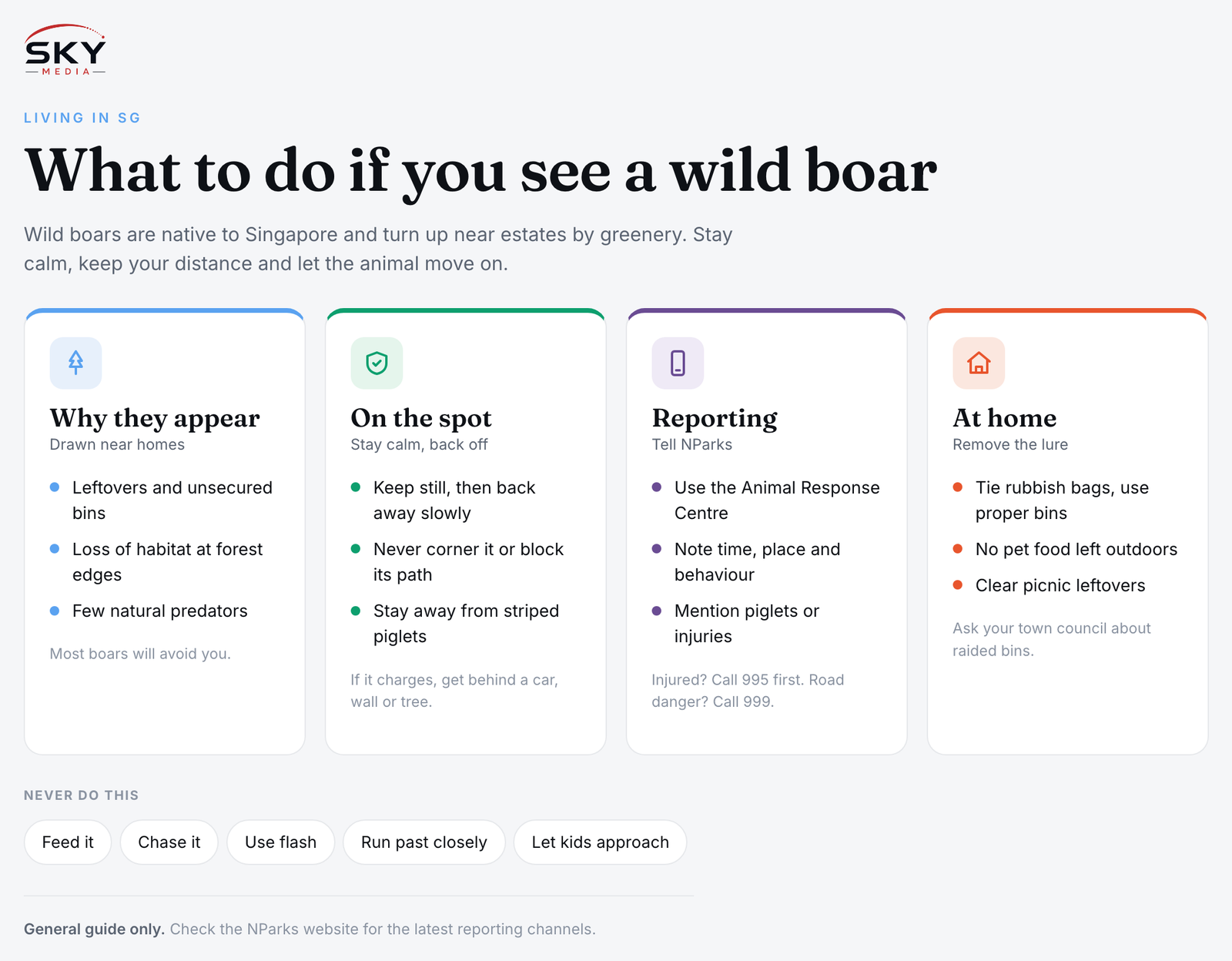
Why Wild Boars Turn Up Near Homes
Wild boars live in forested and scrubby areas, but they range widely in search of food. Residential estates, parks and construction sites next to greenery can bring them close to people. They are commonly reported around places bordering nature areas, including parts of the north and north-east, the western fringes and offshore islands such as Pulau Ubin.
Several things draw them closer:
- Food from people. Leftovers, unsecured bins and deliberate feeding teach boars to associate humans with food.
- Loss of habitat. Development near forest edges pushes animals into new spaces.
- Few natural predators. Without large predators, boar populations can grow if left unmanaged.
Most of the time a wild boar will avoid you. Problems tend to occur when an animal feels cornered, is protecting young, has been fed by people and become bold, or is startled at close range.
How to Behave When You See a Wild Boar
Wild boars are strong, fast and have sharp tusks. Treat any encounter with respect.
- Stay calm and keep still at first. Sudden movement can startle the animal.
- Keep a wide distance. Do not approach for a closer look or a photo. Use your phone’s zoom if you must take a picture, and switch off the flash.
- Back away slowly. Move away without turning and running, and give the boar a clear escape route.
- Do not corner it. Never block its path or stand between it and the forest edge.
- Stay away from piglets. Striped young boars mean a protective mother is nearby, even if you cannot see her.
- Do not feed it or leave food out. Feeding wildlife makes them bolder and is an offence under Singapore’s wildlife laws.
- Keep children close. Hold hands and calmly lead them away.
If a boar charges or acts aggressively, move behind a solid barrier such as a car, a wall or a tree, or climb onto something raised if you safely can. Do not provoke it or throw things at it.
Common Situations and the Right Response
The right response depends on where you meet the animal. This table covers the scenarios residents most often face.
| Situation | Do | Don’t |
|---|---|---|
| Walking or jogging on a park connector | Slow down, give it space, take another route if needed | Run past it closely or try to shoo it away |
| Boar near your HDB block or void deck | Keep away, warn neighbours, report if it lingers | Feed it, film it up close or let children approach |
| Driving at night near forest edges | Slow down, use low beam, stop and wait if it crosses | Honk repeatedly or swerve dangerously |
| Cycling on a trail | Stop, dismount and wait at a distance | Ride past at speed or ring the bell aggressively |
| Mother with piglets | Leave the area calmly and quickly | Linger, approach or try to touch the young |
Reporting a Sighting to NParks
The National Parks Board (NParks) is the agency responsible for managing wildlife issues in Singapore. You can report wild boar sightings, especially if the animal is behaving aggressively, lingering in a residential area, injured or causing a traffic hazard.
To report:
- Contact NParks through its Animal Response Centre, using the hotline or online feedback form listed on the NParks website.
- Note the time, exact location (block number, road name or nearest landmark) and what the animal is doing.
- Mention if piglets are present or if anyone has been hurt.
- Take a photo from a safe distance only if it is easy to do so.
If someone has been injured, call 995 for an ambulance first. If a boar is causing an immediate danger on a busy road, contact the police on 999. Report to NParks afterwards so the agency can follow up.
You do not need to report every brief sighting of a boar moving through greenery. Reports are most useful when an animal is in a populated area, behaving unusually or appears repeatedly in the same place.
Keeping Your Neighbourhood Boar-Friendly and Safe
Residents can reduce encounters by removing the things that attract wild boars.
- Secure your rubbish. Tie bags tightly and dispose of them in proper bins or chutes, not at the foot of the block.
- Do not leave pet food outdoors. Food for community cats can also draw boars.
- Clear picnic leftovers. After eating in parks, take all food waste with you.
- Speak to your town council. If bins or bin centres are regularly raided, your town council can look at better covers or collection.
- Discourage feeding. If you see someone feeding wild boars, you can let them know politely that it puts people at risk, or report it to NParks.
Gated estates and condos can also ask their managing agent to check fence gaps near green spaces and remind residents about food waste.
Respecting Wildlife in a Garden City
Encounters with wild boars are part of living in a city that values its forests and nature reserves. Singapore also has otters, hornbills, monkeys and monitor lizards that share the same green spaces. The same principles apply to all of them: watch from a distance, never feed, keep pets on a leash and let the animal go its own way. If you enjoy spotting wildlife, our guide to seeing otters in Singapore responsibly and the guide to the best places to see hornbills follow the same respectful approach.
Wild boars are not out to get anyone, but they are wild animals that deserve space. A calm reaction, a clear exit for the animal and a timely report to NParks keep both people and boars safe.
Frequently Asked Questions
Are wild boars in Singapore dangerous? They are strong, fast and have sharp tusks, but most will avoid people. Problems tend to arise when a boar is cornered, protecting piglets, startled at close range or has been fed. Keep your distance and let it move on.
What should I do if a wild boar charges at me? Move behind a solid barrier such as a car, wall or tree, or climb onto something raised if you can do so safely. Do not provoke it or throw things. Once it is clear, report the incident to NParks.
What should I do if I see a wild boar while driving at night? Slow down, use low beam and stop to let it cross. Do not honk repeatedly or swerve dangerously, since that can cause a worse accident. If it is a hazard on a busy road, contact the police.
Why are there striped baby boars and should I go closer? Do not. Striped young boars mean a protective mother is probably nearby, even if you cannot see her. Leave the area calmly and quickly, and never try to touch or photograph the piglets from close range.
What details should I give NParks when I report a wild boar? Give the time, exact location such as block number, road name or nearest landmark, and what the animal is doing. Mention piglets or injuries. Take a photo only from a safe distance and only if it is easy to do.
Official sources: National Parks Board (NParks)
Further reading: What to Do If a Bat Flies Into Your Flat