

Making a will in Singapore is one of those tasks that is easy to postpone and quietly important to finish. Estate planning is not only for the wealthy or the elderly; it is simply the act of deciding who receives what you leave behind, and who will look after those who depend on you, so that others are not left guessing during an already painful time. This guide explains, in plain terms, why a will matters, what happens without one, how CPF savings are handled separately, and the other documents that round out a sensible plan. It is general information, not legal advice, so please confirm the details with the official bodies and a qualified lawyer.
Why a will matters
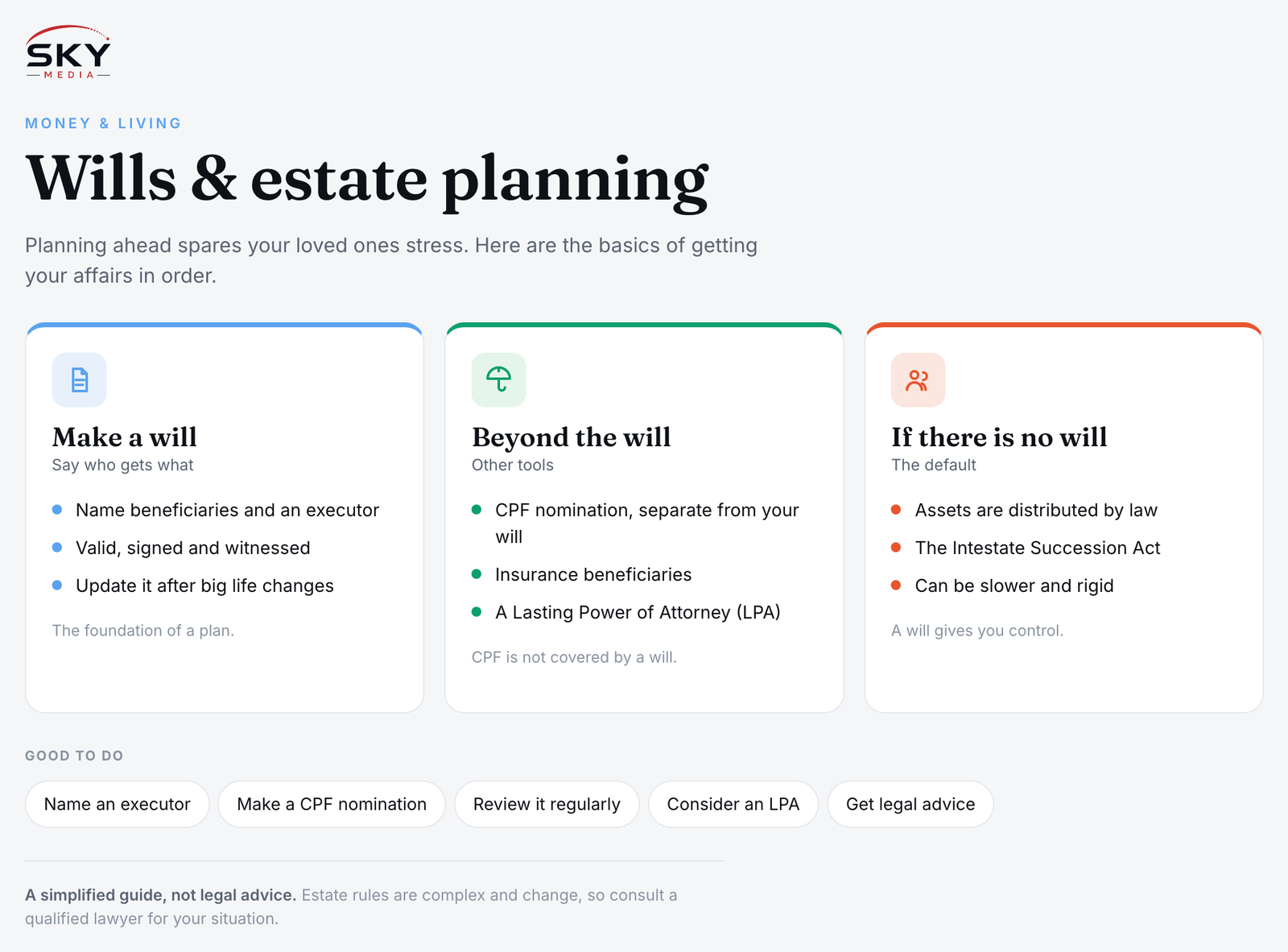
A will is a legal document that sets out how you want your assets distributed after you die and who you appoint to carry out those wishes. Without one, the law decides for you, and the process can be slower and more stressful for the people you leave behind. A clear, valid will lets you:
- Decide who inherits your property, savings and belongings.
- Name guardians for young children.
- Appoint an executor you trust to handle your affairs.
- Reduce the chance of disputes among family members.
Putting your wishes in writing is, in the end, a kindness to the people you care about.
What happens without a will
If you die without a valid will, you are said to die intestate, and your estate is distributed according to fixed legal rules rather than your personal wishes. In Singapore, the Intestate Succession Act sets out how assets are shared among surviving family members, such as a spouse, children and parents, in defined proportions. That may or may not reflect what you would have wanted, and it gives you no say over guardianship or specific gifts. The process can also take longer, since someone must apply to administer the estate under the default rules. Writing a will is how you replace that one-size-fits-all outcome with your own intentions.
CPF savings are handled separately
This is the single most important point many people miss: your CPF savings are not covered by your will. CPF monies are distributed through a separate process called CPF nomination. If you make a CPF nomination, your CPF savings go to the people you name, in the shares you choose, usually more quickly and directly. If you do not make a nomination, your CPF is transferred to the Public Trustee for distribution under the intestacy laws, which takes time and may involve a fee.
Make a CPF nomination and write a will. They are two different instruments covering two different pools of assets, and you need both for a complete plan.
For the current nomination process and rules, check directly with the CPF Board.
The basics of a valid will
A will only does its job if it is legally valid. While you should get proper guidance, the general requirements include:
- In writing. The will must be a written document.
- Mental capacity. You must be of sound mind and generally at least 21 years old.
- Signed and witnessed. You sign the will, and it is witnessed by two people who are present at the same time. Importantly, a witness, and their spouse, should not be a beneficiary, or that gift may fail.
- An executor. You name someone to administer your estate and carry out the will.
Keep the signed original somewhere safe and make sure your executor knows where to find it. Review the will after major life events such as marriage, divorce, a new child, buying property or a significant change in assets, since these can affect or even revoke earlier arrangements.
Choosing executors and guardians
Two roles deserve careful thought. Your executor handles the practical work of settling your estate: gathering assets, paying debts and distributing what remains. Choose someone organised, trustworthy and willing to take it on. Your choice of guardian matters enormously if you have young children, since this is the person who would care for them. Have the conversation with your intended guardian in advance rather than assuming they will agree.
Quick estate-planning checklist
- Write a valid will and store the original safely.
- Make a CPF nomination through the CPF Board.
- Name an executor, and a backup.
- Appoint guardians if you have young children.
- Consider a Lasting Power of Attorney (see below).
- Review everything after any major life change.
The Lasting Power of Attorney
Estate planning is not only about death; it is also about protecting yourself while you are alive. A Lasting Power of Attorney (LPA) lets you appoint someone you trust to make decisions on your behalf, covering your welfare and your finances, if you ever lose mental capacity, for example through illness or an accident. Setting up an LPA while you are well spares your family a difficult and costly court process later. The scheme is administered through the Office of the Public Guardian under the Ministry of Law, and that is the place to confirm the current process and any fees.
How insurance and property fit in
A complete plan looks at the whole picture. Life insurance can provide for your dependants and, if you own a home with a mortgage, help clear the outstanding loan so your family keeps the roof over their heads. Jointly held property and named beneficiaries on certain policies may pass outside your will, so it is worth understanding how each of your major assets would be handled. Mapping this out once, and keeping a simple list of your accounts, policies and important documents, makes everything easier for the people who will one day need it.
Getting it done
None of this needs to be overwhelming. For straightforward situations, a will can be arranged without great cost, and making a CPF nomination and an LPA are well-defined processes. For anything more complex, blended families, business interests, overseas assets, it is wise to consult a qualified lawyer who can tailor the arrangements to your circumstances. Because the rules here carry real legal weight and can change, treat this guide as a starting map and confirm the specifics with the CPF Board, the Office of the Public Guardian, and a professional. The peace of mind that comes from having it all in order is well worth an afternoon of effort.
Explore more: CPF explained, Getting married in Singapore, Having a baby in Singapore