

If you are married, planning a wedding or going through a separation in Singapore, you will hear the Women’s Charter mentioned often. Despite the name, most of it protects everyone in a family, including husbands and children. This plain-language guide to the Women’s Charter in Singapore explains what the law covers, how it affects marriage, maintenance, family violence, divorce and property, and where to turn for proper advice.
This is general information, not legal advice. Laws are amended from time to time, so confirm the current position with the Family Justice Courts, the Ministry of Social and Family Development (MSF) or a family lawyer before acting.
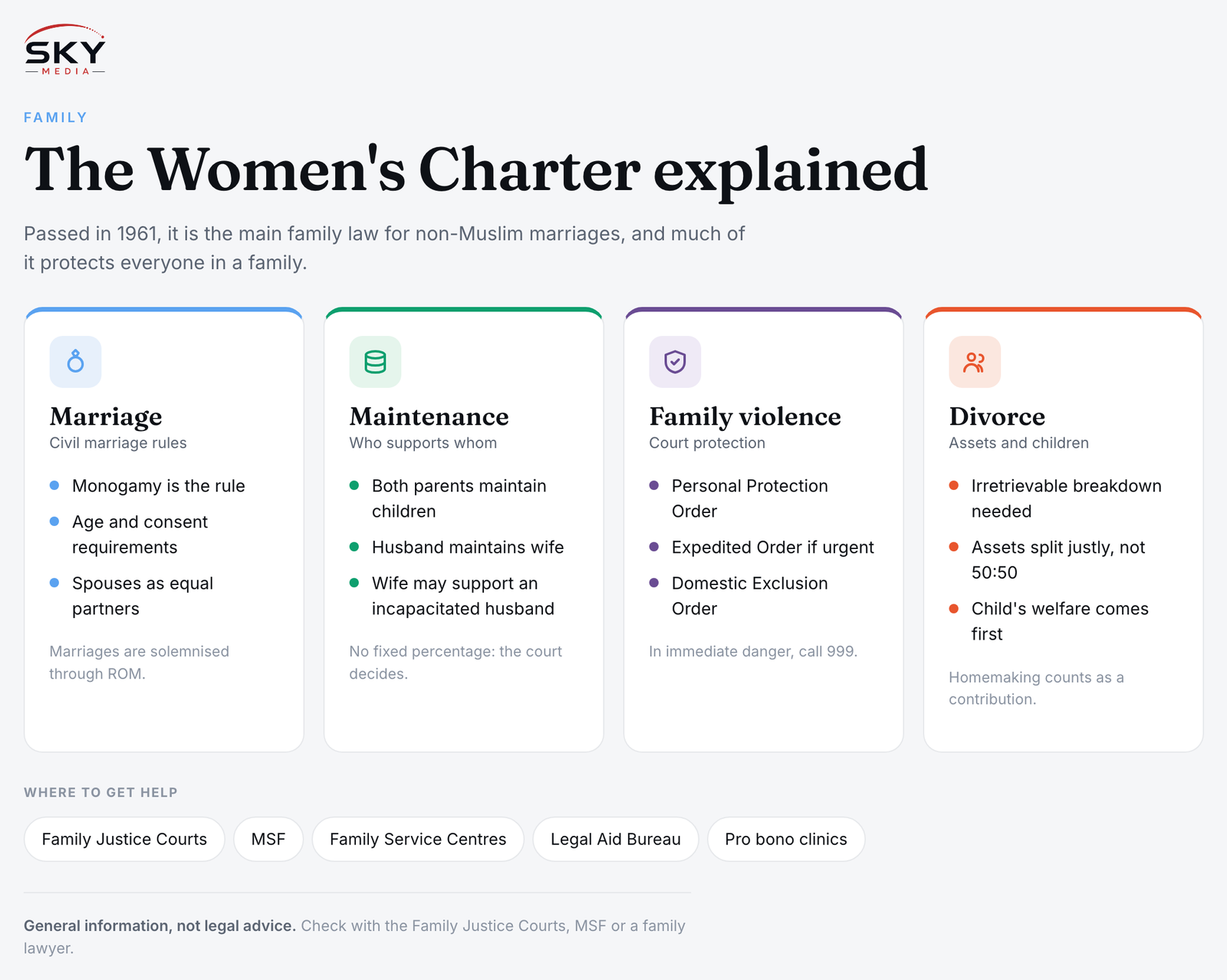
What the Women’s Charter Is and Why It Matters
The Women’s Charter was passed in 1961, a few years before independence. At the time, it was a landmark: it made monogamy the rule for civil marriages, gave married women legal standing to own property and run businesses in their own name, and set out duties to maintain wives and children.
Today the Charter is the main family law statute for non-Muslim marriages in Singapore. It covers:
- Who can marry and how a marriage is solemnised and registered.
- Duties of maintenance between spouses and towards children.
- Protection from family violence.
- Divorce, judicial separation and nullity.
- Division of matrimonial assets after divorce.
- Custody, care and access arrangements for children.
- Offences relating to the protection of women and girls.
Muslim marriages and divorces are mainly governed by a separate law, the Administration of Muslim Law Act (AMLA), with matters heard by the Syariah Court. Some parts of the Women’s Charter, such as protection against family violence and certain child-related matters, still apply to everyone. If your marriage is under Muslim law, check which rules apply to your situation.
Marriage Under the Charter
For civil marriages, the Charter sets out the basic rules. Marriages are solemnised and registered through the Registry of Marriages (ROM). Key points include:
- Monogamy: a person in an existing marriage cannot validly marry someone else under civil law.
- Minimum age and consent: there are age requirements, and younger couples need parental consent and approval. ROM explains the current rules.
- Prohibited relationships: marriages between close relatives are not allowed.
- Equal partnership: the Charter describes husband and wife as equal partners with a shared duty to care for the household and children.
Couples where one or both partners are foreigners follow the same ROM process, though they may need extra documents. If you are on a Dependant’s Pass or planning to sponsor a spouse, check the immigration side separately with ICA or MOM.
Maintenance: Who Must Support Whom
Maintenance is money paid to support a spouse or child. The Charter sets out these duties broadly:
- Children: both parents have a duty to maintain their children, whether or not the parents are married or living together.
- Wives: a husband has a duty to maintain his wife during the marriage and, in some cases, after divorce.
- Incapacitated husbands: a wife may be ordered to maintain a husband who cannot support himself because of illness or disability.
If someone fails to pay, the other party can apply to the Family Justice Courts for a maintenance order. Orders that are not followed can be enforced through the courts, and there is a government-supported route to help with recovery of unpaid maintenance; check the Family Justice Courts and MSF websites for current processes.
How much is ordered depends on the financial needs of the person being supported, the payer’s income and resources, the standard of living during the marriage, and other factors the court considers relevant. There is no fixed percentage.
Protection From Family Violence
One of the Charter’s most important functions is protecting family members from violence. A family member who has suffered or is at risk of family violence can apply to the Family Justice Courts for a Personal Protection Order (PPO), which restrains the other person from committing family violence. Related orders include:
- Expedited Order: an urgent, short-term order where there is imminent danger, granted before the full hearing.
- Domestic Exclusion Order: can exclude the person from the shared home or parts of it.
- Counselling orders: the court may direct parties or children to attend counselling.
Family violence is defined broadly and can include physical harm, wrongful confinement, continual harassment, and certain forms of emotional or psychological abuse. Recent amendments have widened the protections and support available, so check the latest guidance on the MSF and Family Justice Courts websites.
If you or someone you know is in immediate danger, call the police on 999. MSF’s family violence helplines and Family Service Centres can also help with safety planning and applications.
Divorce, Assets and Children
Divorce is a big part of the Charter, and a few key ideas help you understand the process.
| Topic | What the Charter says in brief | Where to check details |
|---|---|---|
| Ground for divorce | The marriage has broken down irretrievably, shown by one of the facts set out in law | Family Justice Courts |
| Time married | Generally you must be married for a minimum period before filing, unless the court allows an exception | Family Justice Courts |
| Matrimonial assets | Divided in a way the court considers just and equitable, considering financial and non-financial contributions | A family lawyer |
| Children | The child’s welfare is the paramount consideration in custody, care and access | Family Justice Courts, MSF |
| Parenting programme | Parents with young children may need to complete a co-parenting programme before filing | MSF |
The recognised facts for irretrievable breakdown include adultery, unreasonable behaviour, desertion and periods of separation. Divorce by mutual agreement has also been added as a route for couples who both agree the marriage has broken down. Each fact has its own requirements, which a lawyer can explain.
Matrimonial assets usually include the matrimonial home, often an HDB flat, and other assets acquired during the marriage. The court looks at direct financial contributions and indirect contributions such as caring for the family and home. This recognition of homemakers’ contributions is one reason the Charter is seen as protective of women who leave paid work to raise children.
Children’s arrangements cover custody (major decisions), care and control (who the child lives with day to day) and access (time with the other parent). Courts encourage parents to agree on these where possible, and mediation and counselling are part of the process.
Our overview of divorce in Singapore for newcomers walks through the steps, and if you hold a pass linked to your spouse, read what happens to your Dependant’s Pass after a divorce.
Common Misunderstandings
- “It only protects women.” Many provisions, including maintenance for children and family violence protection, apply regardless of gender.
- “Assets are always split 50:50.” There is no automatic split; the court weighs each case.
- “A PPO is a criminal conviction.” A PPO is a civil court order, though breaching it is an offence.
- “Foreigners are not covered.” If you married in Singapore or live here, the Charter may apply to you; check with a lawyer on jurisdiction.
Where to Get Help
- Family Justice Courts: information on applications, forms and processes, including guidance for people without lawyers.
- MSF and Family Service Centres: support for families in difficulty, family violence assistance and counselling.
- Legal Aid Bureau: legal help for eligible residents with limited means.
- Pro bono legal clinics: free basic legal advice sessions run by community and legal bodies.
- Women’s and family support organisations: many offer helplines, legal information clinics and counselling.
Understanding your rights under the Women’s Charter does not mean you need to go to court. Often it simply helps you have clearer conversations, make informed decisions and know where to turn if you need protection.
Official sources: Ministry of Social and Family Development (MSF)