

Starting a job in a new country means learning an unwritten language on top of the spoken one. For a mainland professional, the Singapore office can feel both familiar and subtly different: the pace is brisk, the people are often Chinese-speaking, yet the way colleagues talk, disagree, escalate and message after hours follows its own quiet rules. Getting workplace communication Singapore style right is one of the biggest levers for settling in well, because a small misread, being too blunt, too vague, or too formal, can shape how a whole team sees you. This guide maps the everyday contrasts between Chinese and Singaporean work culture so you can adapt quickly, communicate with confidence, and build trust across a multicultural team.
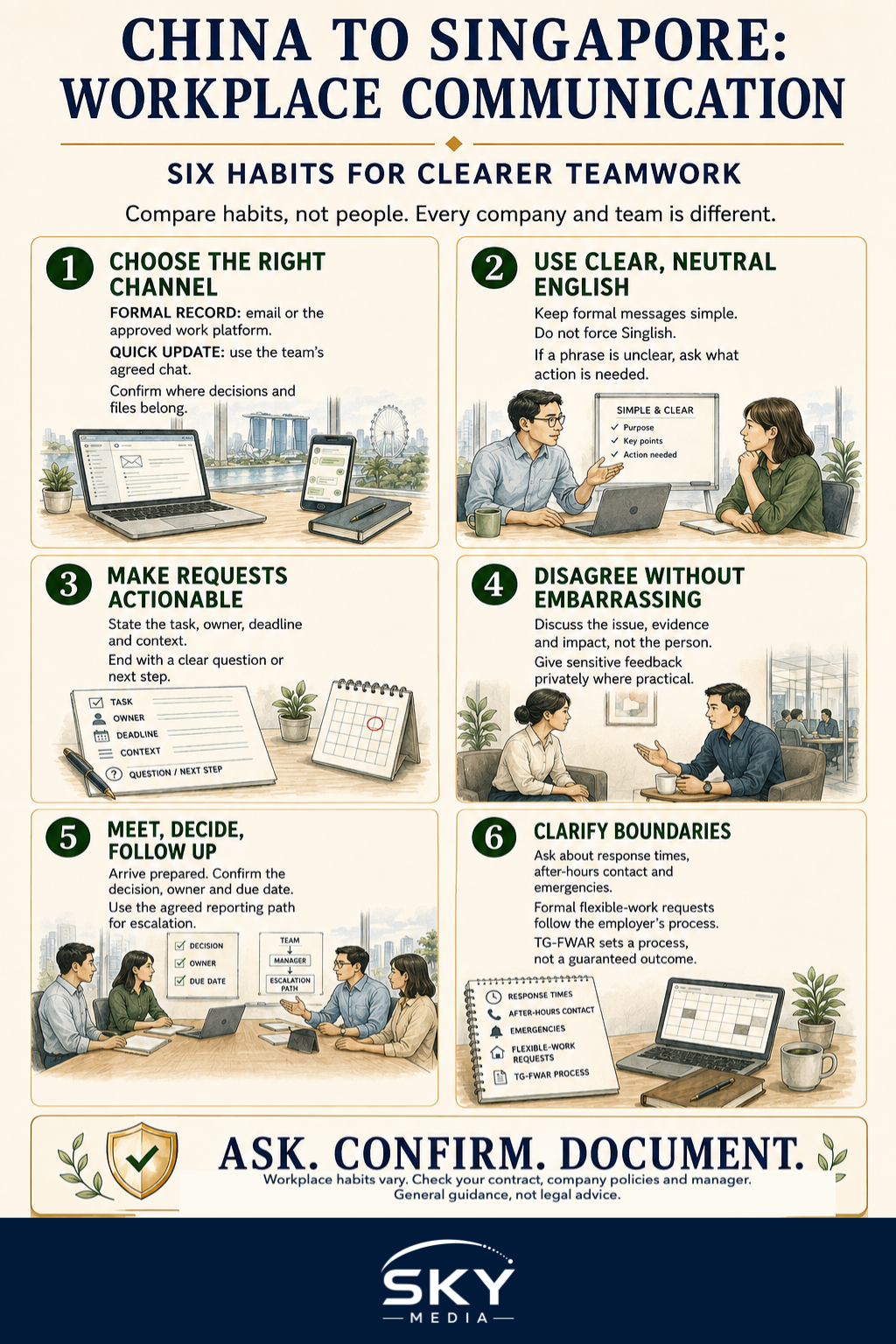
Directness, Indirectness and Reading the Room
Singapore sits in an interesting middle ground. Business here can be more direct than in some parts of Asia, yet politeness and “face” still matter a great deal. Colleagues often soften messages with phrases like “maybe we can consider”, “perhaps we should”, or “just checking”, where the real meaning is a firm suggestion or a gentle no. Taking these too literally, or answering with blunt mainland-style directness, can come across as abrupt.
The skill is calibration. You can be clear and efficient, Singaporeans value that, while wrapping it in courtesy. Instead of “this is wrong”, try “I think there might be an issue here, can we take a look?” Instead of flatly refusing, “let me check and get back to you” buys space gracefully. Watch how your local colleagues phrase requests and mirror their level of softness. Over-explaining or excessive formality can feel stiff, while pure bluntness can feel harsh, so aim for warm and concise.
English, Singlish and Switching Registers
English is the working language across almost all Singapore offices, used in emails, meetings, contracts and presentations. Even in teams where many speak Mandarin, official communication and anything cross-departmental will default to English, so investing in clear professional English pays off quickly. Note too that Singaporean Mandarin differs from mainland Mandarin in vocabulary and rhythm, so do not assume a Chinese-speaking colleague shares your exact phrasing.
Then there is Singlish, the colourful local English peppered with “lah”, “leh”, “can can”, “on the way already” and Malay or Hokkien words. Singlish is the sound of casual belonging: lunch chats, group messages, quick corridor exchanges. You are not expected to speak it, and it is not used for formal writing, but understanding it helps you feel included and read the mood. A safe approach is to keep your written and meeting English clear and standard, while letting yourself relax into the casual register socially as you pick it up. Nobody expects perfection; effort and warmth count more.
Hierarchy, Face and Giving Feedback
Both China and Singapore respect seniority, but the texture differs. Singapore workplaces are often flatter in day-to-day interaction; you may call a manager by their first name and speak up in meetings, yet real decisions and escalation still follow the reporting line, and openly showing up a senior person is poorly received. Preserving “face”, theirs and yours, remains important.
This shapes how feedback and disagreement work:
- Disagree with respect. It is fine to offer a different view, but frame it around the work, not the person. “Another option could be…” lands far better than “that won’t work”.
- Escalate through the line. Going over your manager’s head to their boss is risky. Raise concerns with your direct supervisor first.
- Give feedback privately. Praise can be public; correction is best done one-to-one and gently.
- Take feedback openly. Local managers may deliver critique softly, so listen for the real point beneath the polite wrapping.
Meetings tend to expect some participation, so contributing a considered point is welcome, but reading whether the room wants brisk decisions or open discussion is part of the craft.
Email, Meetings and After-Hours Boundaries
Where mainland teams often live inside WeChat groups, Singapore offices lean on email for anything formal, with WhatsApp, Microsoft Teams or Slack for quicker chat. Email is expected to be reasonably prompt, clear and polite, with a greeting and sign-off; a same-day or next-day reply is a good habit. Meetings usually start on time, so arriving punctually matters.
After-hours culture is an area where expectations are actively shifting. Singapore has been encouraging healthier work-life boundaries, and there is a national conversation, supported by tripartite guidelines from MOM, employers and the labour movement, about respecting workers’ time outside working hours. Norms vary by company and industry, so the practical move is to observe your own team: some managers avoid non-urgent messages at night, others do not. If after-hours contact is a concern, it is reasonable to clarify expectations early and to check what your employment terms and company policy say, rather than assuming. When you do message late, a quick “no rush, for tomorrow” shows consideration.
China Versus Singapore at Work: A Quick Comparison
The table below lines up common workplace habits so you can adjust your instincts as you settle in.
| At work | Common norm in China | Common norm in Singapore |
|---|---|---|
| Main channel for formal matters | Often WeChat groups | Email, with chat apps for quick messages |
| Working language | Mandarin | English, Singlish in casual settings |
| Directness | Can be quite direct | Direct but softened with courtesy |
| Disagreeing with seniors | Often avoided openly | Acceptable if framed around the work |
| Addressing managers | Often by title | Frequently by first name |
| Escalation | Varies, sometimes upward fast | Through the reporting line first |
| After-hours messaging | Frequently expected | Increasingly discouraged, varies by firm |
Finding Your Feet in a Multicultural Team
The heart of Singapore’s work culture is a blend: efficient yet courteous, hierarchical yet approachable, diverse yet cohesive. Your team may include Chinese, Malay, Indian and Eurasian colleagues, alongside people from around the region, so sensitivity matters, avoid assumptions about diet, festivals or beliefs, and treat multicultural respect as part of professionalism. As a mainland newcomer, your strengths in drive and directness are genuine assets; you simply need to pair them with local warmth, patience with softer signals, and a willingness to communicate in clear English. Watch, mirror, ask when unsure, and give yourself a few months to tune in. Do that, and you will find Singapore’s offices are welcoming places where good work and good manners are noticed and rewarded in equal measure.
Explore more
Building strong workplace relationships goes hand in hand with building a life here, so read our guide to making local friends beyond the Chinese community to deepen those connections, and make sure you also understand the fundamentals in understanding your employment contract in Singapore so your terms and boundaries are clear from day one.