

Every business that sells on credit eventually meets a customer who never pays. Once you have chased the money and accepted it is not coming back, the next questions are about the books: when can you write the debt off, does the loss reduce your tax bill, and can you get back the GST you already paid on the invoice? Understanding bad debt write off tax rules in Singapore can recover part of what you lost.
This guide explains when a debt counts as bad, how to write it off properly, how the Inland Revenue Authority of Singapore (IRAS) treats bad debts for income tax, and how GST bad debt relief works. It is general information, not tax advice. Check the latest rules on the IRAS website or with your accountant before you file.
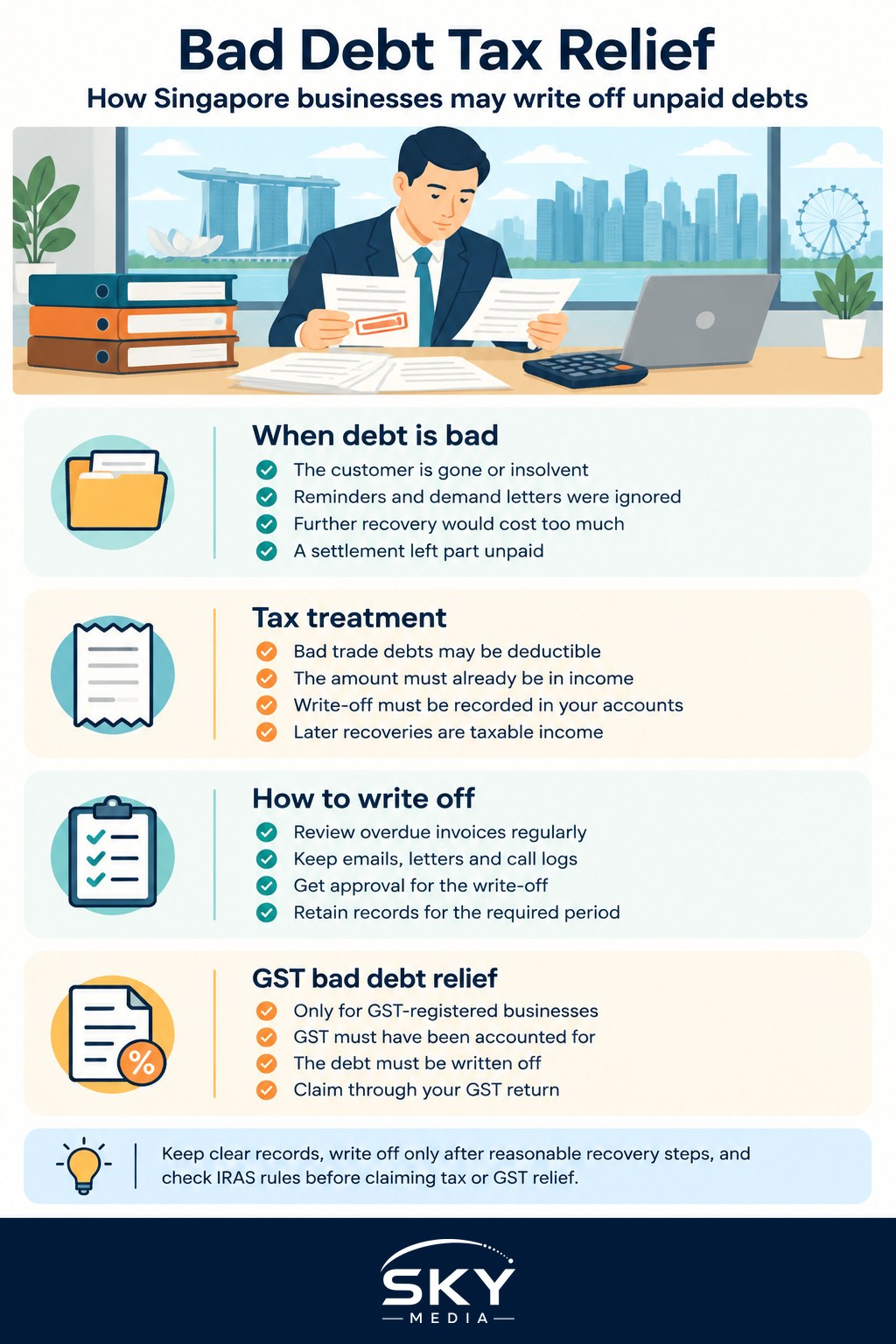
When Does a Debt Become Bad
A bad debt is an amount owed to your business that you have reasonably concluded will not be paid. Writing it off is not the same as giving up early. IRAS generally expects that you have taken reasonable steps to recover the money before you claim it as a loss.
Signs that a debt has genuinely gone bad include:
- The customer has been wound up, made bankrupt or has disappeared, and there is no realistic prospect of payment.
- You have sent reminders and letters of demand, and the debtor has ignored them or refused to pay.
- The cost of further recovery, such as legal action, would outweigh the amount you might get back.
- A settlement has been agreed for less than the full sum, leaving the balance uncollectable.
Keep evidence of your efforts: emails, reminder letters, demand letters, call logs, and any court or insolvency documents. These records support your tax claim if IRAS asks.
Bad Debts vs Doubtful Debts
Accountants distinguish between debts that are definitely lost and debts that may be lost. The tax treatment differs, so it helps to know the terms.
| Type | What it means | General income tax treatment |
|---|---|---|
| Bad debt (specific write-off) | A particular debt you have concluded is irrecoverable and written off | Generally deductible if it is a trade debt meeting IRAS conditions |
| Specific provision for doubtful debt | An allowance against a particular debt that may not be recovered | May be deductible in some cases, subject to IRAS rules |
| General provision | A blanket percentage set aside against all receivables | Generally not deductible until linked to specific debts |
| Non-trade debt | Money lent outside your trade, such as a loan to a friend or director | Generally not deductible, unless lending is your business |
Companies reporting under Singapore financial reporting standards may record impairment losses on receivables using an expected credit loss approach. IRAS has specific guidance on how such impairments are treated for tax, so ask your accountant how this applies to your accounts.
IRAS Rules for Claiming the Deduction
For income tax, a bad debt is generally deductible when it meets conditions along these lines:
- It is a trade debt. The debt arose from your ordinary business, such as an unpaid invoice for goods or services you sold.
- The amount was previously included as income. If you account on an accrual basis, the sale was already counted as revenue when you issued the invoice. Writing it off reverses income that was taxed.
- It has been proven bad. You have taken reasonable steps and concluded it will not be recovered.
- It is written off in your accounts in the basis period for which you claim it.
Debts that are capital in nature, or loans that are not part of your trade, are generally not deductible. A loan to a related company or an advance to a director usually falls outside the deduction unless your business is lending money.
If a debt you claimed is later recovered, in full or in part, the recovered amount is generally treated as taxable income in the year you receive it. Record it properly so it is reported.
Sole proprietors and partners claim bad debts as business expenses in their income tax returns, while companies claim them in their Form C or Form C-S. For a wider view of what else you can claim, see our guide to claiming business expenses and deductions.
How to Write Off a Bad Debt Step by Step
A tidy process helps both your accounts and any IRAS query:
- Review receivables regularly. Run an aged debtors report monthly or quarterly and flag invoices that are long overdue.
- Document recovery attempts. Keep copies of reminders, statements, demand letters and any responses.
- Decide and approve the write-off. In a company, have a director or authorised person approve it, with a short note of the reasons.
- Record the journal entry. Typically, you reduce accounts receivable and record a bad debt expense. If you had a provision, it is used against the write-off instead.
- Handle GST separately. If you are GST-registered, consider whether you can claim GST bad debt relief (see below).
- Keep the file. Retain the records for the period IRAS requires for business records, generally five years.
If you use accounting software, there is usually a built-in function to write off an invoice that updates both the ledger and the GST report. Check that it does not automatically claim GST relief before the conditions are met.
GST Bad Debt Relief
If your business is GST-registered, you will usually have accounted for and paid GST on the invoice when it was issued, even though the customer never paid. GST bad debt relief lets you claim back the output tax on the unpaid amount, provided certain conditions are met. Under IRAS rules, these generally include:
- You made a taxable supply and accounted for and paid the output tax to IRAS.
- You have not received payment, in whole or in part, for the supply.
- The debt has been written off in your accounts as a bad debt.
- A required period has passed since the date of supply, or the debtor has become insolvent, as set out by IRAS.
- You have taken reasonable steps to recover the debt.
There are also time limits for making the claim, and the relief is claimed through your GST return. If the customer later pays, you must repay the GST relief claimed for that amount. Check the current conditions in the IRAS GST bad debt relief guide before claiming. On the purchasing side, our guide to claiming GST input tax explains what businesses can and cannot claim.
Reducing Bad Debts in the First Place
Tax relief softens the blow, but it does not replace the lost profit. A few habits keep bad debts low:
- Check new customers before extending credit, especially for large orders.
- Set clear payment terms in quotes and contracts, including deposits for big jobs.
- Invoice promptly and follow up early, before an overdue invoice becomes a habit.
- Stop supplying customers who repeatedly pay late until their account is settled.
- Consider deposits or milestone billing for long projects.
When a debt does turn bad, write it off cleanly, keep your records, and claim the income tax and GST relief you are entitled to. If you are unsure, an accountant can review your receivables and make sure the claims stand up. For related reliefs, see our overview of income tax reliefs and deductions in Singapore.
Official sources: IRAS
Further reading: Statutory Demands: Using Insolvency Law to Recover Business Debts