

If you have spent time on fitness forums or listened to endurance coaches, you have probably heard that the secret to lasting fitness is going slower. That idea sits at the heart of zone 2 cardio, a steady, comfortable effort that you can hold for a long time while still holding a conversation. This guide explains what zone 2 is, how to find it, and how to train sensibly in Singapore’s hot and humid climate.
This is general information for healthy adults, not medical or coaching advice. If you are older, sedentary, pregnant, or live with a heart condition, high blood pressure or diabetes, please check with a doctor before starting a new cardio programme, and build up gradually.
What Zone 2 Actually Means
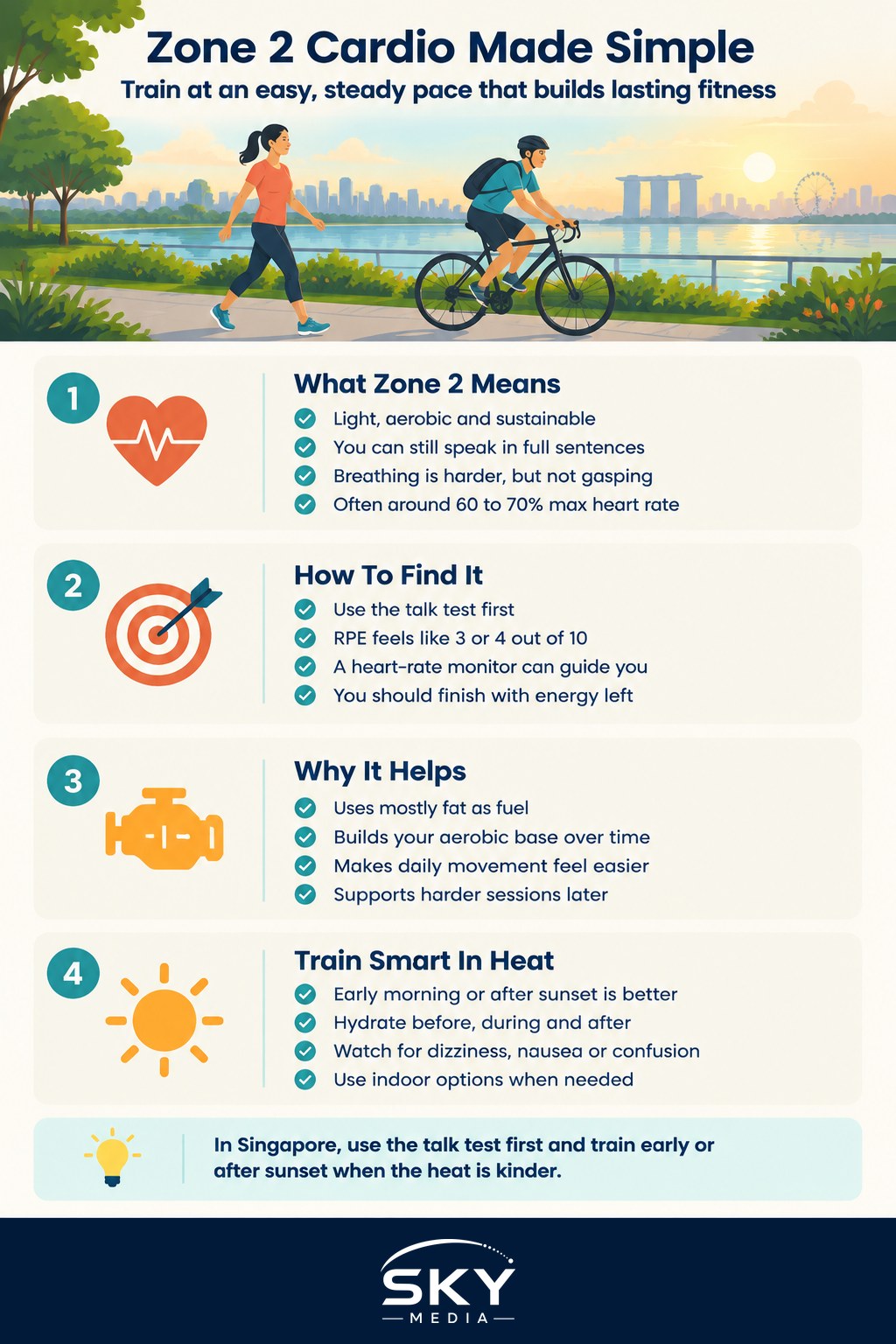
Heart-rate training splits your effort into rough bands, usually numbered one to five, from very easy to all-out. Zone 2 is the second band from the bottom: light, aerobic and sustainable. In practical terms it is the pace at which you are breathing a little harder than at rest but could still speak in full sentences. You are working, yet you never feel like you are gasping.
The appeal is physiological. At this gentle intensity your body relies heavily on fat as fuel and trains the parts of your cells that produce energy aerobically. Over weeks and months this builds what coaches call your aerobic base: a bigger engine that makes everything from climbing HDB stairs to chasing a bus feel easier. It also lays a foundation that harder sessions can later sit on top of.
The numbers people quote for zone 2 are estimates, not diagnoses. A common rough guide puts it at around 60 to 70 percent of your maximum heart rate, and a very rough estimate of maximum heart rate is 220 minus your age. Treat these figures as starting points, because real maximums vary a lot from person to person.
How to Find Your Zone 2
You do not need a laboratory to train in zone 2. Three simple methods work well, and you can layer them for confidence.
- The talk test. This is the most reliable everyday check. If you can speak a full sentence comfortably but singing would be a stretch, you are likely in the right band. If you are puffing too hard to talk, slow down.
- Rate of perceived exertion (RPE). On a scale of one to ten, where one is sitting still and ten is a sprint, zone 2 feels like a three or four. It should feel almost annoyingly easy at first.
- Heart-rate monitor. A chest strap or a decent wrist tracker gives you a live number to aim at. Use the rough percentage above as a target, then adjust based on how the effort actually feels.
A useful sign that you have found it: you finish the session feeling like you could have kept going. If you are wiped out, you were probably drifting into higher zones. Learning to slow down and understand your own effort is a skill, and it connects closely to heart-rate zone training as a whole.
Zone 2 Compared With Harder Efforts
Different intensities do different jobs, and a smart week usually mixes them. The table below compares zone 2 with the higher-intensity work many people default to.
| Feature | Zone 2 cardio | Higher-intensity cardio |
|---|---|---|
| Effort level | Easy, conversational | Hard to very hard |
| Main fuel used | Mostly fat | Mostly carbohydrate |
| How long you can hold it | 30 to 90 minutes or more | Seconds to a few minutes |
| Recovery cost | Low, easy to repeat | High, needs rest days |
| Best for | Building your aerobic base | Raising your ceiling and speed |
| Beginner friendliness | Very high | Lower, build up first |
Neither is better in isolation. If you want to weigh the trade-offs of hard intervals against long steady efforts, our guide to HIIT vs steady state cardio walks through when each earns its place.
Training Zone 2 in Singapore’s Heat
Our climate changes the equation. Heat and humidity push your heart rate up for the same effort, so a pace that felt like zone 2 in an air-conditioned gym can tip into a higher zone outdoors at midday. Do not chase a number blindly in the heat; trust the talk test as your safety valve.
A few practical habits help:
- Train in the cooler parts of the day. Early morning before about 9am or the evening after sunset is far kinder than the midday sun. Park connectors and reservoir loops are pleasant then.
- Hydrate before, during and after. Sip water regularly, and for longer sessions consider replacing some salts. Do not wait until you feel thirsty.
- Know the warning signs. Dizziness, nausea, a headache, stopping sweating, or confusion can signal heat exhaustion or heat stroke. Stop, get into shade or air-conditioning, cool down and rehydrate. Seek medical help if symptoms are severe or do not ease.
- Use indoor options. A treadmill in an ActiveSG gym, an indoor bike, or a covered void deck all let you hold a steady pace without the sun. If you are weighing the surface, see treadmill vs outdoor running.
Because zone 2 is low intensity, it is generally forgiving, but the heat is the wild card here. Respect it.
Building a Simple Zone 2 Routine
Start where you are, not where you wish you were. If you are new to cardio, begin with two or three sessions a week of 20 to 30 minutes at an easy effort. Walking briskly, easy cycling, gentle rowing or a slow jog all qualify, whatever keeps you in that conversational band.
Over several weeks, add five to ten minutes to one session at a time, or add a session, rather than making everything harder at once. This gradual approach is the essence of consistent progress, and it pairs well with the habits in staying consistent with exercise. Many endurance athletes spend the majority of their weekly training in this easy zone precisely because it can be repeated without burning out.
A realistic picture: for the first few weeks, holding a true zone 2 pace may mean walking rather than running, and that is completely normal. As your aerobic base grows, the same heart rate will carry you at a faster pace, which is the whole point.
When to Ease Off or Seek Advice
Listen to your body. Ordinary tiredness and mild muscle soreness are fine, but stop and rest if you feel chest pain or pressure, unusual breathlessness, palpitations, or you feel faint. These are reasons to see a doctor rather than push on. Anyone with a known heart condition or risk factors should get medical clearance before ramping up training volume, even at low intensity.
Zone 2 cardio is one of the most beginner-friendly and sustainable ways to build fitness. It rewards patience over ego, fits neatly around Singapore’s climate if you time it well, and gives every other kind of training a stronger foundation to stand on.
Explore more: HIIT vs steady state cardio · Heart-rate zone training · How to improve your VO2 max · Treadmill vs outdoor running