
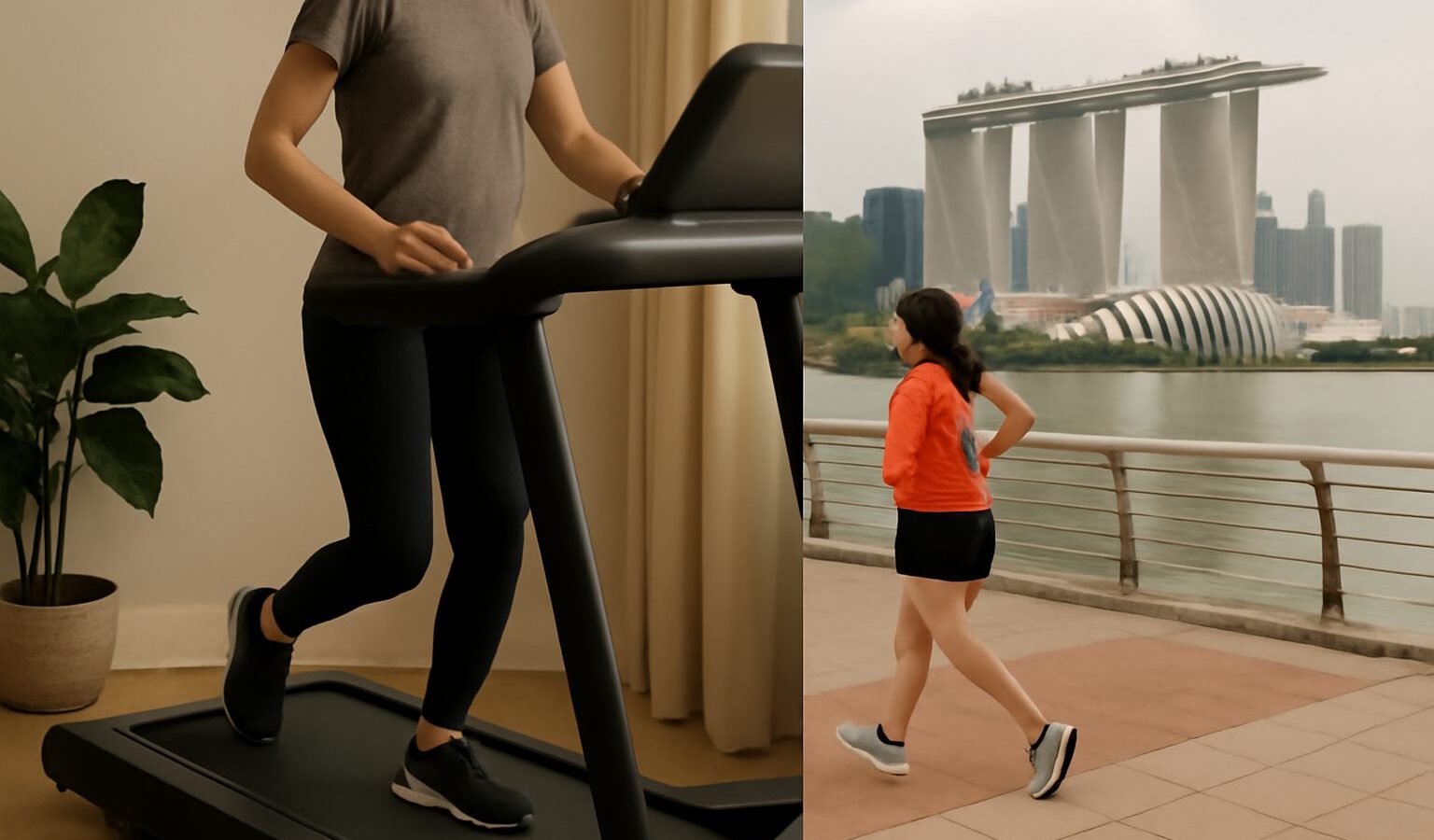
Every runner in Singapore eventually faces the same choice: lace up and head out into the heat, or hop on a treadmill in the cool of a gym. The treadmill vs outdoor running question has no single right answer, because each has clear strengths and each suits different goals, bodies and days. This guide compares them honestly for our tropical climate so you can pick the right tool for the run in front of you.
This is general fitness information, not medical advice. If you are older, sedentary, pregnant, or have a heart condition, high blood pressure, diabetes or a joint injury, please check with a doctor before starting a running programme, and build up gradually.
The Case for the Treadmill
The biggest argument for the treadmill in Singapore is simple: climate control. You escape the heat, humidity, haze and rain, and you can run at any hour in comfort. For beginners, older runners, or anyone worried about heat exhaustion, that predictability is a genuine safety benefit.
Treadmills also offer control and convenience:
- Precise pacing. You set an exact speed and hold it, which is superb for structured intervals or a controlled easy run.
- Softer surface. The cushioned belt is gentler on the knees and shins than concrete pavements, which can help those prone to shin splints.
- Built-in data. Speed, distance, time and an incline setting are all there, making it easy to track a session.
- Safety and privacy. No traffic, no uneven kerbs, and you can stop instantly. This suits people easing back in or feeling self-conscious.
The trade-offs are real too. Treadmill running can feel monotonous, the belt does some of the work so it is slightly easier than road running at the same pace, and you miss the varied terrain that builds real-world strength and balance.
The Case for Outdoor Running
Running outdoors in Singapore has its own rewards, weather permitting. Our park connector network, reservoir loops and coastal paths are genuinely pleasant in the cooler hours, and running in the real world trains you in ways a belt cannot.
- It is free. No gym membership, just a pair of shoes and a route.
- Varied terrain. Gentle slopes, corners and changing surfaces recruit more stabilising muscles and improve balance.
- True pacing skill. You learn to judge effort yourself rather than relying on a machine, which matters for races.
- Mood and scenery. Fresh air, greenery and open water lift the spirits in a way a gym wall rarely does.
The downsides are mostly about our climate. Heat and humidity push your heart rate up and raise the risk of heat illness, midday sun is punishing, and sudden downpours or haze can scupper a plan. The hard surfaces are also less forgiving on the joints over high mileage.
Head-to-Head Comparison
The table below sums up the practical differences for a Singapore runner.
| Feature | Treadmill | Outdoor running |
|---|---|---|
| Climate exposure | None, fully controlled | Full heat, humidity, rain |
| Cost | Gym fee or equipment | Free |
| Joint impact | Lower, cushioned belt | Higher, hard surfaces |
| Pacing control | Precise and easy | Skill you must learn |
| Terrain variety | Minimal | High |
| Best for | Hot midday, structured runs | Cooler hours, race prep |
Neither is a clear overall winner. The smart approach is to match the tool to the day and the purpose, which is very much how you would weigh any HIIT vs steady state cardio decision.
Running Safely in Singapore’s Heat
Whichever you choose, our climate demands respect, and it matters most outdoors.
- Time it well. Run before about 9am or after sunset. Avoid the midday sun for anything long or hard.
- Hydrate properly. Drink before you head out, carry water or plan a route past water points, and rehydrate afterwards. Do not wait for thirst.
- Dress for heat. Light, breathable, sweat-wicking clothing and a cap help. Sun protection matters for daytime runs.
- Know the warning signs. Dizziness, nausea, headache, confusion, or suddenly stopping sweating can signal heat exhaustion or heat stroke. Stop, get to shade or air-conditioning, cool down and rehydrate. Seek medical help if it is severe.
- Have a wet-weather plan. When rain, lightning or haze hits, the treadmill is your safety net rather than a compromise.
Build your distance gradually to protect your joints, and if you keep getting shin or knee pain, ease back and see a physiotherapist rather than running through it. Easy aerobic running fits naturally with the principles in our zone 2 cardio guide.
Making the Choice Work for You
You do not have to be loyal to one option. Many Singapore runners sensibly mix both: the treadmill for hot midday sessions, structured intervals and wet or hazy days, and outdoor runs for cooler mornings, long easy efforts and race-specific preparation. Alternating also keeps training fresh, which helps with staying consistent with exercise.
If you are brand new, starting on a treadmill can be reassuring: you control the pace, the surface is kind, and the heat is off the table while you build fitness. As you grow stronger and learn to read your own effort, adding outdoor runs in the cooler hours gives you variety and real-world skill.
One more practical tip: if you train mainly indoors but plan to race outdoors, do some of your runs outside in the cooler hours beforehand. Your body needs time to acclimatise to the heat and humidity, and the varied terrain and self-paced effort of a real route will not feel the same as a controlled belt on race day. A gradual mix prepares you far better than either surface alone.
In the end, the treadmill vs outdoor running debate is less about which is better and more about which is better right now, for this run, in this weather. Use both wisely, hydrate well, build up slowly, and check with a doctor first if you have any health concerns.
Explore more: Zone 2 cardio explained · HIIT vs steady state cardio · Rowing machine workouts · Staying consistent with exercise