

You have probably seen the headline somewhere: answer 36 questions with a stranger, stare into each other’s eyes for four minutes, and you will fall in love. The 36 questions to fall in love became a viral phenomenon years ago and still pop up on social media and in dating apps. But what did the research really show, and is it worth trying on your next date in Singapore? This guide explains the study behind the questions, why they can work, and how to use them without turning dinner into an interrogation. Pair them with our fresh first date ideas and tips on being a better first date.
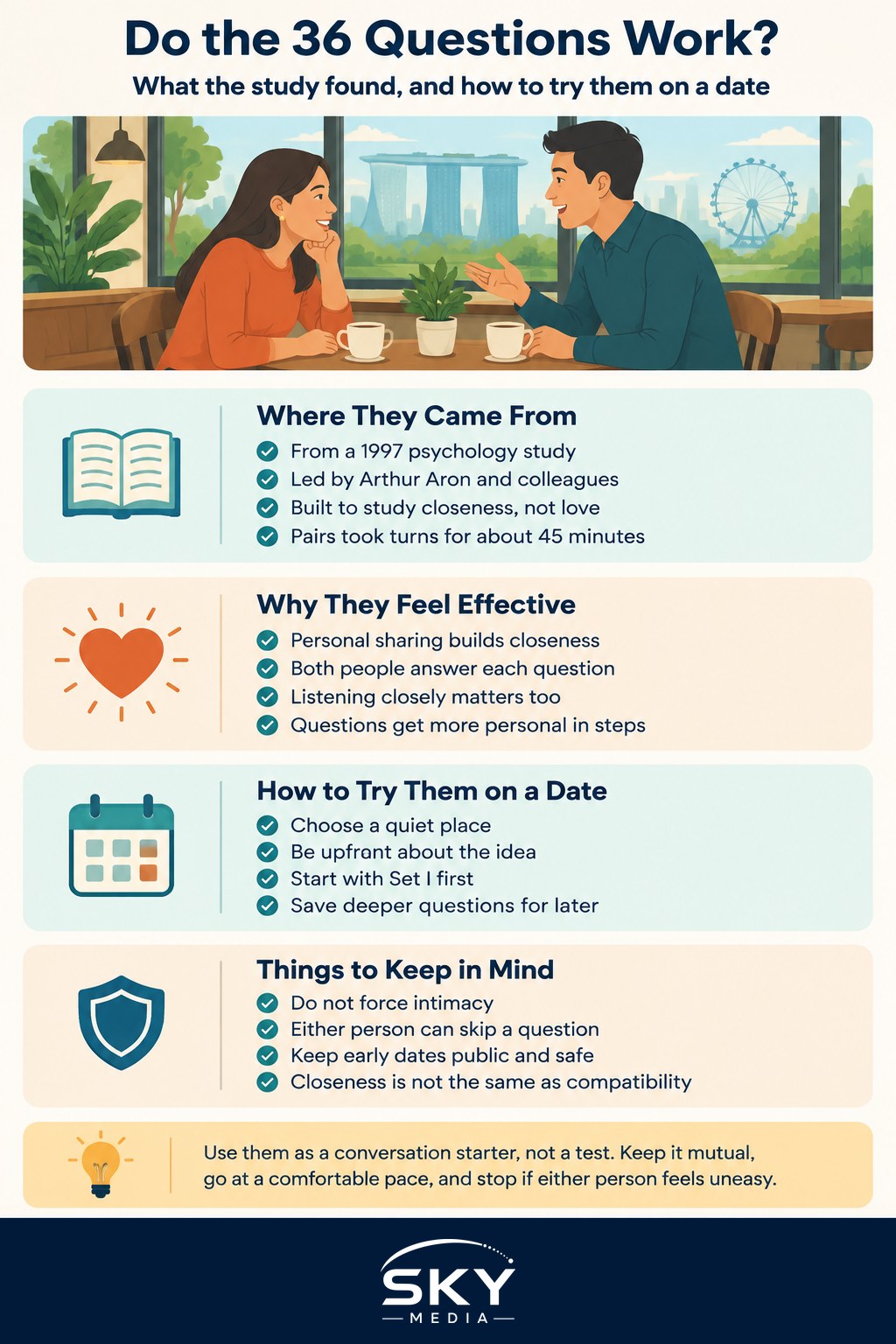
Where the 36 Questions Came From
The questions come from a psychology study led by Arthur Aron and colleagues, published in 1997. The researchers wanted a reliable way to create a feeling of closeness between strangers in a lab, so they could study relationships more easily. Finding love was not the stated goal.
In the study, pairs of participants took turns asking and answering a set of questions over about 45 minutes. The questions were split into three sets, each more personal than the last. A comparison group got small-talk questions instead. Pairs who went through the escalating personal questions reported feeling significantly closer to each other than the small-talk pairs.
The idea reached a much bigger audience in 2015, when a widely read personal essay in The New York Times described a writer trying the questions with an acquaintance, followed by four minutes of eye contact. The pair did end up together, and the “36 questions” became part of popular culture.
What the Study Did Not Claim
It is worth being clear about the limits:
- The study measured closeness after a single session, not romantic love or long-term relationships.
- Participants were mostly university students in a controlled setting.
- The four minutes of eye contact was not part of the original procedure; it came from the later essay and other research.
- Feeling close to someone is not the same as being compatible with them.
So, do the questions “work”? They seem to reliably create a sense of connection. Whether that grows into love depends on everything else: attraction, values, timing and effort.
Why the Questions Create Closeness
The method relies on two well-studied ideas in psychology.
Gradual, mutual self-disclosure. People tend to feel closer when they share personal things and the other person responds with care. The key is that it happens step by step and both people share. Jumping straight to deep secrets can feel uncomfortable, but building up slowly feels natural.
Turn-taking and attention. Each person answers every question, so neither is just interviewing the other. You also have to listen closely, which is rarer than it sounds when phones are on the table.
The three sets are designed to escalate:
| Set | What the questions explore | Example themes | How it tends to feel |
|---|---|---|---|
| Set I | Preferences, light personal stories | Ideal dinner guest, what a “perfect” day looks like | Easy, playful, a bit like a good first date |
| Set II | Values, memories, relationships | Most treasured memory, how you feel about your relationship with your family | Warmer and more reflective |
| Set III | Vulnerability and the other person | What you appreciate about your partner, sharing a personal problem | Intimate, sometimes emotional |
You can find the full list of questions easily online by searching for the Aron study questions. Reading them through before a date helps you decide whether you are both ready for the later ones.
How to Use the Questions on a Date
The questions can feel strange if you suddenly pull out your phone and start reading. Here are ways to make them feel natural.
Choose the Right Setting
A quiet place where you can hear each other is essential. A noisy hawker centre at peak lunch hour or a packed bar is not ideal. Better options in Singapore might be a calm café on a weekday evening, a park bench at a reservoir, a long walk along a waterfront, or simply a night in. You will want about an hour without rushing.
Be Upfront About It
Rather than sneaking the questions in, suggest it openly: “I read about this study with 36 questions that supposedly makes people closer. Want to try a few?” Most people find the idea fun, and being upfront removes any feeling of being tested.
Start With Set I and See How It Goes
There is no rule saying you must do all 36 in one sitting. On an early date, the first set alone can spark a great conversation. If things flow, move into the second set. Save the third set for when you both feel comfortable, perhaps on a later date.
Take Turns, and Really Listen
Both of you answer each question. Ask follow-ups when something interests you. Put phones face down. The value comes from paying attention, not from getting through the list.
Let Either Person Skip
Some questions touch on family, death or personal struggles. Agree at the start that either person can pass on any question without explanation. This makes it safer to be honest about the rest.
Using the Questions in an Established Relationship
The 36 questions are not just for first dates. Couples who have been together for years often use them to reconnect, especially when life gets busy with work, kids or caring for parents. You may be surprised how much you learn about someone you thought you knew well.
Ideas for couples:
- Do one set per week over three date nights.
- Bring the questions on a staycation or a long drive.
- Pick a few each night over dinner instead of scrolling.
Things to Keep in Mind
The questions are a tool for conversation, not a magic formula. A few cautions:
- Do not force intimacy. If your date seems uncomfortable, stop and talk about something lighter. Respecting their pace builds more trust than pushing on.
- Do not use it to manipulate. The point is genuine connection. Using deep questions to rush someone into feelings they have not chosen is not fair to them.
- Be safe with new matches. If you met online, keep early dates in public places and avoid sharing sensitive information such as your address or finances until you know the person better.
- Closeness is not compatibility. You may feel a strong bond after one evening and still discover over time that your goals or values differ. That is normal.
If you are looking for low-pressure ways to meet people in the first place, our guide to lunch dating services in Singapore explains how those work.
So, Should You Try Them?
If you want a conversation that goes beyond jobs, MRT commutes and favourite food spots, the 36 questions are a good way to get there. The research suggests they can make two people feel closer in a short time, and many people simply find them fun. Go in with curiosity rather than expectations, keep it mutual, and let the connection grow at its own pace. Whether or not you fall in love, you will almost certainly leave knowing each other better.
Further reading: When and How to Say I Love You