

If you are new to electric vehicles, the plugs and jargon can feel more confusing than they need to be. The most useful thing to understand early is AC vs DC EV charging, because it explains why one charger fills your battery overnight while another does most of the job over a coffee break. This guide breaks down how each type works, where you find them around Singapore, and what the difference means for your daily routine and your battery, in plain language and without any invented figures.
This is general information, not technical or financial advice. Charging networks, tariffs, and rules change, so for the current picture defer to LTA and EMA, and to the individual charging operators and your carmaker for the specifics of your vehicle and any charger you use.
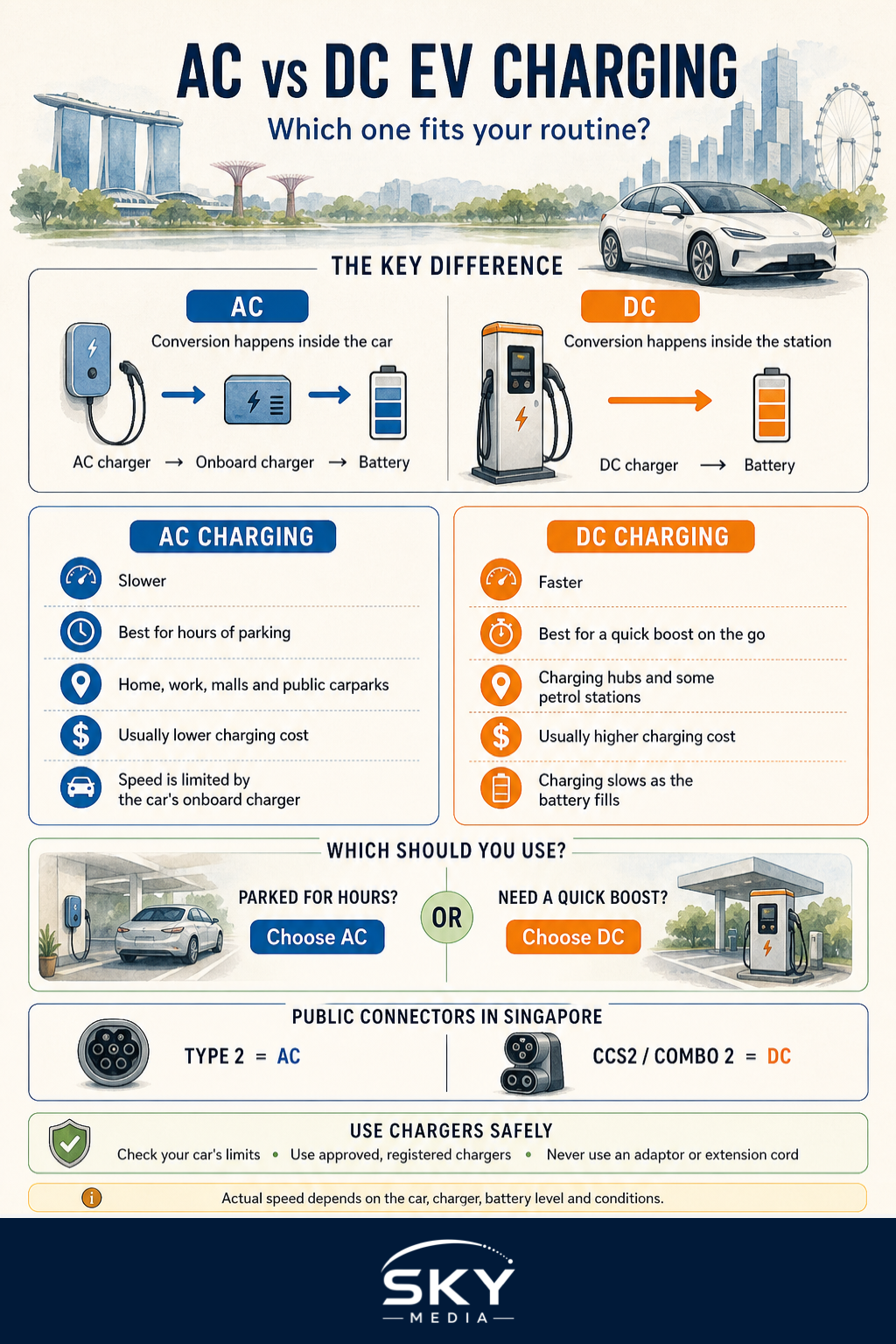
How EV Charging Actually Works
Electricity comes in two forms. The mains supply that runs your home and the grid is alternating current, or AC. The battery in your car, however, can only store and release direct current, or DC. So at some point between the wall and the battery, the power must be converted from AC to DC. The only question is where that conversion happens, and that single detail is the heart of the AC versus DC difference.
Every electric car has a built-in device called the onboard charger. When you plug into an AC point, the electricity arrives as AC and the car’s onboard charger converts it to DC before feeding the battery. Because that converter is compact and built into the car, it can only handle so much power at once, which naturally limits how fast AC charging can go.
A DC charger flips the arrangement. It is a large, powerful unit that does the AC to DC conversion inside the charging station itself, then sends DC straight into the battery and bypasses the car’s small onboard charger altogether. Freed from that bottleneck, a DC charger can deliver far more power, which is why it is often called rapid or fast charging. That is the whole story in a sentence: AC charging converts inside the car and is slower, while DC charging converts inside the station and is much faster.
AC Charging at Home and at Work
AC charging is the everyday, background way most owners keep an electric car topped up. The points are relatively simple and affordable to install, which is why you find them in HDB and condo carparks, at workplaces, shopping malls, and public car parks across the island. A home or shared wall box, where your building allows one, is the classic example.
The appeal of AC charging is not speed but convenience and cost. Because it is slower, it suits the times when the car is parked for hours anyway, such as overnight or through a workday. You plug in, walk away, and return to a full or nearly full battery without ever thinking about it. For many people who drive normal daily distances, this alone covers almost all their charging, and they rarely need anything faster.
A few practical points about AC charging in local conditions:
- Overnight or long stays suit it best. Match the slow speed to time the car is idle anyway rather than waiting around for it.
- Condo and HDB installation needs approval. Getting a home or shared point often involves the management, the operator, and building rules, so check what your development and the current LTA guidance allow before committing.
- Your car sets a ceiling. The onboard charger limits the pace, so a more powerful AC point will not charge faster than your particular car can accept.
DC Fast Charging on the Go
DC fast charging is built for a different job: getting usable range back quickly when you are out and cannot wait. You find these more powerful chargers at dedicated charging hubs, some petrol stations, and along routes where drivers pass through rather than park for the day. They are the tool for a quick boost during a long errand or before a trip, not for daily overnight use.
The trade-off is that DC charging typically costs more per unit of energy than a slower AC top-up, and the stations are more expensive to build, so there are fewer of them. There is also an important detail about how the speed behaves. Rapid charging is fastest when the battery is fairly low and slows down noticeably as the battery fills, because the car deliberately eases the flow to protect the cells. In practice this means a DC session is most efficient for the lower portion of the battery, and topping up the final stretch takes disproportionately longer. For that reason many drivers on the go charge to around the middle or high range and move on rather than waiting for a full battery.
AC vs DC EV Charging at a Glance
The table below sums up the practical differences. Treat the speeds as general descriptions rather than exact numbers, since actual rates depend on your car, the charger, and conditions, and the operators publish the specifics.
| Feature | AC charging | DC charging |
|---|---|---|
| Where conversion happens | Inside the car’s onboard charger | Inside the charging station |
| Typical speed | Slower, suited to hours of parking | Much faster, minutes to under an hour for a useful boost |
| Where you find it | Home, condo, workplace, malls, public carparks | Charging hubs, some petrol stations, key routes |
| Best used for | Overnight and long daytime stays | Quick top-ups when you are out and about |
| Relative cost per charge | Usually cheaper | Usually more expensive |
| Effect of a full battery | Steady throughout | Slows noticeably as the battery fills |
What Fast Charging Means for Your Battery
A common worry is whether frequent DC fast charging harms the battery. The honest answer is that modern electric cars are designed to manage it. The car’s battery management system controls temperature and the rate of charge to protect the cells, which is part of why rapid charging slows as the pack fills and can ease off further in very hot conditions, something worth remembering in our climate.
That said, the gentle consensus is that slower AC charging is a little kinder over the long run, and that relying on DC fast charging for every session is best avoided if you have an easy alternative. A sensible pattern for most owners is to use AC charging as the daily default and reach for DC fast charging when you genuinely need speed on the go. It also helps the battery to avoid routinely sitting at a completely full or completely empty state, and many drivers keep everyday charging within a comfortable middle band, following their carmaker’s guidance.
For anything specific to your vehicle, including recommended charging habits and any warranty conditions on the battery, check your owner’s manual and the manufacturer, since these vary by model.
Choosing the Right Charger for Your Routine
Once the AC versus DC distinction clicks, planning becomes straightforward. If you can charge where you park regularly, lean on AC charging for the bulk of your needs, because it is cheaper, gentler, and effortless when the car is idle anyway. Keep DC fast charging in reserve for the days you are caught short or covering longer distances, and accept that you pay a little more for that speed and convenience.
Use a reputable charging app or the operators’ own apps to find nearby points, check whether they are AC or DC, see live availability, and understand the pricing before you plug in, since these details differ between networks and change over time. Good charging etiquette matters too: move your car once it has enough charge so others can use the point, especially at busy DC stations. Understanding AC vs DC EV charging turns a confusing wall of plugs into a simple choice, the slow one for parking and the fast one for passing through, and for the current rules, tariffs, and network details, defer to LTA, EMA, and the charging operators.