

Bought your flat as a single, or got married after keying in? Many owners later want to add spouse name to HDB flat ownership so that both partners hold the home together. It is a common request, and the Housing & Development Board (HDB) has a defined process for it, but it is not a simple form. It involves eligibility checks, legal documents, stamp duty and sometimes CPF considerations.
This guide walks through the steps and costs from an owner’s point of view. It is general information, not legal or financial advice. HDB’s rules, fees and the Inland Revenue Authority of Singapore’s (IRAS) stamp duty treatment can change, so confirm your own case with HDB and IRAS before you apply.
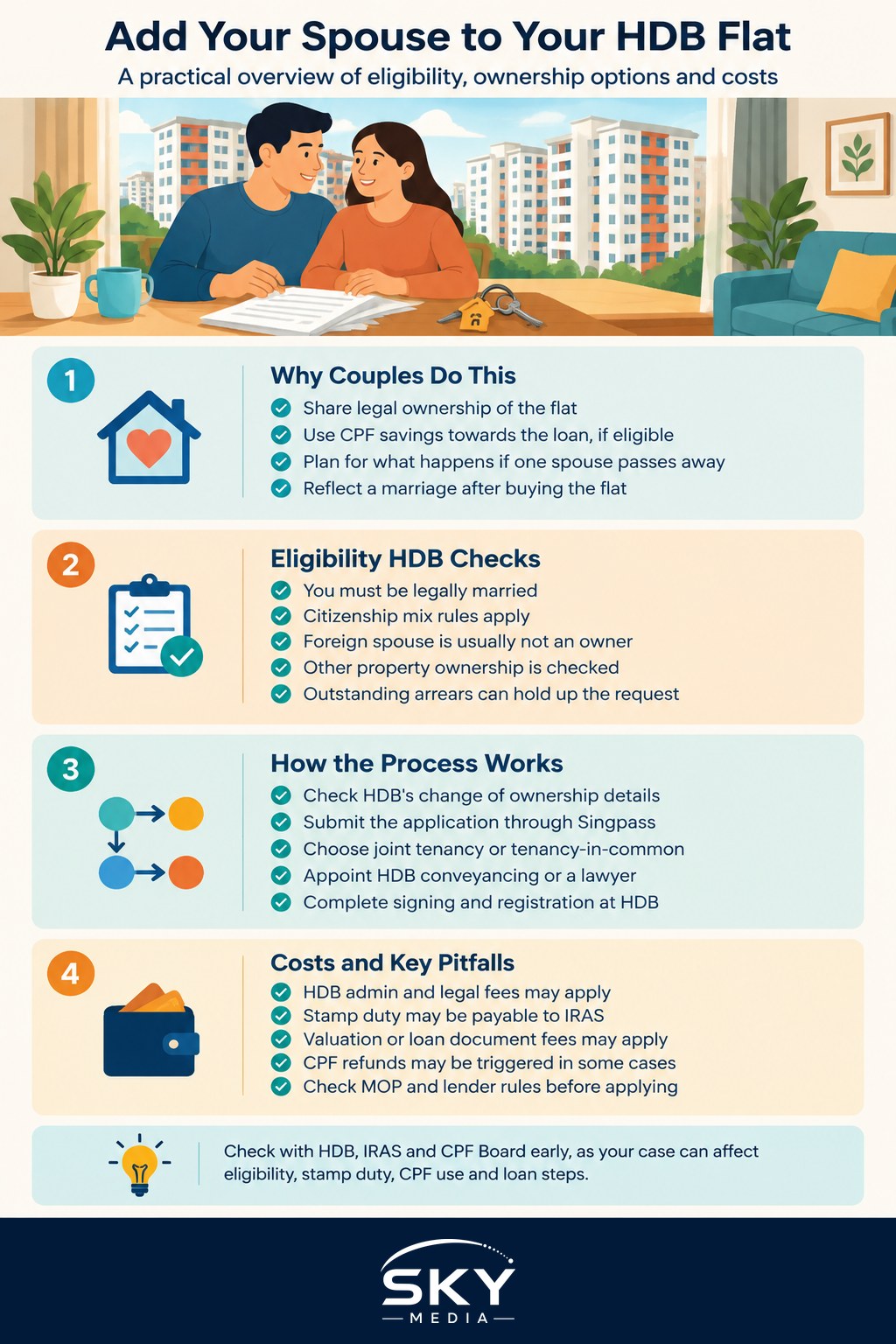
Why Couples Add a Spouse as Owner
Being listed as an occupier is different from being an owner. An occupier lives in the flat but has no ownership share. An owner holds a legal interest in the property. Couples usually add a spouse as owner to:
- Share legal ownership of what is often their largest asset
- Allow both to use CPF savings toward the loan, where eligible
- Plan for what happens to the flat if one spouse passes away
- Reflect a marriage that happened after the flat was bought
If your aim is only to let your spouse live with you, registering them as an occupier may be enough. For other family members living with you, our guide to adding your parents as occupiers in your HDB flat explains that route.
Eligibility: What HDB Checks
HDB assesses every request to change ownership. The exact criteria depend on the flat type, how it was bought and your household profile, but HDB typically looks at:
- Relationship. You must show you are legally married, usually with your marriage certificate.
- Citizenship. HDB has rules on the citizenship mix of owners. A Singapore Citizen or Singapore Permanent Resident spouse may generally be considered; a foreign spouse is usually not eligible to be an owner and may only be listed as an occupier, depending on HDB’s rules.
- Other property. HDB checks whether the spouse owns, or has recently owned or disposed of, private property, and whether they already own another HDB flat.
- Age and household. Other conditions may apply depending on the flat type and scheme under which you bought it.
- Outstanding issues. Arrears or other outstanding matters with the flat can hold up an application.
If your spouse is a foreigner, our guide to buying an HDB flat with a foreign spouse from China explains how citizenship affects ownership and occupier status. Check HDB’s website or the HDB e-service for change of ownership to confirm your specific eligibility.
Step by Step: How the Process Usually Works
The process is run through HDB, typically via its online services using Singpass. The broad sequence:
- Check eligibility online. Review HDB’s change of flat ownership information for your situation.
- Submit the application. The current owner applies to add the spouse, and both parties confirm through Singpass.
- Choose how to hold the flat. Decide between joint tenancy and tenancy-in-common (explained below).
- Appoint a lawyer. You can use HDB’s conveyancing service or a private lawyer, depending on whether there is a housing loan and which lender holds it.
- Settle the price or consideration. The share may be transferred by way of gift or for a price. This affects stamp duty and CPF.
- Pay fees and stamp duty. Admin and legal fees, plus stamp duty to IRAS if applicable.
- Attend the completion appointment. Documents are signed and the ownership change is registered.
Processing time varies with your case, the volume of applications and whether a loan is involved. Do not assume a fixed timeline; HDB will tell you what to expect.
Joint Tenancy vs Tenancy-in-Common
This choice matters more than many couples realise, especially for estate planning.
| Manner of holding | How ownership works | If one owner passes away |
|---|---|---|
| Joint tenancy | Both own the whole flat together, with no separate shares | The flat generally passes to the surviving owner (right of survivorship) |
| Tenancy-in-common | Each owns a specific share, such as 50:50 or 70:30 | That owner’s share is distributed according to their will or intestacy law |
| Sole owner (current) | Only one person owns the flat | The flat is distributed according to the owner’s will or intestacy law |
Most married couples choose joint tenancy for simplicity, while tenancy-in-common can suit blended families or couples who contributed unequal amounts. HDB may have conditions on which manner of holding is allowed. A lawyer can explain the implications for your family.
Costs: Stamp Duty, Legal and Admin Fees
The costs of adding a spouse fall into a few groups:
- HDB administrative fee for processing the change of ownership.
- Legal fees for conveyancing, whether you use HDB’s service or a private lawyer.
- Stamp duty paid to IRAS on the share being transferred. Stamp duty on a transfer of property is generally based on the higher of the price paid or the market value of the share. Additional Buyer’s Stamp Duty (ABSD) rules also exist; IRAS provides remission or special treatment in some spousal situations, but whether it applies depends on your circumstances.
- Valuation fees, if a valuation is required.
- Other fees, such as for loan or mortgage documents if your lender is involved.
Exact amounts depend on the flat’s value, the share transferred and current rates, so get a breakdown from HDB, your lawyer, and IRAS’s stamp duty calculators rather than relying on estimates. Budget for these in cash or CPF where allowed.
CPF, Housing Loans and Common Pitfalls
CPF. If the share is transferred for a price, the incoming spouse may be able to use CPF Ordinary Account savings, subject to CPF Board rules. If the outgoing owner used CPF to buy the flat, a transfer can trigger requirements to refund CPF used plus accrued interest, depending on how the transfer is structured. Check with the CPF Board early, as this can change the whole plan.
Housing loans. If you have an HDB concessionary loan or a bank loan, your spouse may need to become a borrower on the loan, and the lender must agree. Bank loans may need restructuring, which can involve fees.
Minimum Occupation Period (MOP). HDB has rules on changes of ownership during the MOP, the period you must live in the flat before you can sell it. Check with HDB how adding a spouse affects your flat’s MOP before you apply.
Common pitfalls to avoid:
- Assuming the process is free or quick
- Forgetting stamp duty and ABSD checks with IRAS
- Not discussing CPF refunds before deciding on gift versus sale
- Skipping a will when choosing tenancy-in-common
If you are planning major works or a future sale, finalise ownership first. Our guide to selling your HDB flat explains how ownership affects the resale process later.
Adding your spouse is a meaningful step for many couples. Take time to understand eligibility, costs and the manner of holding, and confirm each point with HDB, IRAS and the CPF Board before you sign.
Frequently Asked Questions
Should I gift my spouse a share of the flat or sell it to them? It depends on your finances and CPF position, and the choice changes the paperwork. A gift and a sale are treated differently for stamp duty, and a sale at a price may let the incoming spouse use CPF savings. Ask HDB, IRAS and the CPF Board to explain both routes before you commit.
Can my foreign spouse still live in the flat if they cannot be an owner? Usually yes, as an occupier. Being an occupier lets your spouse live with you but gives no ownership share. Whether a foreign spouse can be registered, and on what terms, depends on HDB’s rules and the pass they hold, so confirm the details with HDB.
How long does it take to add a spouse to an HDB flat? There is no fixed timeline. It depends on your case, how busy HDB is and whether a housing loan or a lawyer’s documents are involved. Starting with the eligibility check and a loan discussion early tends to prevent delays, and HDB will tell you what to expect once you apply.
Do we still need wills if we hold the flat as joint tenants? Joint tenancy generally passes the flat to the surviving owner regardless of what a will says, so a will matters more for your other assets. It becomes more important under tenancy-in-common, where each share follows the will. A lawyer can advise on how the two fit together.
Is it worth using a private lawyer instead of HDB’s conveyancing service? It can be, when your case is more complicated, such as a bank loan, unequal shares or blended-family planning. Which option is allowed may depend on whether there is a housing loan and who the lender is. Compare quotes and ask HDB what applies to you.
Official sources: HDB
Further reading: How to Prepare for Your HDB Flat Selection Appointment · Removing a Co-Owner’s Name From an HDB Flat: When HDB Allows It