
Life changes, and sometimes the names on an HDB flat no longer match the people who live there. A couple divorces, a sibling marries and moves out, or a parent who co-owned the flat passes away. Many owners assume they can simply remove a name from an HDB flat by signing a form, but HDB treats any change in ownership seriously, because public housing comes with eligibility conditions that must still be met after the change.
This guide explains the situations in which HDB may allow a co-owner to be removed, what the remaining owner has to satisfy, and the money matters to plan for. It is general information, not legal advice. HDB assesses each case on its own facts, so check the current rules on the HDB website or through the HDB Flat Portal before you act.
Why You Cannot Just Drop a Name
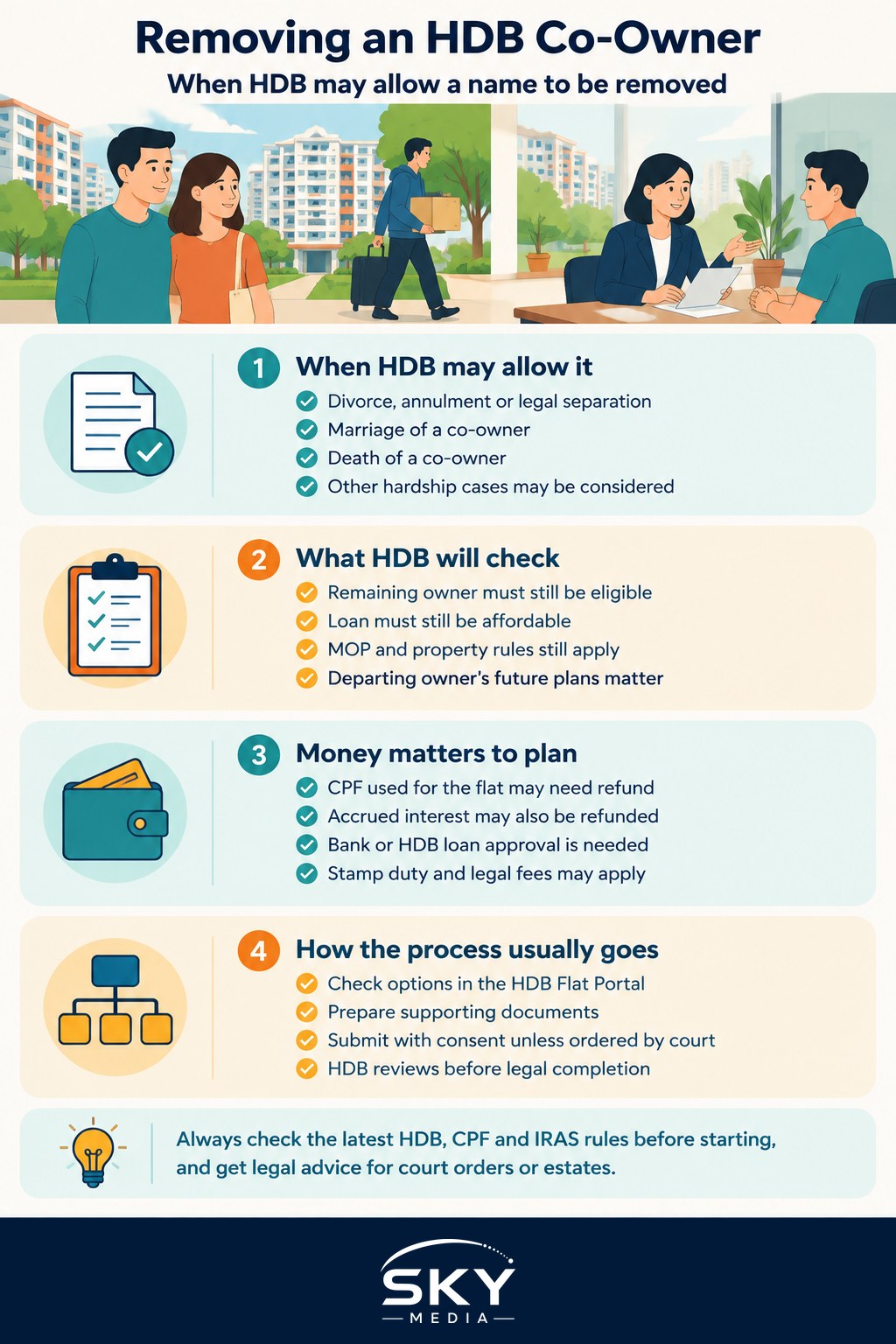
When you bought the flat, every owner and occupier was assessed together as a household. The scheme you bought under (for example a family scheme or a singles scheme), any housing grants received, the income ceiling and the loan were all based on that combination of people. Removing one owner changes the household, so HDB needs to be satisfied that:
- the remaining owner, or owners, still qualify to own the flat on their own;
- the outstanding housing loan can still be serviced; and
- the change is not being used to get around rules such as the Minimum Occupation Period (MOP), the restrictions on owning private property, or the rules on buying another subsidised flat.
This is why a voluntary “I no longer want my name on it” request is often not approved on its own. HDB looks for a recognised change in circumstances.
Situations Where HDB May Allow a Name to Be Removed
HDB’s published guidance lists specific circumstances in which a change of ownership, including the removal of an owner, may be considered. The common ones are:
Divorce, annulment or legal separation. This is the most frequent reason. Where the court has ordered how the matrimonial flat is to be dealt with, HDB will generally follow the order, for example transferring the flat to one former spouse. The spouse keeping the flat must still meet HDB’s eligibility conditions to retain it, and the court order and any related documents will need to be submitted.
Marriage of a co-owner. Where, for example, siblings or a parent and child co-own a flat and one of them marries, HDB may consider letting that person’s name be removed so the newly married couple can form their own household. Whether this is allowed depends on the remaining owner’s eligibility and the departing owner’s plans.
Death of a co-owner. How this works depends on how the flat was held. If the owners held it as joint tenants, the deceased owner’s share passes automatically to the surviving owner by the right of survivorship, and the change is updated in HDB’s records. If they held it as tenants-in-common, the deceased’s share forms part of their estate and passes under the will or intestacy rules, which may involve a grant of probate or letters of administration. Either way, the person who ends up owning the flat must be eligible to do so.
Other family or hardship circumstances. HDB may consider other cases on their merits, such as an owner who has to move out permanently for medical reasons. These are assessed individually, and approval is not automatic.
What HDB Checks Before Approving
| Check | What HDB looks at | Why it matters |
|---|---|---|
| Eligibility of remaining owner | Citizenship, age, marital status and family nucleus under the relevant scheme | A single remaining owner may need to meet the conditions for singles to keep the flat |
| Loan and finances | Ability to take over the full outstanding loan from HDB or the bank | The lender must agree that one person can service the loan |
| MOP and property rules | Whether the flat is still within MOP, and whether any owner holds private property | Ownership changes cannot be used to sidestep MOP or ownership restrictions |
| Departing owner’s next home | Whether they plan to buy another HDB flat or private property | Their future eligibility for subsidised housing can be affected |
A few points to note:
- Singles keeping a flat. If the remaining owner is unmarried, HDB will typically assess them against the conditions for singles, which include an age requirement. If they do not meet these, the request may not be approved, or other options such as selling may need to be considered.
- Occupiers. If the remaining owner needs family members listed as occupiers to form an eligible household, HDB will check that they genuinely live in the flat.
- Grants. Housing grants already received are generally not clawed back simply because ownership changes, but the departing owner’s grant history can affect what they qualify for in future. Check the specifics with HDB.
The Money Side: CPF, Loans and Fees
Removing an owner is usually treated as a transfer of their share to the remaining owner, so several financial steps follow.
CPF refunds. If the departing owner used CPF savings for the flat, the CPF Board’s rules may require the amount withdrawn, plus the accrued interest, to be refunded to their CPF account. In some transfers, such as certain divorce cases, there may be arrangements on how this refund is handled. Check your CPF statement and the CPF Board’s guidance early, because the sum can be substantial.
Taking over the loan. The remaining owner must usually be approved to carry the full housing loan alone. For an HDB loan, HDB will assess this. For a bank loan, the bank must agree, which may involve a fresh assessment under the usual borrowing limits.
Stamp duty and legal fees. A transfer of ownership may attract stamp duty, which is administered by IRAS. There are also conveyancing fees for the lawyer handling the transfer, and HDB administrative fees. The amounts depend on the case, so get a quote and check IRAS for the current position rather than relying on old figures.
Step-by-Step: How the Process Usually Runs
- Check eligibility online. Log in to the HDB Flat Portal with Singpass and look up the change of ownership options. The portal will guide you on whether your situation falls within the allowed categories.
- Gather documents. These may include the divorce or annulment order, marriage certificate, death certificate, grant of probate, and income documents for the remaining owner.
- Submit the application. All parties usually need to give their consent, unless a court order directs the transfer.
- HDB assessment. HDB reviews eligibility, the loan position and any MOP or property issues, and may ask for more information.
- Legal completion. If approved, the transfer is completed with a lawyer, CPF refunds are processed, and the title is updated.
Timelines vary with the complexity of the case, so start well before any deadline in a court order or before the departing owner wants to commit to a new home.
Related Ownership Changes
If you are trying to do the opposite, our guide on how to add your spouse’s name to your HDB flat covers that process. If co-owners have simply fallen out and one wants to buy the other out, read buying over your co-owner’s share. And if the real answer is to sell, see selling your HDB flat before MOP for the limited exceptions HDB may consider.
Whatever your situation, HDB is the final authority. Use the HDB Flat Portal, call or visit an HDB branch, and speak to a lawyer for anything involving a court order or an estate. Rules on eligibility, CPF and stamp duty are updated from time to time, so confirm the current requirements before making plans.
Frequently Asked Questions
Can I remove my ex-spouse’s name from the HDB flat after divorce? Where the court has ordered how the flat is dealt with, HDB will generally follow the order, for example transferring it to one former spouse. The spouse keeping the flat must still meet HDB’s eligibility conditions, and the court order must be submitted.
What happens to an HDB flat when a co-owner dies? It depends on how the flat was held. Joint tenants pass the deceased’s share automatically to the survivor, while tenants-in-common pass it under the will or intestacy rules. Either way, the person who ends up owning the flat must be eligible.
Do I have to refund CPF if I leave the flat title? If the departing owner used CPF savings for the flat, the rules may require the amount withdrawn plus accrued interest to be refunded to their CPF account. Some transfers, such as certain divorce cases, have special arrangements. Check early with the CPF Board.
Can a single owner keep the flat after the other name is removed? HDB will typically assess an unmarried remaining owner against the conditions for singles, which include an age requirement. If they do not meet them, the request may not be approved, and selling may need to be considered.
Will removing my name affect my chance to buy another HDB flat later? It can. The departing owner’s grant history and plans for another HDB flat or private property are checked, and future eligibility for subsidised housing can be affected. Check the specifics with HDB before committing to a new home.
Official sources: HDB
Further reading: Transferring HDB Flat Ownership to Your Child: When HDB Allows It