
When an HDB flat owner passes away, families often assume the flat simply goes to whoever lives there. In reality, what happens next depends on three things: how the flat was owned, whether there is a valid will, and whether the people who inherit are allowed to own an HDB flat at all. Getting these right early saves months of confusion and avoids a forced sale nobody wanted.
This guide walks through the order of events before any decision to sell is made. It is general information, not legal advice. HDB, the courts and a lawyer can confirm what applies to your family’s situation.
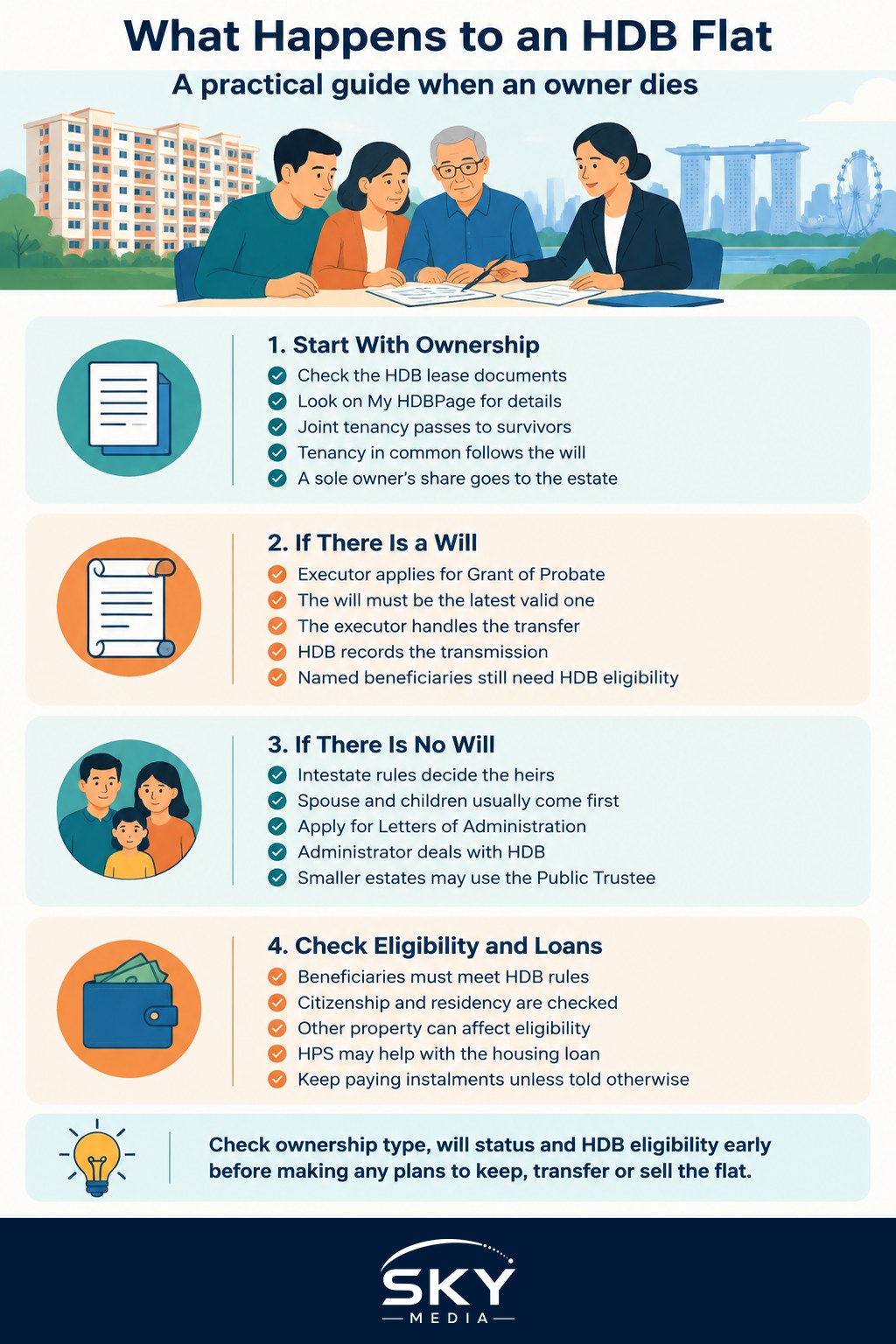
Step One: Check How the Flat Was Owned
Every HDB flat with more than one owner is held in one of two ways. You can see which on the HDB lease documents or by checking the flat’s details in My HDBPage on the HDB website.
- Joint tenancy. All owners hold the whole flat together. When one owner dies, their interest passes automatically to the surviving owner or owners. This is called the right of survivorship. A will cannot override it, because the deceased’s share never enters the estate.
- Tenancy in common. Each owner holds a defined share, for example 50:50 or 70:30. When one owner dies, that share becomes part of their estate and passes under their will, or under intestacy rules if there is no will.
- Sole owner. If the deceased was the only owner, the whole flat becomes part of the estate.
Most married couples buy as joint tenants, so for many families the answer is simple: the surviving spouse becomes the sole owner. Muslim families should note that inheritance under the Administration of Muslim Law Act follows its own rules, and how a joint tenancy is treated should be confirmed with the Syariah Court or a lawyer familiar with Muslim estates.
The Three Routes Compared
| Situation | Who gets the deceased’s interest | Main paperwork | Typical next step with HDB |
|---|---|---|---|
| Joint tenancy, co-owner still alive | Surviving joint owner(s) automatically | Death certificate | Apply to HDB to update ownership records |
| Tenancy in common or sole owner, with a will | Beneficiaries named in the will | Grant of Probate obtained by the executor | Executor applies to HDB to transfer the flat |
| Tenancy in common or sole owner, no will | Next of kin under the Intestate Succession Act | Letters of Administration obtained by the administrator | Administrator applies to HDB to transfer the flat |
| Muslim deceased | Heirs under Faraid rules | Inheritance certificate from the Syariah Court, plus the relevant court grant | Confirm the transfer route with HDB and a lawyer |
When There Is a Will
If the deceased left a will, the person named as executor applies to the Family Justice Courts for a Grant of Probate. This document confirms the executor’s authority to deal with the estate, including the deceased’s share of the flat.
With the grant in hand, the executor contacts HDB to transfer the flat, or the deceased’s share of it, to the beneficiaries named in the will. HDB processes this as a transmission, which is the formal term for property passing because of a death rather than a sale.
A few practical points:
- The will must be the latest valid one. If you are unsure whether a will exists, a lawyer can help you search, and the deceased’s own lawyer may hold a copy.
- An executor can be a family member. They do not have to be a lawyer, though many use one for the court application.
- Leaving the flat to someone in a will does not guarantee they can keep it. HDB eligibility still applies, as covered below.
When There Is No Will
If there is no valid will, the estate is distributed under the Intestate Succession Act. The law sets out a fixed order of who inherits, generally starting with the spouse and children, then moving to parents, siblings and more distant relatives if there are none.
A family member, usually the spouse or an adult child, applies to the court for Letters of Administration and becomes the administrator. The administrator then deals with HDB on behalf of all the beneficiaries. Because several people may inherit shares at once, intestate cases often take longer and need more agreement within the family.
For smaller estates, the Public Trustee’s Office may be able to administer the estate instead of a court grant. Check the Public Trustee’s Office website for the current criteria before assuming it applies.
Can the Beneficiaries Actually Keep the Flat?
This is the part families most often miss. Inheriting a share of an HDB flat is not the same as being allowed to own it. HDB will look at whether each beneficiary meets its ownership rules, which typically cover points such as:
- Citizenship and residency. HDB ownership is generally limited to Singapore Citizens and Singapore Permanent Residents, with conditions on how the household is made up.
- Other property. A beneficiary who already owns another HDB flat or private property may not be allowed to hold the inherited flat as well.
- Household composition. HDB may need the flat to be owned and occupied in a way that fits one of its eligibility schemes.
If a beneficiary is not eligible, HDB may require the flat to be sold within a set period, or allow it to be transferred to a different eligible family member instead. The rules and time limits can change, so ask HDB directly before the family makes plans. Do not let anyone move in, rent out rooms or start renovations until ownership is settled.
Outstanding Loans and the Home Protection Scheme
Many owners still have a housing loan when they die. If the flat was bought with CPF savings, the owners were usually required to be covered by the Home Protection Scheme (HPS), a mortgage-reducing insurance run by CPF Board. If the deceased was covered, HPS may pay off their share of the outstanding loan, up to the cover they had.
Check with CPF Board whether the deceased had active HPS cover and what it pays. A private bank loan may have its own mortgage insurance, so ask the bank too. Keep paying instalments in the meantime, unless the lender tells you otherwise, to avoid arrears building up while paperwork is processed.
CPF money itself is handled separately. CPF savings go to the people named in the deceased’s CPF nomination, not through the will. You can read more in our guide on what happens to CPF LIFE payouts when you pass away.
A Practical Checklist for the Family
- Register the death and collect several copies of the death certificate.
- Find the HDB ownership documents and confirm joint tenancy or tenancy in common.
- Search for a will and identify the executor, or agree who will apply as administrator.
- Contact CPF Board about HPS and CPF nominations, and the bank about any loan.
- Apply for the Grant of Probate or Letters of Administration where needed.
- Ask HDB how the transfer works for your case and whether the beneficiaries are eligible.
- Only then decide whether to keep, transfer or sell the flat.
For the wider set of tasks after a death, see what to do when a family member passes away in Singapore, and our guide to bank accounts after death for the deceased’s savings. If ownership later needs restructuring among living owners, removing a co-owner’s name from an HDB flat explains when HDB allows it.
Always confirm the current requirements with HDB, the Family Justice Courts and CPF Board, as procedures and eligibility rules are updated from time to time.
Official sources: HDB
Further reading: What Happens to Your HDB Flat If You Emigrate or Give Up Citizenship · Handling a Car After the Owner Passes Away in Singapore