

Many newcomer families put all their energy into preparing for the AEIS exam, then realise they know very little about what happens next. AEIS, the Admissions Exercise for International Students, is the Ministry of Education (MOE) exam that international students take to enter Singapore’s government primary and secondary schools. Passing the exam is only half the journey. AEIS school placement, accepting the offer and getting the right pass all follow, and each step has its own rules.
This guide explains what happens after the exam, how placement decisions are made, and what you can do if things do not go as planned. It is general information. MOE changes details from year to year, so always check the current rules on the MOE website.
A Quick Comparison With the System in China
For families from mainland China, the biggest difference is choice. In many Chinese cities, families choose a school based on their household registration or home district, or apply to particular schools. In Singapore’s AEIS process, families do not choose the school. MOE assigns a school to each successful candidate.
Another difference is timing. Local students in Singapore start the school year in January. AEIS results and placement are arranged so that successful candidates can usually join at the start of a new school year or term, depending on which exercise they took. Check MOE’s published timeline for the year you apply.
From Exam to School: The Main Steps
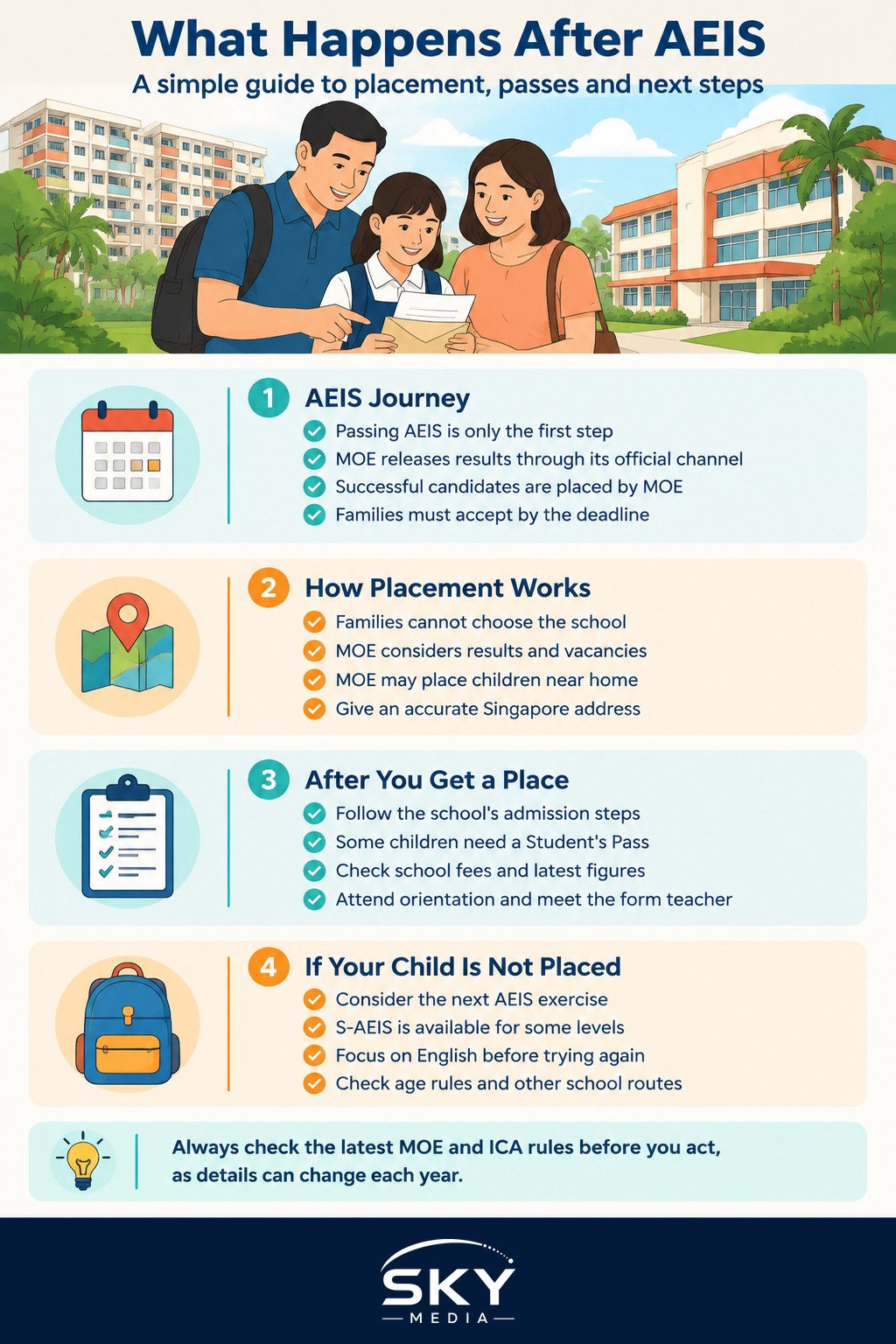
Here is the general sequence after your child sits the AEIS exam. The exact dates are published by MOE each year.
| Stage | What happens | What parents should do |
|---|---|---|
| Results release | MOE releases results to candidates through its official channel | Log in on the stated date and save the result |
| School placement | Successful candidates are placed in a government school by MOE | Read the placement details carefully, including the level |
| Accepting the offer | Families confirm the place and complete the school’s admission steps | Respond before the deadline and prepare the documents listed |
| Student’s Pass | The child applies for a Student’s Pass through ICA, the Immigration and Checkpoints Authority, if needed | Follow the school’s and ICA’s instructions closely |
| First day of school | The child joins the assigned class | Attend orientation and meet the form teacher |
A few things are worth knowing at each step:
- Results are pass or fail for placement purposes. Families generally do not receive a detailed score breakdown like a school report.
- The level matters. Your child applies to sit the exam for a particular level. Read the placement letter to confirm which level and school they have been offered.
- Deadlines are firm. If you do not accept or complete admission on time, the place may be lost.
How MOE Decides Which School
MOE assigns schools centrally. Families cannot pick a school, and MOE does not take requests for particular schools through AEIS. According to MOE’s guidance, placement considers the child’s results and the availability of vacancies in schools. MOE also tries, where possible, to place children in a school reasonably near the home address provided.
In practice this means:
- Popular schools often have few vacancies at the levels international students enter, so placement there is not guaranteed even with strong results.
- Your address matters. Give an accurate Singapore address. If you are still looking for a home, think about where you are likely to live, as moving later does not automatically mean a school transfer.
- Siblings may not be placed together. Each child is placed based on their own result and the vacancies at their level.
- Transfers after placement are not guaranteed. If you want to change schools later, you must go through the normal transfer process and the new school must have a vacancy.
For secondary students, there is an extra layer. Singapore’s secondary schools now use Full Subject-Based Banding, where students take subjects at different levels based on their strengths, instead of the older Express and Normal streams. Ask the school how your child’s subject levels will be set and reviewed, especially for English and Mathematics.
After Placement: Settling In
Once your child has a place, practical tasks follow quickly:
- School fees. International students pay higher school fees than Singapore Citizens and Permanent Residents. MOE publishes the current fee schedule, and fees are reviewed periodically, so check the latest figures.
- Student’s Pass. Most international students need a Student’s Pass to study in Singapore. Children who already hold a Dependant’s Pass may be treated differently, so confirm with the school and ICA which pass your child needs.
- Mother Tongue Language. Local schools teach a Mother Tongue Language, such as Chinese. Many children from China find this subject a strength. Ask the school what applies to your child.
- School terms and vocabulary. Words like CCA (Co-Curricular Activity), form teacher and PSLE will come up often. Our guide on how China-newcomer families can read PSLE school terms explains the common ones.
Children who enter mid-way through primary or secondary school often find the first months tiring. English is the main language of instruction, and classroom styles may feel more discussion-based than they are used to. Talk with the form teacher early and ask how you can support learning at home. Our guide to getting involved in your child’s school as a newcomer has practical ideas.
If Your Child Is Not Placed
Not every candidate passes, and that is not a reflection of a child’s ability in the long term. Common next steps include:
- Consider the next exercise. MOE runs the main AEIS once a year and a Supplementary AEIS (S-AEIS) for some levels at another time of year. Check which levels and dates apply.
- Focus on English. Many candidates find the English paper the hardest. Structured English learning in the months before the next exam can make a real difference.
- Check age limits. There are age requirements for each level, so a child who waits a year may need to apply for a different level. Check MOE’s eligibility rules carefully.
- Look at other routes. Some families consider private or international schools for a period. Our comparison of international schools and local schools sets out the trade-offs.
AEIS rules, timelines, fees and pass requirements are set by MOE and ICA and can change. Treat this guide as a starting point, and confirm every detail on the official MOE and ICA websites before making decisions for your child.
Frequently Asked Questions
Can I choose which school my child goes to after passing AEIS? No. MOE assigns schools centrally, and placement considers the child’s results, vacancies and, where possible, a reasonably nearby school. Popular schools often have few vacancies at entry levels, so even strong results do not guarantee a particular school.
Will siblings who pass AEIS be placed in the same school? Not necessarily. Each child is placed on their own result and the vacancies at their level, so siblings may end up in different schools. Raise it with MOE and ask what options exist.
What happens if I miss the deadline to accept the AEIS placement? The place may be lost, because deadlines are firm. Respond within the stated period and prepare the documents listed. If something goes wrong, contact MOE straight away rather than waiting.
How can my child prepare for the English paper before retaking AEIS? Many candidates find English the hardest paper, so structured English learning in the months before the next exercise helps. Reading, writing practice and speaking daily can make a real difference. Check MOE’s current format for details.
Can we ask for a school transfer after placement? Transfers are not guaranteed. You must go through the normal transfer process, and the new school needs a vacancy at your child’s level. Check MOE’s website for the current procedure and eligibility.
Official sources: Ministry of Education (MOE)
Further reading: School Admission Documents for Newcomers to Singapore · Chinese Bridging Classes for Newcomer Children in Singapore