

Moving to Singapore with children means juggling flats, passes and work, and school paperwork often lands at the last minute. Whether your child is heading to a government school, an international school or a private school, the school admission documents Singapore schools ask for tend to overlap a lot. Getting them sorted early, especially anything that needs translating or certifying in China, saves weeks of stress.
This article is a practical document checklist, not an explainer of the school system. If you are still deciding between school types, read our guide to international schools versus local schools first. Requirements differ by school and change over time, so treat this as a starting list and always follow the exact instructions from the school, the Ministry of Education (MOE) and the Immigration and Checkpoints Authority (ICA).
Why Paperwork Matters More for Newcomer Families
In China, many school records stay inside the local system, and parents rarely need to carry them around. In Singapore, a school that has never seen your child’s previous school has to rely entirely on the documents you bring. Foreign children who will study at a local school usually also need a Student’s Pass, a student immigration pass issued by ICA, and that application has its own document list.
Two things catch families out most often:
- Documents not in English. Schools and government agencies generally need an English translation of Chinese documents. Ask whether they require a certified or notarised translation, and whether an original must be shown.
- Records left behind. Report cards, transfer letters and vaccination booklets are much easier to collect before you leave China than to request from overseas later.
The Core Document Checklist
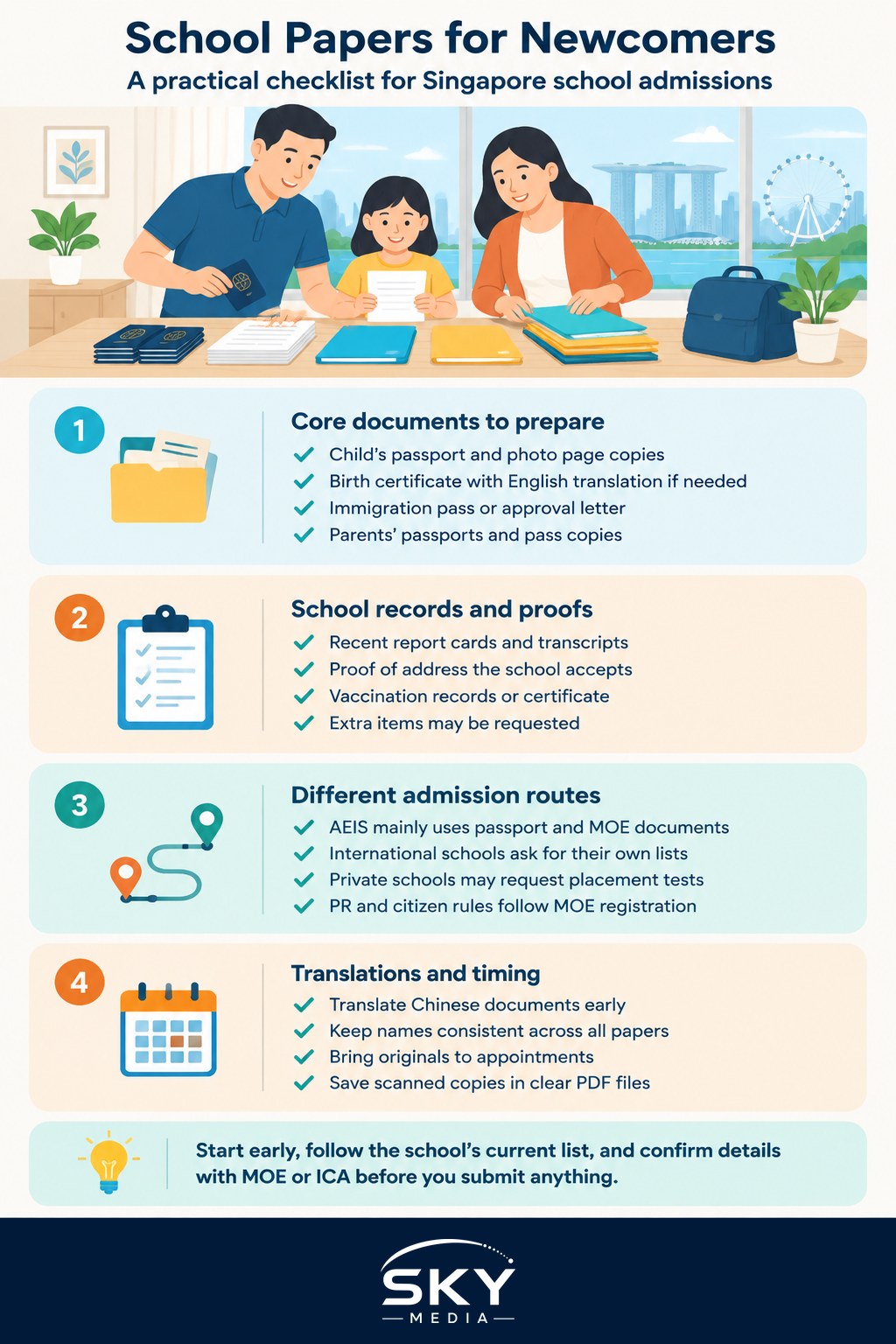
Most schools ask for some combination of the documents below. Use the table to see what each one is for and what to prepare.
| Document | Why schools usually ask for it | What to prepare |
|---|---|---|
| Child’s passport | Confirms identity and nationality | Original plus copies of the photo page; check validity covers the school period |
| Child’s birth certificate | Confirms date of birth and parents’ names | Original plus an English translation if it is in Chinese; ask if it must be notarised |
| Child’s immigration pass | Shows the child may live or study in Singapore | Dependant’s Pass, Student’s Pass, or the in-principle approval letter, as applicable |
| Parents’ passports and passes | Links the child to the parents and their status | Copies of passports and Employment Pass, S Pass or other pass cards |
| Previous school reports | Helps decide level and placement | Recent report cards and transcripts, with English translations |
| Proof of address | Some schools use it for registration or allocation | Tenancy agreement or other document the school accepts |
| Immunisation records | Schools may check vaccinations | Vaccination booklet or certificate, translated if needed |
Not every school will need every item, and some will ask for things not listed here, such as passport photos, a medical form or an application fee receipt. Keep this table as your base list and add school-specific items as you go.
Documents for Different Admission Routes
The route your child takes into school shapes which documents matter most.
Government schools via AEIS
Many international students enter mainstream primary and secondary schools through the Admissions Exercise for International Students (AEIS), a central test run by MOE. For AEIS, the most important items are your child’s passport and the documents MOE lists for registration. After the results are out, MOE places successful candidates in a school, and the school then asks for documents for enrolment and the Student’s Pass. Our guide to how AEIS school placement works covers the process step by step, and preparing for a school admission test helps with the test itself.
International and private schools
International schools run their own admissions. Expect to submit previous school reports, sometimes teacher recommendations, and occasionally an English placement test result. Some ask for records from the past two or three years. Check each school’s website, as their document lists vary widely.
Children of Singapore Permanent Residents or citizens
If your child is, or will become, a Singapore Permanent Resident or citizen, the process for local school places is different and follows MOE’s registration rules for that group. Ask MOE or the school directly which documents apply, rather than assuming the international student list covers you.
Translations, Certification and Names
Chinese documents are usually the biggest source of delay. A few practical tips:
- Translate everything at once. Birth certificates, report cards and vaccination records can usually be translated together. Ask the school or agency what level of certification they accept before you pay for it.
- Keep names consistent. Make sure your child’s name appears in the same way, in the same Hanyu Pinyin order and spelling, as on the passport across every document. A mismatch can mean extra checks.
- Bring originals to appointments. Even if copies are submitted online, originals are often checked in person. Keep them in one folder.
- Get school records stamped before leaving. If you are still in China, ask your child’s current school for stamped report cards and a transfer or leaving letter. This is much harder to arrange once you have moved.
For broader advice on organising family paperwork across both countries, see our guide to keeping your China and Singapore documents in order.
A Simple Timeline for Getting Ready
Timing depends on the school and admission route, but working backwards helps.
- Several months before the move: Collect original birth certificates, report cards and vaccination records. Arrange translations. Check passport validity for every family member.
- When applying: Scan every document into clearly named PDF files. Most applications are online, and having everything ready speeds things up.
- After an offer or placement: Follow the school’s instructions for the Student’s Pass application on ICA’s system, and any medical or enrolment forms.
- Before the first day: Keep a printed set of key documents and the pass approval in a folder, as schools sometimes ask to see them during orientation.
Keeping Your Copies Organised
A little organisation now saves stress at every renewal and school change later. Store scanned copies in a secure cloud folder that both parents can access, and keep the originals together at home. Note the expiry dates of passports and passes in your phone calendar, since a lapsed pass can affect your child’s schooling. When your child changes schools in Singapore, you will often need the same set of documents again, plus the latest local report book.
Getting your school admission documents in order is mostly about starting early and checking each school’s list carefully. Requirements can change from year to year, so confirm the current document list with the school, MOE or ICA before you submit anything.
Official sources: Ministry of Education (MOE)
Further reading: School Interview Tips for Primary and Secondary Admissions in Singapore