
Shopping for a new air conditioner usually starts with a search for “aircon price Singapore” and ends with a pile of quotes that are hard to compare. One installer’s package looks cheap until you notice it excludes trunking, another includes free dismantling but uses a lower-efficiency model. The headline air con price in Singapore depends far more on what is bundled in than most buyers expect.
Shop prices change with promotions, brands and the season, so this guide gives rough ranges and explains what you are actually paying for, so you can judge a fair price and spot the add-ons that push a quote up.
What Makes Up an Aircon Price
Every aircon quote in Singapore is built from the same few parts. Understanding them is the quickest way to compare offers.
- The outdoor condenser. This is the biggest single cost. Its capacity must match the number and size of indoor units connected to it.
- The indoor fan coils. Usually wall-mounted units in each room. Bigger rooms need higher-capacity units, which cost more.
- Standard installation. Most packages include a set length of copper piping, trunking, insulation and drainage per unit. Anything beyond that is charged extra.
- Brackets and placement. Mounting the condenser on a ledge or bracket, and any work at height, may be priced separately.
- Electrical works. A new isolator, power point or wiring upgrade may be needed, especially in older flats.
- Removal of the old system. Dismantling and disposing of existing units is sometimes free and sometimes a separate charge.
Big gaps between quotes usually sit in these line items, not the machine.
System 1, 2, 3 and 4 Explained
Singapore homes mostly use multi-split systems, where one outdoor condenser serves several indoor units. The “System” number simply tells you how many indoor units share one condenser.
| System type | Indoor units per condenser | Typical use | Relative cost |
|---|---|---|---|
| System 1 | 1 | A single room, or a room on its own condenser | Lowest upfront, but a separate condenser per room adds up |
| System 2 | 2 | Two bedrooms, or living room plus master bedroom | Moderate |
| System 3 | 3 | Common choice for 3-room and 4-room HDB flats | Higher upfront, often good value per room |
| System 4 | 4 | Larger 4-room, 5-room and executive flats, condos | Highest upfront, needs a large condenser |
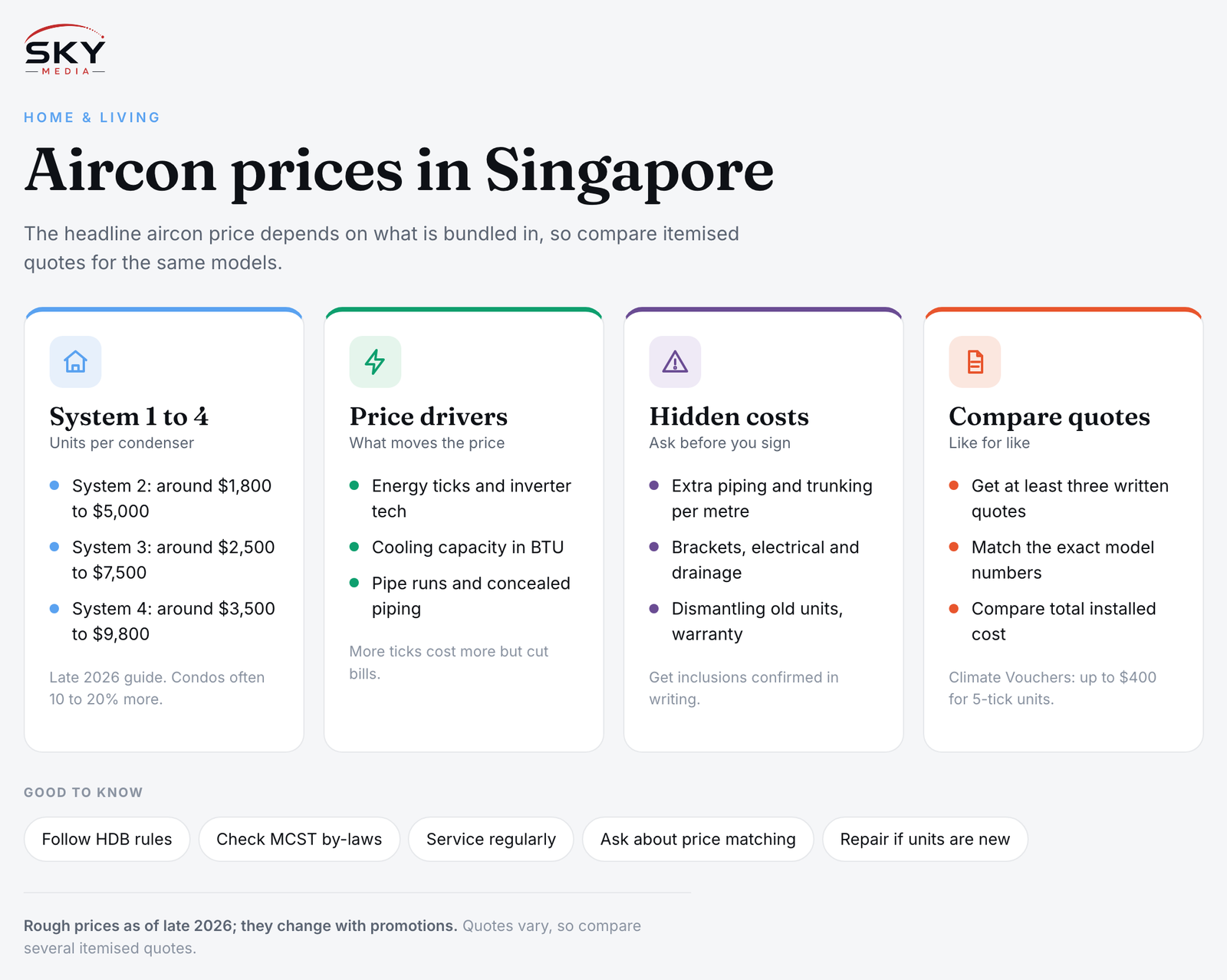
As a rough guide, as of late 2026, a System 2 with standard installation typically costs around $1,800 to $5,000, a System 3 around $2,500 to $7,500 and a System 4 around $3,500 to $9,800. The low end is an entry-level brand on existing piping; the high end is a premium 5-tick inverter model with new piping. Condo jobs often cost 10 to 20% more. Quotes vary.
A higher system number is not automatically better. A larger condenser runs less efficiently when only one room is in use, and if it breaks down, every connected room loses cooling at once. Some households choose a System 3 for the bedrooms plus a separate System 1 for the living room so they can run the room they use most on its own.
Factors That Push the Price Up or Down
Beyond the system type, these choices make the biggest difference to what you pay.
- Energy efficiency rating. Air conditioners sold in Singapore carry an energy label from NEA (the National Environment Agency) showing efficiency in ticks. More ticks usually means a higher purchase price but lower electricity bills over the years. NEA also sets minimum efficiency standards, so very inefficient models cannot be sold.
- Inverter technology. Inverter units adjust compressor speed instead of switching on and off. They usually cost more upfront and tend to save power when run for long hours.
- Cooling capacity. Measured in BTU, it should match the room size, sun exposure and how many people use the space. Oversizing wastes money and undersizing leaves rooms warm.
- Brand and model range. Premium ranges add features like quieter operation, better filters and app control.
- Refrigerant type. Newer models commonly use refrigerants with lower climate impact. Your installer can tell you which one a model uses and whether it affects servicing.
- Installation complexity. Long pipe runs between rooms and the condenser, concealed piping or wall hacking all add cost.
- Timing. Prices move with sales periods and new model launches.
Hidden Costs to Ask About Before You Sign
Ask each installer to confirm in writing whether these are included:
- Extra piping and trunking beyond the included length, and the rate per metre.
- Condenser bracket or ledge work, including any safety equipment needed for work at height.
- Electrical upgrades such as a new isolator or dedicated power supply.
- Drainage changes, such as rerouting a drain pipe or adding a pump.
- Dismantling and disposal of your old units and condenser.
- Wall hacking, patching and painting after concealed piping work.
- Warranty terms, including what the installer covers on workmanship and what the manufacturer covers on the compressor and parts, and for how long.
- Servicing packages, which are sometimes bundled to make a quote look better value than it is.
If you live in an HDB flat, the outdoor unit must be installed in line with HDB’s rules on where and how condensers are placed. Check HDB’s website and make sure your installer follows them. Condominium owners should also check the MCST (Management Corporation Strata Title) by-laws for any restrictions on condenser location or work hours.
How to Compare Quotes Fairly
The cheapest quote is not always the best price. To compare like for like:
- Get at least three written quotes for the same configuration, ideally after each installer has visited your home.
- Match the model numbers. A similar-sounding model from the same brand may have a different energy rating or capacity.
- Compare the total installed cost, not just the equipment price.
- Check what happens if something goes wrong. Ask about response times for warranty repairs and whether the installer is authorised by the brand.
- Look at lifetime cost. A more efficient unit with a higher price can cost less overall once electricity is counted. Our guide to calculating your aircon’s running cost shows how to estimate this.
- Ask about price matching. Some retailers will match a lower advertised price for the same model. See how to ask about price matching at Singapore retailers.
Eligible households can use Climate Vouchers, worth up to $400 and valid until 31 December 2027, towards a 5-tick air conditioner at participating retailers. Check the Climate Friendly Households Programme website for eligibility before you buy.
When to Repair Instead of Replace
A new system is a big spend, so it is worth asking whether you need one. Repair may make sense if the units are relatively new, the problem is a single part such as a fan motor or sensor, and the system has been serviced regularly. Replacement is usually the better choice if the compressor has failed outside warranty, repairs keep recurring, the units use an older refrigerant that is getting harder to service, or your electricity bills have climbed noticeably.
Regular servicing helps either way. Clean filters and coils keep efficiency up and catch small problems early. During haze periods, clean filters matter even more. Read should you run the aircon during the haze for tips.
Frequently Asked Questions
What is a reasonable aircon price in Singapore?
Roughly $2,500 to $7,500 for a System 3, depending on efficiency rating, brand and installation work. Comparing several itemised quotes for the same models is the most reliable way to judge a fair price.
Is System 3 or System 4 better for a 4-room flat?
Many 4-room flats use a System 3 for the bedrooms and living room. A System 4 suits homes that want cooling in an extra room, such as a study. Ask installers to size the system to how you actually use each room.
Are inverter aircons worth the higher price?
For rooms cooled for many hours a day, inverter units often recover the extra cost through lower electricity use over their lifespan.
How long does a new aircon installation take?
It varies with the number of units and the complexity of the piping. Your installer can give an estimate after a site visit.