

If you have ever wished you could stay calmer under pressure, worry less about things outside your hands, and act with a bit more steadiness, then this introduction to stoicism may speak to you. Stoicism is an ancient philosophy of life that began in Greece and later flourished in Rome, developed over centuries by many thinkers. It is not a quick productivity hack or a way to suppress your feelings, though it is sometimes flattened into those things online. At its heart, Stoicism is a practical guide for living well and facing life’s difficulties with wisdom and character. That combination of ancient depth and everyday usefulness is why it still resonates, including with people navigating the pressures of modern Singapore life.
Before going further, one honest note. Stoicism is a rich tradition, and thoughtful people interpret it in different ways. What follows is a plain, respectful overview of some widely shared ideas, not the final word.
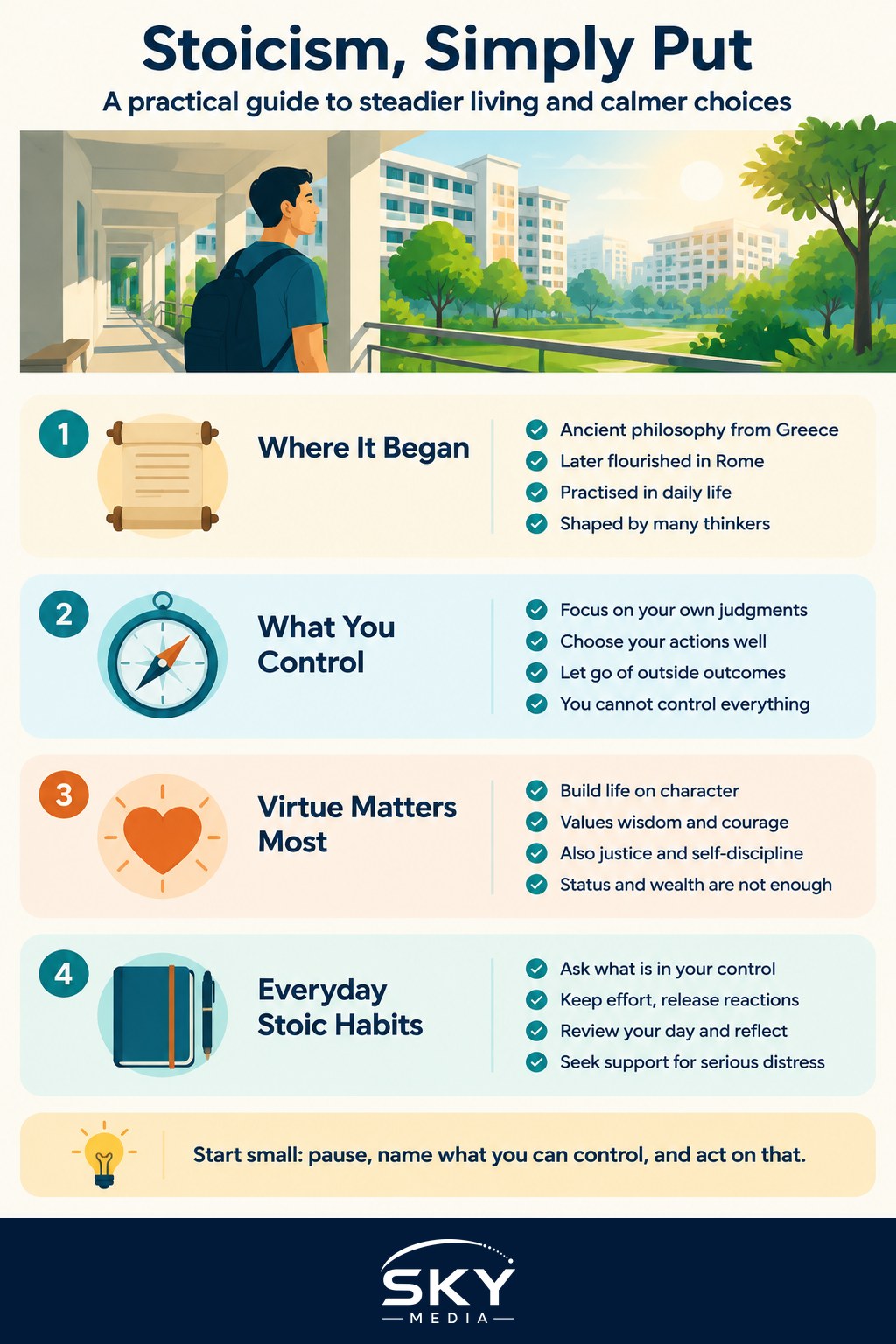
Where Stoicism Comes From
Stoicism arose in Athens more than two thousand years ago and became influential across the Greco-Roman world. Its later Roman voices are among the most quoted today, and their surviving writings still form much of what people read. Across its history, Stoicism was never just abstract theory. It was meant to be lived, practised daily, and tested against real hardship, loss, and duty.
This matters because Stoicism is easy to misread. It is not about being cold, emotionless, or indifferent to others, despite how the word “stoic” is used in casual English. The tradition actually cares deeply about virtue, justice, and our duties to fellow human beings. Understanding this guards against the common caricature of the unfeeling person who simply bottles everything up.
The Core Idea: What You Control
If Stoicism has one central teaching that has travelled well through the ages, it is the distinction between what is in our control and what is not. Broadly, the Stoics held that our own judgments, choices, and actions are up to us, while outcomes, other people’s opinions, the weather, the economy, and much else are not fully in our hands.
The practical wisdom here is to invest your energy where you actually have power, and to release your grip on the rest. You cannot control whether the MRT is delayed, but you can control how you respond to it. You cannot control whether you get the promotion, but you can control your effort, your integrity, and your attitude. This single shift can lift an enormous amount of unnecessary suffering, and it pairs naturally with learning how to let go of what you cannot control.
Importantly, this is not passive resignation. Stoics still acted, planned, and cared about results. They simply tried to hold outcomes lightly, doing their best while accepting that the final result was not entirely theirs to command.
Living With Virtue and Character
For the Stoics, the good life was not built on wealth, status, or pleasure, though they did not necessarily despise these things. It was built on virtue, on being a person of wisdom, courage, justice, and self-discipline. External goods could come and go, but your character was the one thing that could remain steady and truly yours.
This has a grounding effect. It suggests that a meaningful life is available to you regardless of your circumstances, because it depends less on what happens to you and more on how you choose to meet it. In a fast, comparison-heavy environment, that is a quietly radical thought, and it connects to the ongoing work of finding your personal values and living by them.
The Stoics also practised reflection. Many valued the habit of reviewing the day, examining their reactions, and gently correcting course, which is close in spirit to the benefits of journaling as a tool for self-examination.
Bringing Stoicism Into Everyday Life
You do not need to adopt every ancient teaching to benefit from a Stoic outlook. Many people simply borrow a few practices and test them against their own lives, which is very much in keeping with the tradition’s practical spirit.
- When something frustrates you, pause and ask what part of this is actually within my control.
- Focus your effort on your own actions and let go of managing others’ reactions.
- Remind yourself that events are not good or bad in themselves, but shaped by your judgment of them.
- Practise being content with enough, rather than always reaching for more.
A gentle word of care here. Stoicism can help you meet ordinary stress, disappointment, and uncertainty with more steadiness. It is a philosophy of life, not a treatment for serious distress. If you are struggling with persistent low mood, anxiety, or a sense of hopelessness, please reach out to someone you trust, a doctor, or a counsellor. Reaching for support is itself a wise and courageous act, and no philosophy replaces real human care.
Stoicism has lasted for good reason. It offers a calm, dignified way to face a world you cannot fully control, without pretending the difficulty away. Read a little, try a practice or two, and see what genuinely helps you. If it deepens your curiosity, you might explore how to develop a personal philosophy of your own, taking what is useful from Stoicism and elsewhere, and building a way of living that fits your one particular life.
Frequently Asked Questions
Does Stoicism mean suppressing my emotions? No, the article stresses that it is not about being cold or bottling things up. The tradition cares deeply about virtue, justice and our duties to others. It is about judging events wisely, not pretending you feel nothing.
Where should a beginner start reading about Stoicism? Start with short, readable pieces and try one or two practices before committing to the heavy texts. Its later Roman writers are widely quoted and approachable in modern translations. Thoughtful people interpret it differently, so read more than one view.
Is Stoicism a religion? No, it is a philosophy of life, so you can borrow practices whatever your faith or none. It does not require you to give up other beliefs. Take what is useful and fit it to your own life.
Can Stoicism help with anxiety or depression? It can help you meet ordinary stress and uncertainty more steadily, but it is not a treatment for serious distress. If you have persistent low mood, anxiety or hopelessness, speak to a doctor or counsellor. Seeking support is itself a wise and courageous act.
What is a simple Stoic exercise I can try today? When something frustrates you, pause and ask what part of it is within your control, then put your effort there. Reviewing your day and your reactions in the evening is another classic practice. Start small.
Further reading: An Introduction to Ikigai · Understanding Amor Fati: Loving Your Fate