

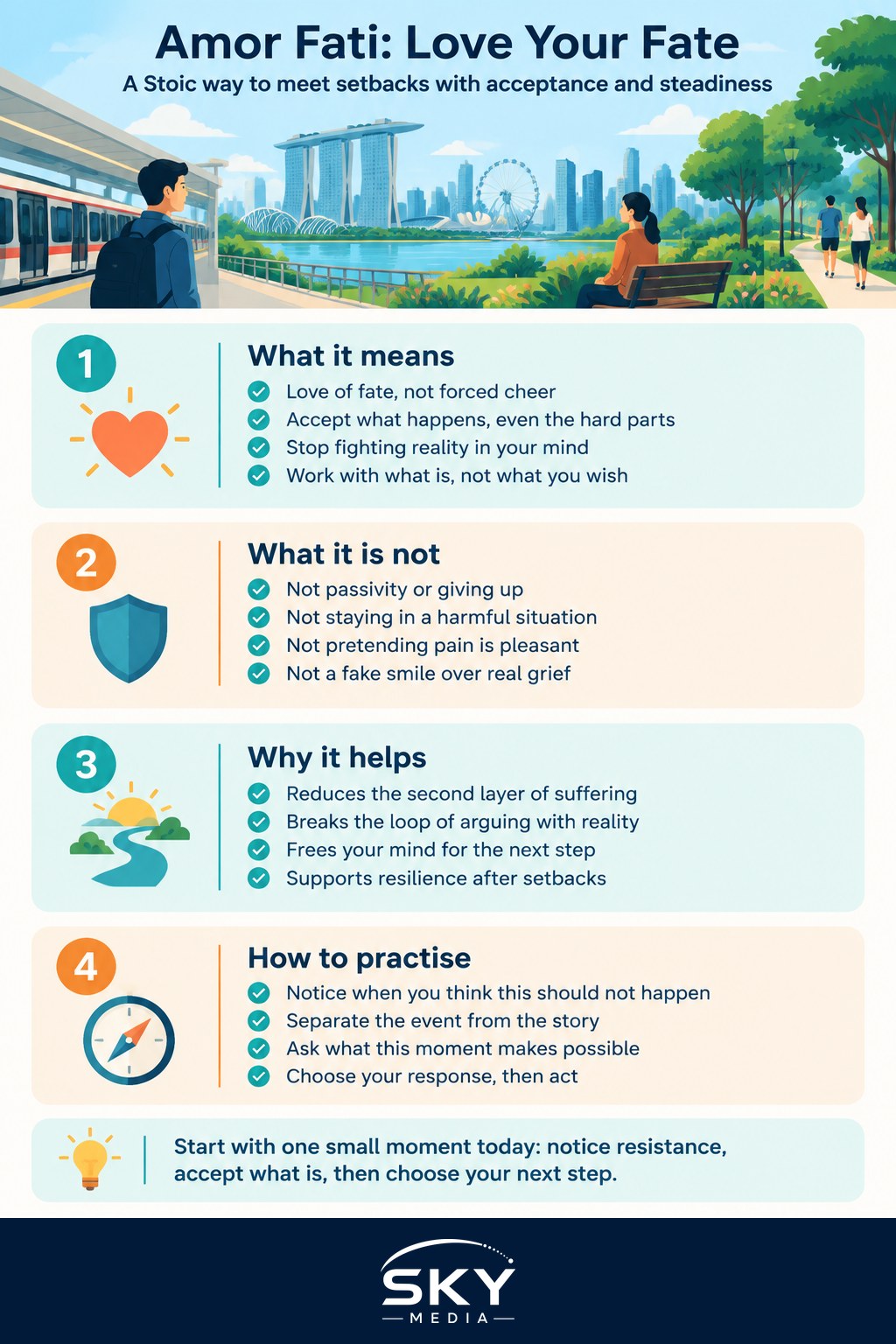
Amor fati is a Latin phrase that means love of fate. It is a Stoic idea about meeting whatever happens in your life, including the hard parts, not with grudging tolerance but with acceptance and even a kind of welcome. Stoicism is a Greco-Roman philosophy, and amor fati is one of its most striking themes. It does not ask you to pretend that pain is pleasant. It invites you to stop fighting reality and to work with what is, rather than endlessly wishing it were otherwise. In busy Singapore, where plans get disrupted by delays, retrenchments, and change, this quiet stance can be surprisingly steadying. Keep in mind that interpretations of Stoicism vary, so hold this as a perspective, not a strict formula.
What Amor Fati Is and Is Not
At its heart, amor fati is about acceptance. When something has already happened, or is happening beyond your control, resisting it in your mind only adds a second layer of suffering. You have the event itself, and then you have the exhausting inner protest against it. Amor fati gently drops the second layer.
It is important to be clear about what this does not mean. Loving your fate is not passivity or giving up. It does not mean staying in a harmful situation or refusing to act. The Stoics were practical people who still worked, planned, and cared deeply. Amor fati is about your relationship to what you cannot change, so that your energy goes into what you can. It also does not mean forcing a fake smile over real grief. You can accept a loss while still feeling its weight.
Why Loving Your Fate Helps
Much of our daily stress comes from arguing with reality. The train is delayed, the client says no, the results are not what we hoped. We replay these moments and insist they should be different. Amor fati offers an exit from that loop. Once you accept what has happened, your mind is freed to ask a better question: given this, what now?
This shift builds resilience. People who can accept setbacks tend to recover faster, because they spend less time stuck in resentment. It connects closely to building resilience when things go wrong, which is about bouncing back rather than bracing against every knock. Amor fati adds a deeper layer: not just enduring the setback, but finding a way to say yes to your actual life, including its detours.
How to Practise Amor Fati in Daily Life
You do not become a philosopher overnight. Amor fati is a habit of mind you build slowly, one situation at a time.
- Notice the resistance. When you catch yourself thinking this should not be happening, pause. That thought is the extra suffering you can put down.
- Separate event from story. The event is what actually occurred. The story is the anger or blame you pile on top. Work with the event.
- Ask what it makes possible. Even unwanted events open some door, however small. A cancelled plan might give you a rare quiet evening. A rejection might redirect you.
- Choose your response. Acceptance is where useful action begins. Once you stop fighting the fact, decide your next real step.
This ties naturally to learning how to let go of what you cannot control. Amor fati is the warmer cousin of that idea. It is not only letting go, but leaning in.
A Realistic Word on Hard Times
Amor fati is a reflective philosophy, not a treatment for serious distress. Loving your fate does not mean you should carry heavy grief, anxiety, or hopelessness alone. If you are going through a genuinely difficult season and it is not lifting, please reach out to someone you trust, or to a professional such as a GP or counsellor. A philosophy can steady an ordinary bad day. It is not a replacement for real support when life feels too heavy.
Be gentle with the practice too. Some days you will accept things easily. Other days the resistance will be loud, and that is human. Amor fati is a direction to walk in, not a test to pass.
Bringing It Into Singapore Life
Our city rewards planning, and there is nothing wrong with that. But no amount of planning removes uncertainty. Projects fall through, health changes, and life takes turns we did not choose. Amor fati offers a way to stay open-handed. When the MRT breaks down, you can seethe, or you can accept the delay and use the time. When a career path closes, you can insist it was unfair, or you can accept the reality and start building the next chapter.
Over time, this stance frees up a lot of energy. Instead of a running argument with life, you get a quieter partnership with it. If this appeals to you, it sits alongside other Stoic practices worth exploring, such as an introduction to Stoicism.
Amor fati will not make hardship vanish. What it offers is a change in posture: from resistance to acceptance, from bitterness to a hard-won openness. Loving your fate is less about liking everything that happens and more about choosing to fully live the life you actually have. Practised gently, it can make you calmer, steadier, and freer in a city that never quite slows down.
Frequently Asked Questions
Does amor fati mean I should never try to change my situation? No. Amor fati is about how you relate to what has already happened or cannot be changed, not about staying put. Once you accept the facts, you can act more clearly on what is within your control, such as changing jobs or asking for help.
How is amor fati different from simply being positive? Positive thinking tries to see everything as good, whereas amor fati accepts reality as it is, including pain, without pretending. You can feel sad and still say yes to your actual life. It is a steadier stance than forced cheerfulness.
Can I practise amor fati after a retrenchment or job loss? Yes, as a way to stop fighting what has happened so your energy can go to next steps. It does not replace practical support. Check the latest help and schemes through MOM and SWDA, and lean on family, friends or a counsellor if the stress is heavy.
What is a simple phrase I can use to remind myself of amor fati? Something like ‘this is what is happening, so what now?’ works well. It acknowledges the event without adding a story of blame, then points you at a useful next step. Pick wording that feels natural to you, in any language.
Is amor fati the same as fatalism? Not quite. Fatalism says nothing you do matters, while amor fati asks you to accept the past and present and still act with care. The Stoics kept working, planning and caring. The difference is that you stop wasting energy on protesting what is already settled.