

For many Chinese families in Singapore, the wedding morning does not start with the gate crash or the tea ceremony. It starts quietly, in front of the family altar. A Chinese wedding ancestor prayer is the moment the couple, or the groom and bride separately, inform their forebears and household deities that a new member is joining the family, and ask for blessings on the marriage.
This guide walks through when these prayers usually happen, who does what, what offerings families commonly prepare and how to fit the rites into a tight wedding-day schedule. Practices vary widely between dialect groups, religions and individual households, so treat everything here as a description of common practice, not a rulebook. The best authority is always the elders in your own family.
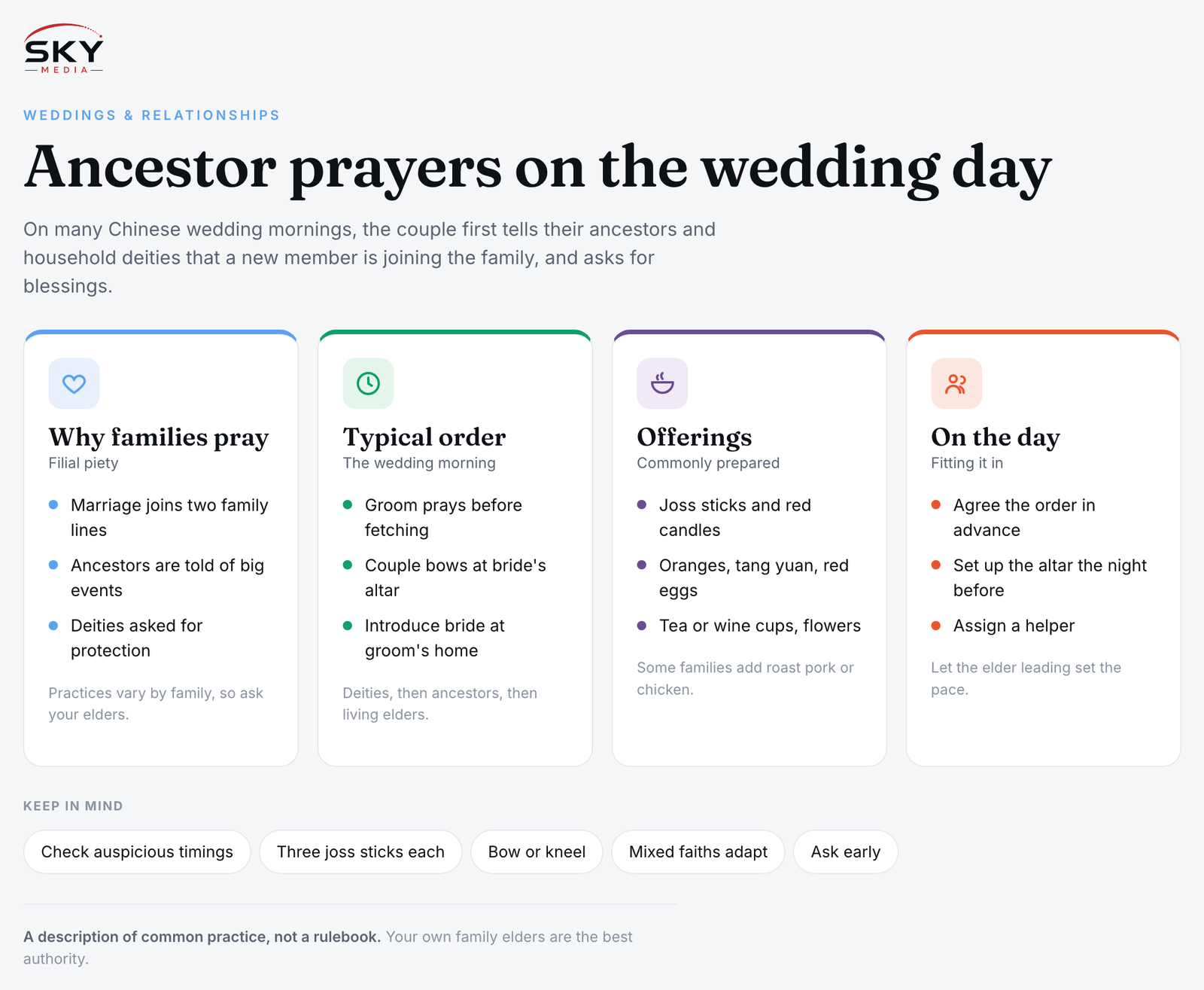
Why Families Pray to Ancestors and Deities on the Wedding Day
In traditional Chinese belief, marriage is not just a union of two people but the joining of two family lines. Ancestors are seen as members of the family who should be told about major life events, much as you would inform a living grandparent. Paying respects is a way of showing filial piety and gratitude for the family’s continuity.
Deity prayers serve a related purpose. Many homes keep an altar to the Heavenly God (Tian Gong) at the door or window, the Earth God or kitchen god, or a household guardian deity such as Guan Yin. Offering incense on the wedding morning is a request for protection, harmony and a smooth day.
For couples who are Christian, Buddhist-only, freethinkers or from mixed backgrounds, the approach differs. Some families keep only the ancestral portion, some replace it with a family prayer or a quiet bow to photographs, and some skip it entirely. If you are unsure what your parents expect, ask early rather than on the morning itself.
When the Prayers Happen: A Typical Wedding Morning Sequence
The exact order depends on family custom and any auspicious timings chosen from the Chinese almanac (Tong Shu) or by a fortune master. A commonly seen sequence looks like this:
- Groom’s home, before he leaves to fetch the bride. The groom, sometimes with his parents, offers incense to the deities and then to the ancestors, announcing that he is going to bring his bride home.
- Bride’s home, before or after the gate crash. Some families have the bride pray to her own ancestors early in the morning to bid farewell. Others do it together with the groom after he arrives, so both can bow before her family altar.
- Bride’s home tea ceremony. The couple serves tea to the bride’s parents and elders.
- Groom’s home, on arrival. The couple prays to the groom’s deities and ancestors together, formally introducing the bride as a new member of the household.
- Groom’s home tea ceremony. Tea is served to the groom’s parents and relatives.
The key principle in many families is that deities come before ancestors, and ancestors come before living elders. That is why the prayers usually precede each tea ceremony. If you are building a detailed timeline, our guide to your wedding day run of show shows how to slot these segments in.
Offerings Families Commonly Prepare
There is no single required list. Older relatives often have firm preferences tied to dialect tradition, so check with them first. Commonly seen items include:
- Joss sticks and red candles. A pair of red candles is often lit at the altar, and each person offering prayers holds three joss sticks.
- Fruit. Oranges and mandarin oranges are popular for their association with gold and good fortune. Some families avoid certain fruits for weddings, so ask.
- Sweet items. Sweet dumplings (tang yuan), red eggs, or kueh in auspicious colours are often included to wish the couple a sweet marriage.
- Tea or wine cups. Small cups of tea or Chinese wine are poured for the ancestors.
- Flowers. Fresh flowers in red, pink or yellow are commonly placed on the altar. If you grow your own, see growing flowers for prayers and offerings.
- Roast pork or whole chicken. Some families, particularly those with Cantonese roots, include roast meats, which are later shared with the household.
After the incense has burned partway, families often treat the food offerings as blessed and share them, sometimes with the wedding party.
Who Does What: Roles at the Altar
| Moment | Who usually prays | What they commonly do |
|---|---|---|
| Groom’s home, before fetching | Groom, often with his parents | Lights incense, bows to deities then ancestors, announces he is fetching his bride |
| Bride’s home, morning | Bride, sometimes with parents | Thanks her ancestors and bids farewell before leaving her family home |
| Bride’s home, after arrival | Couple together | Bows at the bride’s family altar before the tea ceremony |
| Groom’s home, on arrival | Couple together | Introduces the bride to the groom’s ancestors and asks for blessings |
In many households a parent or senior relative leads, telling the couple when to bow and what to say. The words can be simple: stating their names, that they are marrying today and asking the ancestors to bless them. Some families recite in dialect, which is a lovely way to involve grandparents.
Bowing customs also vary. Some families bow three times while holding the joss sticks, then place them in the urn. Others kneel. Let the person leading set the pace.
Fitting the Rites Into a Tight Schedule
Wedding mornings in Singapore often run on a strict timetable, especially if you have an auspicious hour to meet and a lunch or dinner banquet to follow. A few practical tips help:
- Agree the order with both families in advance. Confirm whether prayers happen before or after each tea ceremony and whether the couple prays together at both homes.
- Budget realistic time. Lighting candles, distributing joss sticks and bowing take a few minutes per person. Add time if many relatives will join.
- Prepare the altar the night before. Set out fruit, cups, candles and a lighter so nothing is hunted for in the morning.
- Assign a helper. A sibling or cousin can hand out joss sticks and keep track of timing. Our guide on creating a wedding day schedule for your helpers covers how to brief them.
- Brief your photographer. Many couples want this moment captured. Agree where the photographer can stand without blocking the altar.
Safety in HDB flats and condos
Incense and candles in a small flat full of guests, flowers and wedding gowns call for care. Keep candles away from veils and curtains, never leave flames unattended, and make sure the urn is stable. If your condo has rules about burning items in common areas, follow them and keep the rites indoors at the family altar.
Etiquette for Brides Joining a New Family
For a bride entering a family with different customs, the altar can feel unfamiliar. A few gentle pointers:
- Follow the lead of your mother-in-law or the elder guiding the prayers.
- Dress in your planned morning outfit, often a qun kwa or a red dress, which suits the occasion.
- If your own faith means you prefer not to hold incense, talk to your partner and parents-in-law beforehand. Many families are happy for you to bow with your hands together instead.
- Ask questions afterwards. Learning the names of the ancestors honoured is a respectful way to show interest in your new family.
Planning Checklist
- Ask both sets of parents which rites they want and in what order.
- Check auspicious timings if your family consults the almanac.
- Buy joss sticks, red candles and fruit a few days ahead.
- Prepare sweet offerings or arrange for a relative to make them.
- Brief your helpers and photographer.
- Confirm arrangements for couples of different faiths.
These morning rites take only minutes, but they are often the part parents remember most fondly. For the wider picture of betrothal, gate crash and tea ceremony traditions, read our guide to Chinese wedding customs in Singapore.
Further reading: Holding a Wedding During Chinese New Year · Wearing a Kua (Qun Gua) for Your Chinese Wedding