

A rolled ankle is one of the most common injuries in Singapore, whether it happens on a futsal court, during a run at the park connector, on wet stairs in the rain or simply stepping off a kerb in the wrong shoes. Most sprains heal well with sensible care, but a poorly managed sprain can leave the ankle weak and prone to rolling again. This guide explains ankle sprain treatment at home, how recovery usually progresses, and the signs that mean you should see a doctor.
This is general information, not medical advice. If you are unsure how serious your injury is, see a GP, a polyclinic doctor or a physiotherapist. Do not take medication for pain or swelling without checking with a doctor or pharmacist that it is suitable for you.
What Happens When You Sprain Your Ankle
A sprain is an injury to the ligaments, the tough bands that hold the bones of a joint together. The most common type is an inversion sprain, where the foot rolls inward and stretches or tears the ligaments on the outer side of the ankle. Less often, the foot rolls outward, or the injury affects the “high ankle” ligaments above the joint, which tend to take longer to heal.
Typical symptoms include:
- Pain on the outside of the ankle, often worse when you put weight on it
- Swelling, which may appear quickly or build over several hours
- Bruising that can spread down towards the toes over the following days
- Stiffness and difficulty moving the ankle
- A feeling that the ankle is unstable or “gives way”
How Sprains Are Graded
Doctors and physiotherapists often describe sprains in three grades. Only a clinician can grade your injury properly, but understanding the general idea helps you set realistic expectations.
| Grade | What it generally means | What you might notice |
|---|---|---|
| Grade 1 (mild) | Ligament stretched, with small tears at most | Mild pain and swelling, able to walk with some discomfort |
| Grade 2 (moderate) | Partial tear of the ligament | More swelling and bruising, walking is painful, some looseness |
| Grade 3 (severe) | Complete tear of the ligament | Marked swelling and bruising, often unable to bear weight, ankle feels unstable |
Recovery time varies widely by grade, age, fitness and how well rehab is done. Mild sprains often settle within a few weeks; more severe ones can take much longer. A clinician can give you a realistic timeline for your case.
First Aid in the First Few Days
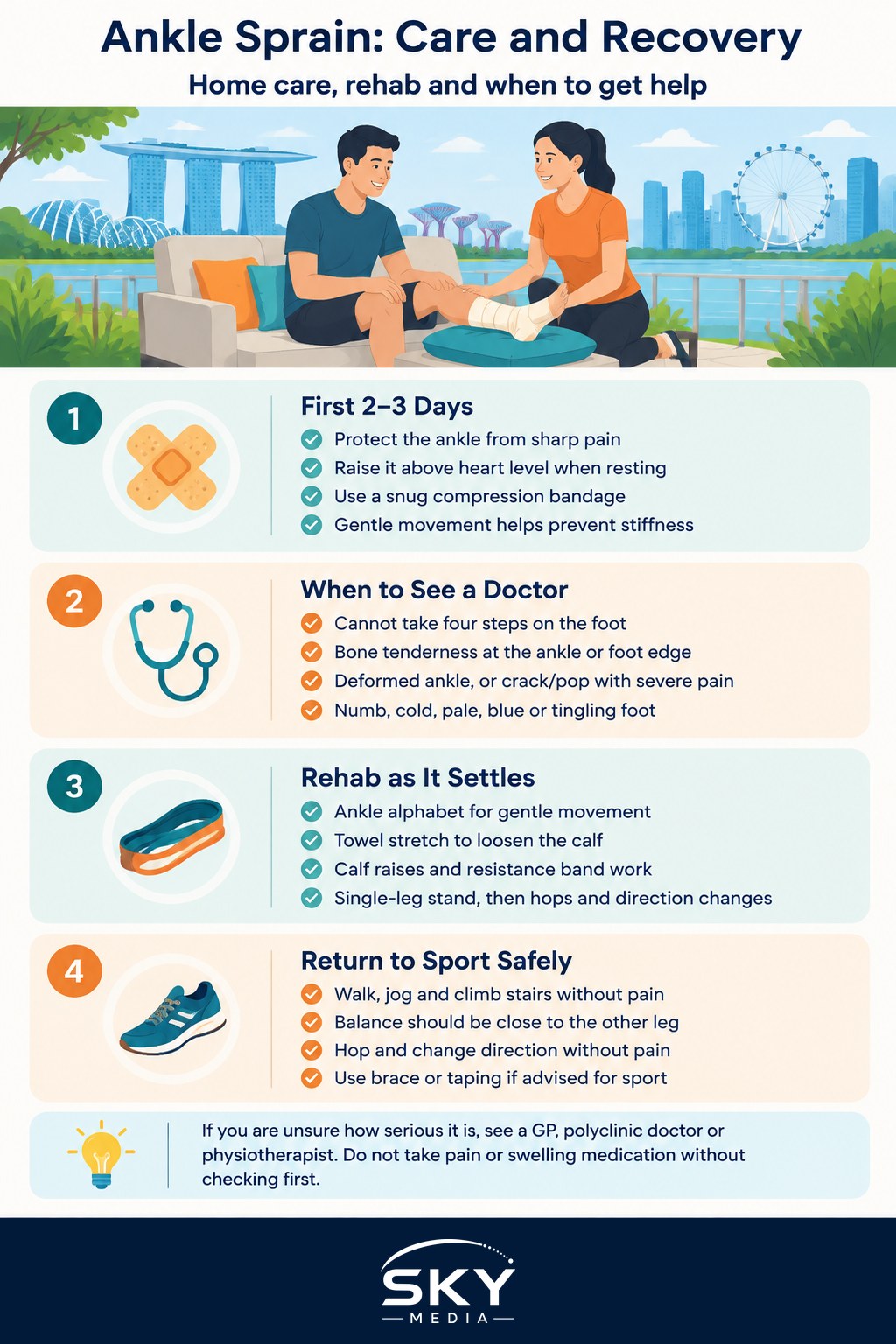
The first two to three days are about protecting the ankle and settling the swelling. A widely used framework is often summarised by the words “protect, elevate, compress”, plus relative rest and gentle movement as pain allows.
- Protect it. Avoid activities that cause sharp pain. Use crutches if walking is very painful, and ask a doctor or physiotherapist whether a brace or support is right for you.
- Elevate it. Raise your ankle above heart level when resting, propped on pillows on the sofa or bed. This helps fluid drain away.
- Compress it. A compression bandage can help limit swelling. It should feel snug, not tight. Loosen it if your toes go numb, tingle, turn pale or feel cold.
- Ice, if it helps. Many people find cold packs ease pain. Wrap ice in a thin cloth rather than putting it directly on the skin, and keep sessions short.
- Move gently. Gentle movement within comfort, such as pointing and flexing the foot, helps prevent stiffness.
Avoid alcohol, heavy massage and hot baths or heat rubs in the first couple of days, as these may increase swelling. Also avoid the temptation to “walk it off” through sharp pain.
When to See a Doctor
Many sprains can be managed at home, but you should see a doctor, either a GP, a polyclinic or, in more serious cases, an Accident and Emergency (A&E) department, if:
- You cannot take four steps on the injured foot, either straight away or later
- There is tenderness when pressing on the bony bumps on either side of the ankle or along the outer edge of the foot
- The ankle or foot looks deformed, or you heard a crack or pop with immediate severe pain
- Your foot feels numb, tingly, cold or looks pale or blue
- There is a wound over the injury, or signs of infection such as spreading redness, warmth or fever
- The pain and swelling are not improving after several days of home care
- The ankle keeps giving way weeks after the injury
A doctor will examine the ankle and decide whether you need an X-ray to check for a fracture. They may refer you to a physiotherapist for a structured rehab plan. If you are a newcomer and unsure how the system works, our guide on how to see a doctor in Singapore explains your options. For a child’s injury, see knowing when to see a doctor for your child.
Simple Rehab Exercises as the Ankle Settles
Once the initial pain and swelling start to ease, rehab helps restore movement, strength and balance. Rehab is the step most people skip, and it is the main reason sprains recur. The exercises below are commonly used, but check with a physiotherapist before starting, especially after a moderate or severe sprain. Stop if any exercise causes sharp pain.
Range of motion (early stage)
- Ankle alphabet. Sit with your leg out and “write” the letters of the alphabet in the air with your big toe.
- Towel stretch. Sit with your leg straight, loop a towel around the ball of your foot and gently pull it towards you to stretch the calf.
Strength (middle stage)
- Calf raises. Stand holding a wall or chair and slowly rise onto your toes, then lower down. Progress from both feet to one foot.
- Resistance band work. Loop a band around your foot and push the foot outward, inward, up and down against the resistance.
Balance (later stage)
- Single-leg stand. Stand on the injured leg near a support. Once that feels easy, try it with eyes closed or on a cushion.
- Hops and direction changes. Gentle hopping and side steps, only once balance and strength are good.
Returning to Sport Safely
It is tempting to get back on court as soon as walking feels normal, but the ankle needs to cope with jumping, cutting and sudden turns. Signs you may be ready, ideally confirmed by a physiotherapist:
- You can walk, jog and climb stairs without pain or limping
- Your balance on the injured leg is close to your other leg
- You can hop on the injured leg and change direction without pain or giving way
- Swelling no longer returns after activity
Ease back in with training before full matches. Some people use an ankle brace or taping for a period when returning to sports with lots of jumping and turning; ask your physiotherapist whether this suits you. For ongoing prevention once you are fully recovered, our guide to ankle mobility and stability covers training to keep your ankles strong.
Reducing the Risk of Another Sprain
A previous sprain is one of the biggest risk factors for another. A few habits help:
- Wear supportive, well-fitting shoes for your sport and replace worn-out ones
- Warm up before exercise
- Keep up balance work even after recovery
- Take extra care on wet surfaces, uneven paths and stairs, which are common during Singapore’s rainy spells
With early care, patient rehab and a sensible return to activity, most ankle sprains heal well. If in doubt at any stage, check with a doctor or physiotherapist.
Official sources: HealthHub
Further reading: Ingrown Toenails: Home Care and When to See a Podiatrist · Hamstring Strains: Recovery and Prevention · Fractures and Sprains in Kids: How to Tell When It’s More Than a Bump