
Children fall off scooters, trip at the playground and land badly in football every day, and most of the time a cuddle and a short rest is all they need. Sometimes, though, a limb injury is more serious than it looks. Knowing the child broken bone signs, how they differ from a sprain, and where to go for help can save you a long wait in the wrong place or, more importantly, stop a fracture from going unnoticed. This guide is general information for parents, not medical advice. If you are worried, have your child seen by a doctor.
Why Children’s Injuries Can Be Tricky
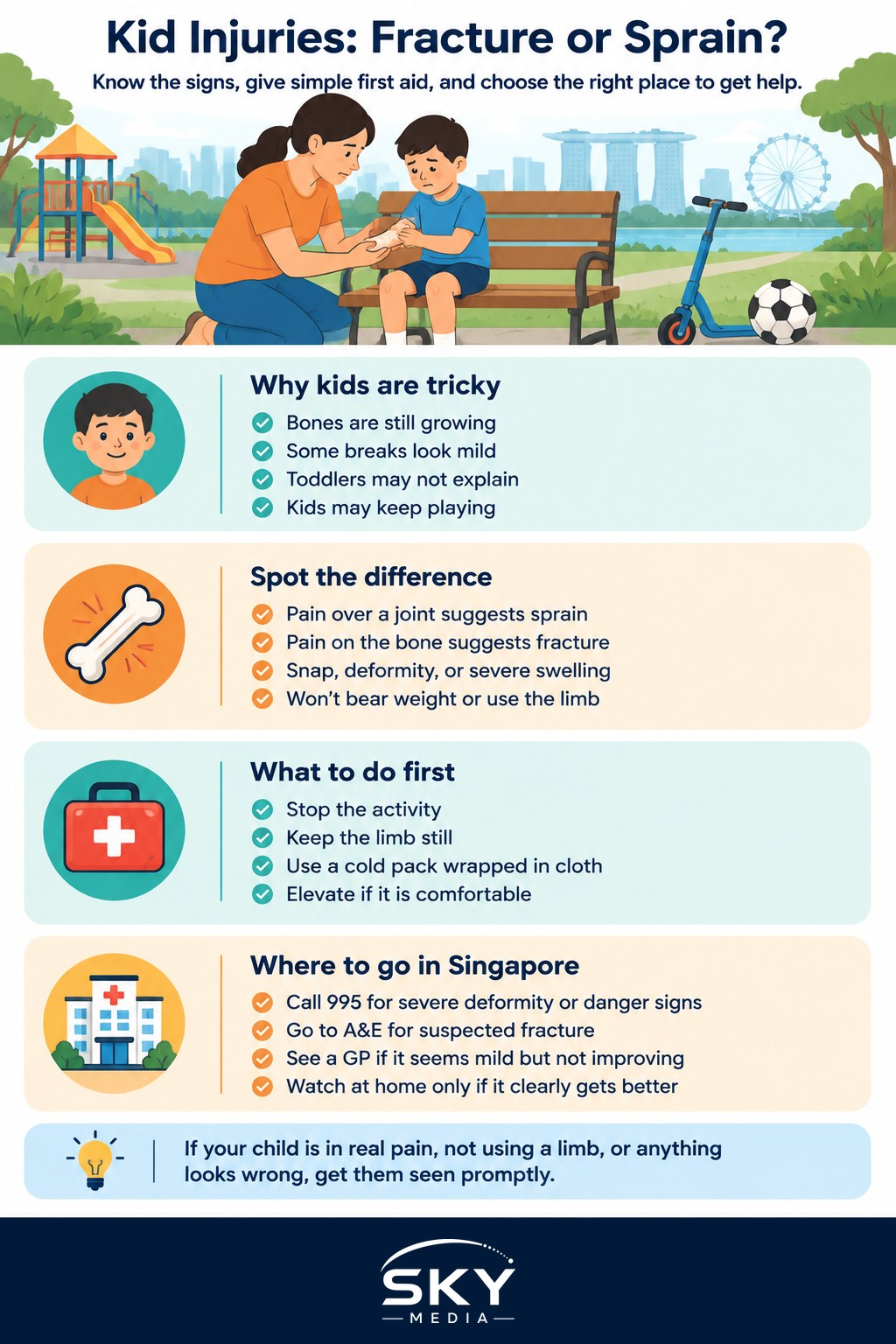
Children’s bones are still growing, which changes how injuries behave:
- Bones bend and partly break. Young bones are more flexible, so they can crack on one side only. These incomplete breaks (often called greenstick or buckle fractures) may not look dramatic at all.
- Growth plates are vulnerable. Near the ends of long bones are areas of growing cartilage. Injuries here need proper assessment because they can affect growth if missed.
- Young children cannot always explain. A toddler may simply refuse to walk, or stop using an arm, rather than telling you where it hurts.
- Kids keep going. Children may play on after a fracture, so being able to move a limb does not rule out a break.
For head injuries, see our separate guide on what to do when your child bumps their head. This article focuses on arms, legs, wrists, ankles, fingers and collarbones.
Fracture or Sprain: Spotting the Difference
A sprain is an injury to a ligament, the tissue holding a joint together. A fracture is a break or crack in the bone. They can look similar, and only an examination and often an X-ray can tell them apart for certain. These patterns can help you decide how urgently to act.
| Sign | More suggestive of a sprain | More suggestive of a fracture |
|---|---|---|
| Location of pain | Around the joint, such as the ankle or wrist | Pain directly over the bone, tender to a gentle touch at one spot |
| Shape | Swelling, but the limb looks normally aligned | Visible bend, bump or deformity |
| Use of the limb | Can usually bear some weight or use it gingerly | Refuses to bear weight or use the limb at all |
| Sound or feeling at injury | No particular sound | Child or others heard a snap or crack |
| Pain over time | Gradually improves over a day or two | Stays severe or gets worse, waking the child at night |
| Bruising and swelling | Mild to moderate | Rapid, significant swelling and bruising |
Other child broken bone signs to watch for include holding the arm tightly against the body, limping that does not improve, pain when the limb is tapped or squeezed gently away from the injury, and a child who is unusually quiet, pale or distressed.
Simple First Aid at Home
While you decide what to do, these general first aid steps are widely recommended:
- Stop the activity. Do not encourage your child to “walk it off”.
- Keep the limb still. Support it in the most comfortable position. For an arm, a folded towel or a simple sling from a scarf can help. Do not try to straighten a deformed limb.
- Cool it. Apply a cold pack or ice wrapped in a cloth for short periods. Never put ice directly on the skin.
- Elevate if comfortable. Raise an injured ankle or wrist on a pillow to help with swelling.
- Pain relief. Ask a doctor or pharmacist about suitable children’s pain relief and the correct dose for your child’s age and weight. Avoid giving food or drink if a fracture seems likely and your child may need treatment under sedation, until a doctor advises otherwise.
- Comfort and reassure. A calm parent helps a frightened child.
The familiar “rest, ice, compression, elevation” approach suits mild sprains, but if you suspect a fracture, focus on keeping the limb still and getting it checked.
A&E, GP or Wait and See
Singapore offers several options, and choosing well matters for both your child and the system.
Call 995 for an ambulance if:
- The limb is badly deformed, or bone is visible through the skin.
- The hand or foot below the injury is cold, pale, blue or numb.
- There is heavy bleeding, or your child is drowsy, confused or struggling to breathe.
- The injury involves the neck or back, in which case do not move your child.
Go to a children’s emergency department or hospital A&E if:
- You suspect a fracture: deformity, severe pain over a bone, inability to bear weight or use the arm.
- Swelling is rapid and severe.
- Your child is very young and you cannot tell how bad the injury is.
Children’s emergency services are available at public hospitals with paediatric departments. Check the hospital’s website or HealthHub for which A&E sees children and what to expect.
See a GP or polyclinic if:
- The injury looks like a mild sprain but is not improving after a day or two.
- There is ongoing limping, or pain on using the limb.
- You are unsure and the situation is not urgent. A GP can examine the limb, refer for an X-ray, and direct you to a specialist or A&E if needed.
Watching at home may be reasonable when: the pain is mild, your child is using the limb almost normally, there is no deformity, and things clearly improve over the next day. If anything worsens, get it checked.
What Happens After a Diagnosis
If an X-ray shows a fracture, treatment usually involves a splint, a cast, or occasionally a procedure to realign the bone, followed by check-ups with an orthopaedic team. Doctors will explain how long the cast stays on and what activities to avoid.
At home, keep the cast dry, watch for warning signs such as increasing pain, numbness, tingling, swelling of fingers or toes, or a bad smell from the cast, and return to the doctor promptly if they appear. Let the school know about restrictions, especially for PE. Your child may need help with writing, carrying a school bag or getting up and down stairs.
For sprains, doctors may suggest rest, a support bandage or brace, and a gradual return to activity. Going back to sport too soon is a common cause of repeat injuries.
Reducing the Risk of Injuries
You cannot prevent every tumble, and children need active play to grow strong. Some simple habits help:
- Helmets, wrist guards and knee pads for scooters, bicycles and skates.
- Proper footwear for sport, and checking playground surfaces.
- Supervising trampoline use, one child at a time.
- Building strength and balance through varied play and sport.
Most childhood bumps heal quickly. Trust your instincts: if your child is in real pain, will not use a limb, or something looks wrong, get them seen. For older children who run a lot, our guide on stress fractures in runners explains the slower-onset injuries that do not involve a fall at all.
Official sources: HealthHub
Further reading: Appendicitis in Children: Signs Parents Should Not Miss · MRI vs CT vs X-Ray in Singapore: Costs and When You Need Each