

When a marriage ends, most people think of divorce. But in some situations the law treats the marriage as never having been valid at all, or as defective from the start. That is what an annulment deals with. Understanding annulment Singapore rules can matter a great deal if your marriage was very short, if there was a problem with consent, or if one party was already married to someone else.
This article explains, in general terms, the difference between a void and a voidable marriage, the main grounds for each, and how annulment compares with divorce and separation. It is general information, not legal advice. Family law is detailed and every case turns on its facts, so speak to a family lawyer, or check the Family Justice Courts website, before you take any step.
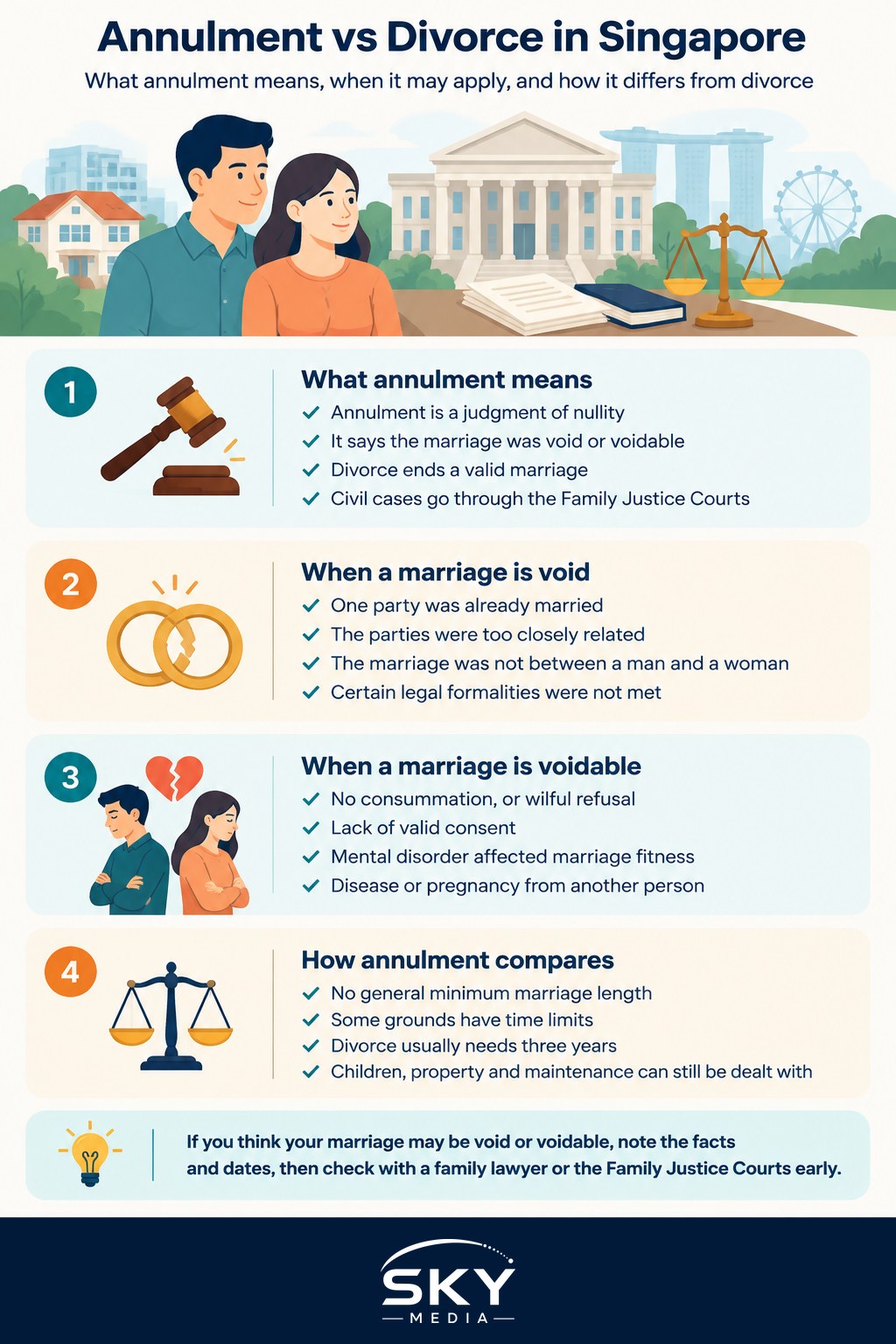
What an Annulment Actually Does
A divorce ends a marriage that was valid. An annulment, called a “judgment of nullity” in court, declares that a marriage was either:
- Void: never a valid marriage in law at all, because of a fundamental defect; or
- Voidable: valid until annulled, but open to being set aside by the court because of a defect that existed from the beginning.
For civil marriages, the relevant rules are mainly in the Women’s Charter, and applications are dealt with by the Family Justice Courts. Muslim marriages registered under the Administration of Muslim Law Act fall under a separate system, including the Syariah Court, so Muslim couples should seek advice specific to that framework.
Grounds for a Void Marriage
A void marriage is treated as never having existed in law. In general, the Women’s Charter treats a marriage as void in situations such as these:
- One party was already married. Singapore civil law requires monogamy. If either party was still lawfully married to someone else at the time, the later marriage is void.
- Either party was under the minimum age and the marriage was not properly authorised under the rules that apply.
- The parties were too closely related, within the prohibited degrees of relationship set out in the law.
- The marriage was not between a man and a woman as required under Singapore law.
- Certain legal formalities were not met, in specific circumstances set out in the law.
Even though a void marriage is technically invalid from the start, parties often still apply to the court for a judgment of nullity. This gives legal certainty and allows the court to deal with related matters such as children and property.
Grounds for a Voidable Marriage
A voidable marriage is valid until the court annuls it. The grounds generally relate to problems that existed when the marriage began. Broadly, they include:
- Non-consummation, either because one party is unable to consummate the marriage, or because the other party wilfully refuses to.
- Lack of valid consent, for example where one party agreed under duress, by mistake, or because of unsoundness of mind.
- Mental disorder of a kind or to an extent that made a party unfit for marriage, even if they could technically consent.
- A communicable venereal disease that the respondent had at the time of the marriage.
- Pregnancy by another person at the time of the marriage.
Some of these grounds come with important conditions. For several of them, the application must usually be made within a set period after the marriage, and the applicant may need to show that they did not know the relevant facts when they married. A court may also refuse to annul a voidable marriage if the applicant knowingly behaved in a way that led the other party to believe they would not seek an annulment. Check the precise conditions with a lawyer, because missing a time limit can mean an annulment is no longer available.
Annulment, Divorce and Separation Compared
People sometimes consider annulment because it is perceived as quicker or carries less stigma than divorce. In practice, the right route depends on your facts, not on preference. Here is how the main options compare in broad terms:
| Annulment (nullity) | Divorce | Judicial separation | Deed of separation | |
|---|---|---|---|---|
| What it does | Declares the marriage void or sets aside a voidable marriage | Ends a valid marriage | Court order that the parties need not live together; marriage continues | Private written agreement to live apart; marriage continues |
| Basis | A specific defect existing at the start of the marriage | Irretrievable breakdown of the marriage, shown through facts set out in the law | Similar facts to divorce | Mutual agreement of both spouses |
| Minimum length of marriage | No general minimum, though some grounds have time limits | Generally three years, unless the court allows an earlier filing in exceptional circumstances | Generally no three-year bar | None |
| Can parties remarry afterwards? | Yes | Yes | No | No |
| Court involvement | Yes | Yes | Yes | No, though a court may later consider it |
The three-year rule is often why annulment comes up in conversations about very short marriages. If a couple married recently and the facts fit a nullity ground, annulment may be possible without waiting. If the facts do not fit, divorce is generally the route once the three-year period has passed, unless the court permits an earlier application.
Separation is a different matter again. Some couples choose a deed of separation or a judicial separation for religious, financial or personal reasons, or as a step before deciding on divorce. Our guide to deed of separation vs divorce in Singapore covers that choice in more detail.
Children, Property and Maintenance After an Annulment
A common worry is what an annulment means for children and assets. In general terms:
- Children of a marriage that is annulled are not left without legal protection. The court can make orders on custody, care and control, access and maintenance, with the child’s welfare as the paramount consideration.
- Matrimonial assets can be divided by the court after a judgment of nullity, similar to the position after a divorce. Our article on splitting property in a divorce explains the general principles the court considers.
- Maintenance for a spouse may be ordered in appropriate cases.
- HDB flats and CPF used for a matrimonial home need careful handling, and HDB’s and CPF Board’s own rules will apply alongside the court order.
These ancillary matters are often the most complex part of any case, whichever route you take.
Taking the First Steps
If you think your marriage may be void or voidable:
- Write down the key facts and dates: when you married, where, and what you knew at the time. Many grounds depend on exactly when you found out something.
- Gather documents such as your marriage certificate and any evidence relevant to the ground you are considering.
- Get legal advice early. A family lawyer can tell you whether a nullity ground genuinely applies and whether any time limit has passed. If cost is a concern, look into the Legal Aid Bureau under the Ministry of Law and community legal clinics.
- Check the official information. The Family Justice Courts website explains the process for nullity and divorce applications, including forms and filing steps.
- Look after yourself. Ending a marriage, however it is done, is stressful. Family Service Centres and counselling services can help.
For a broader overview of the divorce process, read navigating divorce in Singapore. Whatever route applies, getting proper advice at the start will save time, money and stress later.
Frequently Asked Questions
Can a couple simply agree between themselves to annul their marriage? No. A marriage can only be declared void or set aside by the court, and only if a legal ground such as bigamy or lack of consent is proven. A private agreement does not end a marriage, although a deed of separation can record a couple’s living arrangements. A family lawyer can say which route fits.
Can I annul my marriage because my spouse lied about something important? Not automatically. The grounds are specific, such as duress, mistake, unsoundness of mind, non-consummation or a communicable disease, and a lie on its own is not a ground by itself. Whether the facts fit one of them is a legal question, so take advice from a family lawyer.
Does a church or religious annulment end a marriage in Singapore law? No. A religious annulment may matter within the faith community but does not change a civil marriage in law. Ending a civil marriage legally needs a court order, either a judgment of nullity or a divorce, from the Family Justice Courts. Muslim marriages follow a separate system through the Syariah Court.
How long does an annulment take, and what does it cost? Both depend on the ground, whether the other party contests, and whether children or property must be settled. There is no fixed figure to rely on. Ask a family lawyer for an estimate in writing, check the Family Justice Courts website for the process, and look at Legal Aid Bureau options if cost is a concern.
How do I prove my spouse was already married when we wed? You would normally need records showing the earlier marriage was valid and still subsisting on the date of your wedding, such as marriage certificates and any proof that no divorce had been granted. A family lawyer can advise on what evidence the court expects and how to obtain it.
Official sources: Singapore Courts
Further reading: Simplified Uncontested Divorce in Singapore: How It Works