
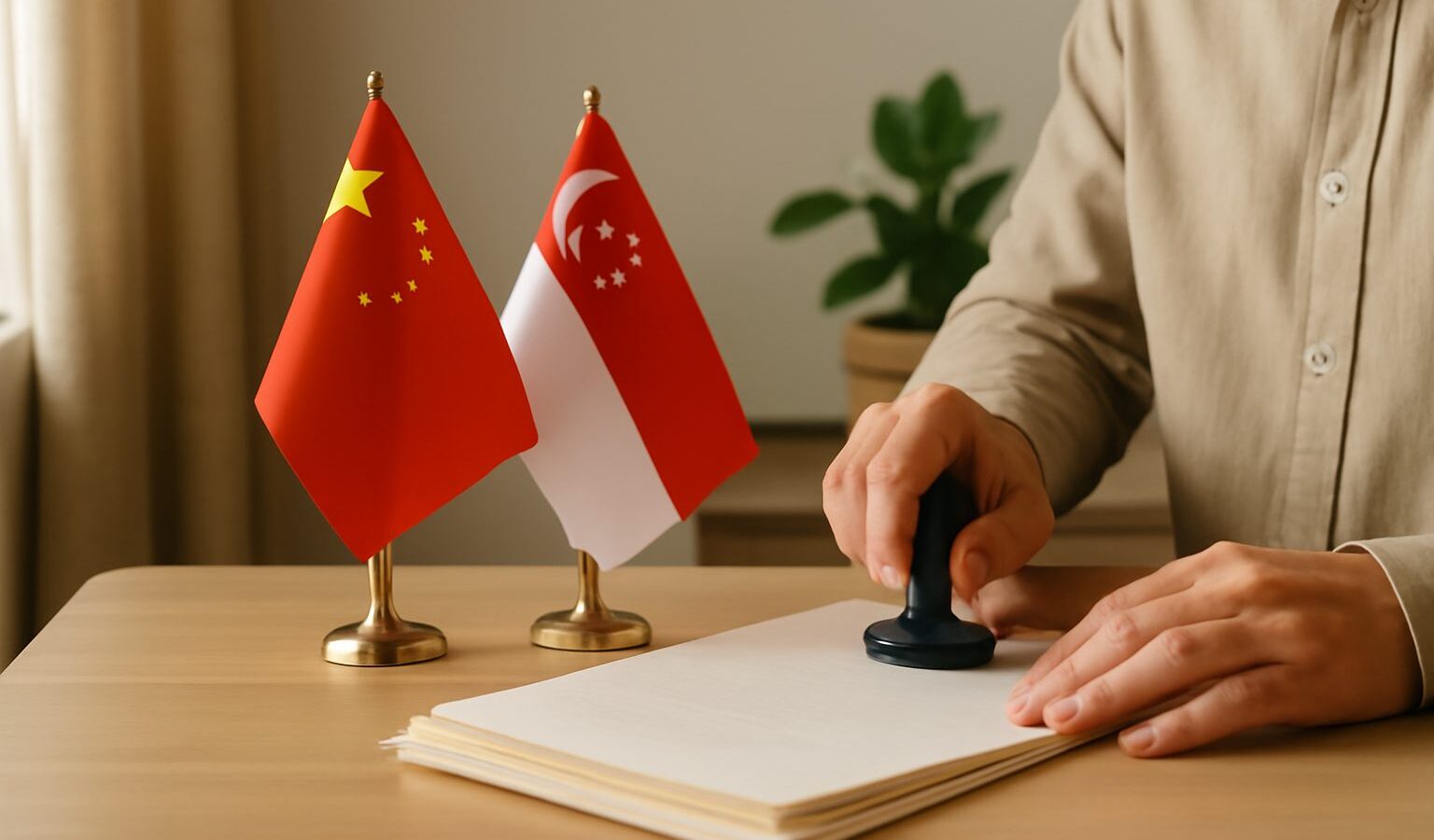
If you have moved from the mainland to Singapore, sooner or later an official here will ask for a Chinese document to be “legalised” or “apostilled”. A birth certificate for a school application, a marriage certificate for a Dependant’s Pass, a degree for a work pass, a police clearance for permanent residence: all of these often need proof that they are genuine before a Singapore authority will accept them. Understanding how apostille china singapore procedures work will save you weeks of confusion and more than one wasted trip. This guide explains what apostille and legalisation mean, how the process changed recently, and how to confirm the current steps for your exact document.
What Legalisation and Apostille Actually Mean
A document issued in one country does not automatically carry legal weight in another. Legalisation is the chain of official confirmations that tells a foreign authority, “yes, this stamp and this signature are real”. Traditionally this meant consular legalisation: a document was notarised, then authenticated by the issuing country’s foreign ministry, then stamped again by the destination country’s embassy. It was slow and involved several counters.
An apostille replaces that long chain with a single certificate. It is a standardised stamp or attached page, defined by the Hague Apostille Convention, that one designated authority in the issuing country adds to a public document. Any other member country then accepts it without further embassy involvement. Both China and Singapore are now parties to the Hague Apostille Convention, which has simplified movement of documents between the two considerably compared with the old consular route.
The key idea to hold on to: an apostille verifies the origin of the document, the signature, and the seal. It does not verify that the content is true or that a translation is accurate. Those are separate concerns you may still need to handle.
When You Will Need an Apostille in Singapore
Not every document needs legalisation. You usually need it when a Singapore government body, employer, or institution requires official proof that a foreign public document is authentic. Common triggers for newcomers from China include:
- Immigration and family: marriage certificates, birth certificates, and death certificates for passes and sponsorships handled through ICA.
- Employment and study: academic degrees, diplomas, and transcripts for work passes or course enrolment.
- Personal status and background: police clearance certificates (无犯罪记录证明) for PR or certain jobs.
- Legal and commercial: powers of attorney, company documents, or declarations for use in Singapore.
Whether a given office wants a full apostille, a certified translation, or simply a certified copy varies. Always ask the receiving Singapore authority exactly what they require before you spend money, because requirements differ between ICA, MOM, schools, and private employers.
How the Process Works Step by Step
While details vary by document and by the Chinese city where it was issued, the general path from a Chinese public document to something Singapore will accept looks like this:
- Obtain or issue the original document from the relevant Chinese authority. Some documents must first be turned into a notarial certificate (公证书) by a Chinese notary office (公证处), especially for items like single-status declarations or copies.
- Have the document notarised in China where required. The notary confirms the copy, the signature, or the fact stated.
- Obtain the apostille from the competent Chinese authority designated under the Convention. This is the step that replaces the old embassy legalisation for documents heading to Singapore.
- Arrange a certified translation into English if the receiving Singapore body requires it, since Chinese-language documents usually need an accompanying English version.
- Submit to the Singapore authority. Keep the original apostilled document and translation together.
If your document was issued in Singapore and needs to be used in China, the direction reverses: you would have the Singapore document notarised and apostilled by the Singapore side before sending it to the mainland.
Old Consular Route Versus Apostille
Because both countries now recognise apostilles, most people no longer need the multi-step consular chain. The comparison below shows why the newer route is simpler, but remember that some receiving parties, or documents issued before certain dates, may still be handled differently, so confirm your case.
| Feature | Old consular legalisation | Apostille route |
|---|---|---|
| Number of authenticating bodies | Multiple, including an embassy or consulate | Single designated authority |
| Embassy or consulate involvement | Usually required | Not required between member countries |
| Typical complexity | Higher, several counters | Lower, one certificate |
| Recognition | Country by country | Accepted by all Convention members |
| Best for | Documents to or from non-member countries | China to Singapore public documents |
Treat this as a picture of how the two approaches differ, not as a promise about your specific document. The safest move is always to ask the office that will receive the document.
Translation, Copies, and Common Pitfalls
A frequent mistake is assuming an apostille removes the need for translation. It does not. If your certificate is in Chinese, a Singapore authority will typically still want an accurate English translation, and some want that translation itself certified or notarised. Our guide on translating and notarising Chinese documents in Singapore covers how to get this done properly.
Other pitfalls to avoid:
- Apostilling the wrong version. Some offices want the apostille on the original, others on a notarial certificate. Confirm first.
- Assuming one apostille covers everything. Each document generally needs its own.
- Letting documents go stale. Police clearances and single-status declarations are often expected to be recent, so time your requests.
- Skipping the receiving-body check. The Singapore office, not a forum post, decides what is acceptable.
Where to Verify Before You Commit
Rules on both sides of the border change, and procedures vary by Chinese city and by the type of document, so never rely on a single blog, including this one, as the final word. This article is general information, not personalised legal advice, and the requirements you face may differ.
To confirm the current process, verify on the China side with the Chinese Embassy or Consulate in Singapore or the relevant Chinese authorities and notary offices (公证处) in the city that issued your document, since they administer notarisation and apostille there. On the Singapore side, confirm acceptance requirements directly with the body that will receive the document, such as ICA for immigration and civil-status matters, MOM for work passes, or the specific school or employer. When both sides agree on what they expect, you can proceed with confidence.
Explore More
For related steps, see our guide on translating and notarising Chinese documents in Singapore and, if your paperwork involves your background check, getting a China police clearance certificate for Singapore. You can also read about Chinese Embassy consular services in Singapore to plan any counter visits.