
If you are a writer, musician, visual artist, dancer or theatre maker, an NAC grant in Singapore can turn a project idea into something you can actually afford to make. The National Arts Council (NAC) is the statutory board that supports the arts in Singapore, and it runs funding schemes that individual practitioners, not just companies, can apply for. The process can feel bureaucratic the first time, but it rewards preparation more than polish. This guide walks you through it from an individual artist’s point of view, from choosing the right scheme to writing a budget that holds up.
Grant schemes, names, deadlines and eligibility rules change from time to time, so treat this as a general orientation and always read the current guidelines on the NAC website before you apply.
Understanding What NAC Funds for Individuals
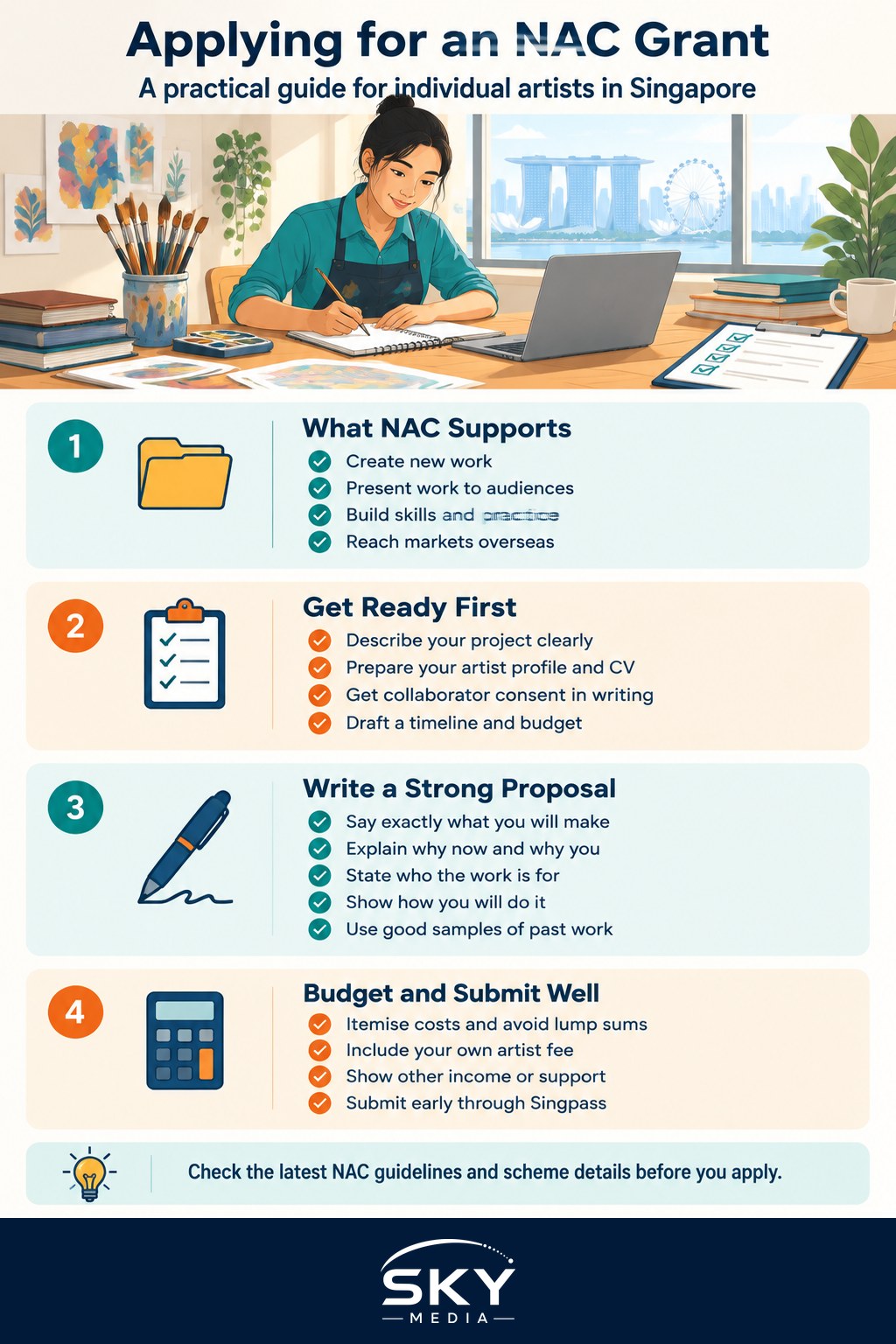
NAC grants broadly support activities across the life of an artistic project. While the exact scheme names and structures are updated periodically, funding for individuals typically falls into a few areas:
- Creating new work. Time and resources to research, develop and make a new piece, such as a manuscript, a composition, a body of visual work or a new performance.
- Presenting work. Staging an exhibition, a performance, a publication launch or a screening for audiences in Singapore.
- Developing your capability. Courses, mentorships, residencies or professional development that build your skills as a practitioner.
- Reaching markets and audiences. Taking work overseas, attending festivals or markets, or building new audiences.
Each scheme has its own guidelines covering who may apply, what costs are supported, how much NAC may contribute and when applications open. Some schemes accept applications year-round, while others have fixed windows. Eligibility may depend on factors such as citizenship or residency status and your track record, so confirm these before investing time in a proposal.
If you are still building your practice, our guide to artist residency programmes in Singapore explains another route to time and space for your work.
Preparing Before You Open the Application
The strongest applications are usually prepared weeks ahead. Before you log in, gather the following:
- A clear project idea. Be able to describe in a few sentences what you are making, why it matters, and who it is for.
- Your artist profile. A short biography, a CV of past work, and links or files showing samples of your practice.
- Collaborators. If others are involved, get their agreement in writing and collect their short biographies.
- A timeline. Key milestones from research to completion, presentation and wrap-up.
- A draft budget. Itemised costs and any other income or support you expect.
- Your Singpass. Government grant applications are generally submitted online with Singpass, Singapore’s national digital identity login. NAC grants have been handled through the government’s OurSG Grants portal; check the NAC website for the current portal link.
Reading the scheme guidelines line by line is worth the time. Note what costs are excluded, whether there is a co-funding requirement, and what reporting you will owe if successful.
Writing a Strong Project Proposal
Assessors read many applications, so clarity matters more than flourish. Aim for a proposal that answers these questions directly:
- What is the project? Describe the work concretely. “A series of ten large-scale ink paintings exploring coastal reclamation” is easier to assess than a general statement about memory and place.
- Why now, and why you? Show how this project grows from your previous work and what it will do for your development.
- Who is it for? Name the audiences or communities you hope to reach and how they will encounter the work.
- How will you do it? Lay out the process, venues or platforms, and partners.
- How will you know it worked? Suggest realistic outcomes, such as attendance, a completed manuscript, or a body of work ready for exhibition.
Support the proposal with good samples of previous work. Choose quality over quantity, and label everything clearly.
Building a Budget That Holds Up
A realistic budget signals that you understand your own project. Itemise costs rather than lumping them together, and explain any unusual items. Typical lines include artist fees (including your own), materials, venue hire, production, marketing, documentation and transport.
Keep these points in mind:
- Pay yourself fairly. Many artists underprice their own time. Grant guidelines generally allow artist fees, so include them honestly.
- Show other income. Ticket sales, sponsorship, crowdfunding or your own contribution show the project is not entirely dependent on one source.
- Use quotes where you can. For larger items like venue hire or printing, get written quotes and keep them on file.
- Check what is not supported. Some costs, such as certain equipment purchases, may be excluded or capped. The guidelines will say.
Stages of the Application, at a Glance
| Stage | What you do | What to watch for |
|---|---|---|
| Choose a scheme | Match your project to the right NAC grant | Eligibility, deadlines and supported costs |
| Prepare materials | Draft proposal, budget, timeline, work samples | Collaborator consent and accurate figures |
| Submit online | Apply through the portal with Singpass | Submit before the deadline, keep a copy |
| Assessment | NAC reviews your application, may ask questions | Reply promptly and stay consistent with your budget |
| Outcome and agreement | Accept the offer and its conditions if successful | Acknowledgement rules and reporting duties |
| Delivery and reporting | Complete the project and submit final reports | Keep receipts and documentation throughout |
Common Mistakes That Weaken Applications
Many unsuccessful applications share the same avoidable problems:
- Applying to the wrong scheme. A presentation grant will not fund a project that is still in early research. Read the purpose of each scheme carefully.
- Vague outcomes. If you cannot say what will exist at the end, assessors will struggle to support it.
- Budgets that do not match the proposal. If the proposal mentions three venues but the budget lists one, it raises questions.
- Last-minute submissions. Portals can be slow near deadlines, and rushed proposals show it.
- Ignoring past reporting. If you have received a grant before, outstanding reports may affect future applications.
After You Apply: Results, Reporting and Next Steps
If your application succeeds, you will usually receive a letter of offer setting out conditions, such as how to credit NAC in your publicity, when funds are disbursed and what reports are due. Read it closely before accepting. Keep receipts, photos, programme notes and audience data as you go, since final reporting is much easier when you have documented along the way.
If your application is not successful, treat it as part of the process. Where feedback is offered, ask for it, refine the project and consider whether a different scheme or timing would suit it better. Many established artists in Singapore were turned down before they were funded.
Grants are only one part of a sustainable practice. Building audiences and relationships matters just as much, and our pieces on supporting local artists in Singapore and visiting artist studios and open studios show how the wider community engages with working artists.
For the latest schemes, guidelines and application windows, go directly to the National Arts Council website, and contact NAC through its official channels if you are unsure which scheme fits your project.
Further reading: Finding Open Calls and Art Competitions in Singapore