
If you are an art student or a young practitioner, you have probably seen the phrase “artist in residence” on exhibition labels and social media. An artist residency Singapore programme gives an artist time, space and support to develop work, usually for a set period and often with a public outcome at the end. It is different from visiting open studios, showing at an art fair or selling work to collectors: a residency is about the process of making, researching and connecting, not about the finished product alone.
This guide explains how residencies typically work in Singapore, the main formats you will come across, how to find and apply for them, and what to think about before you commit. Details of specific programmes, including eligibility, funding and deadlines, change from year to year, so always read the current open call from the organiser.
What an Artist Residency Actually Is
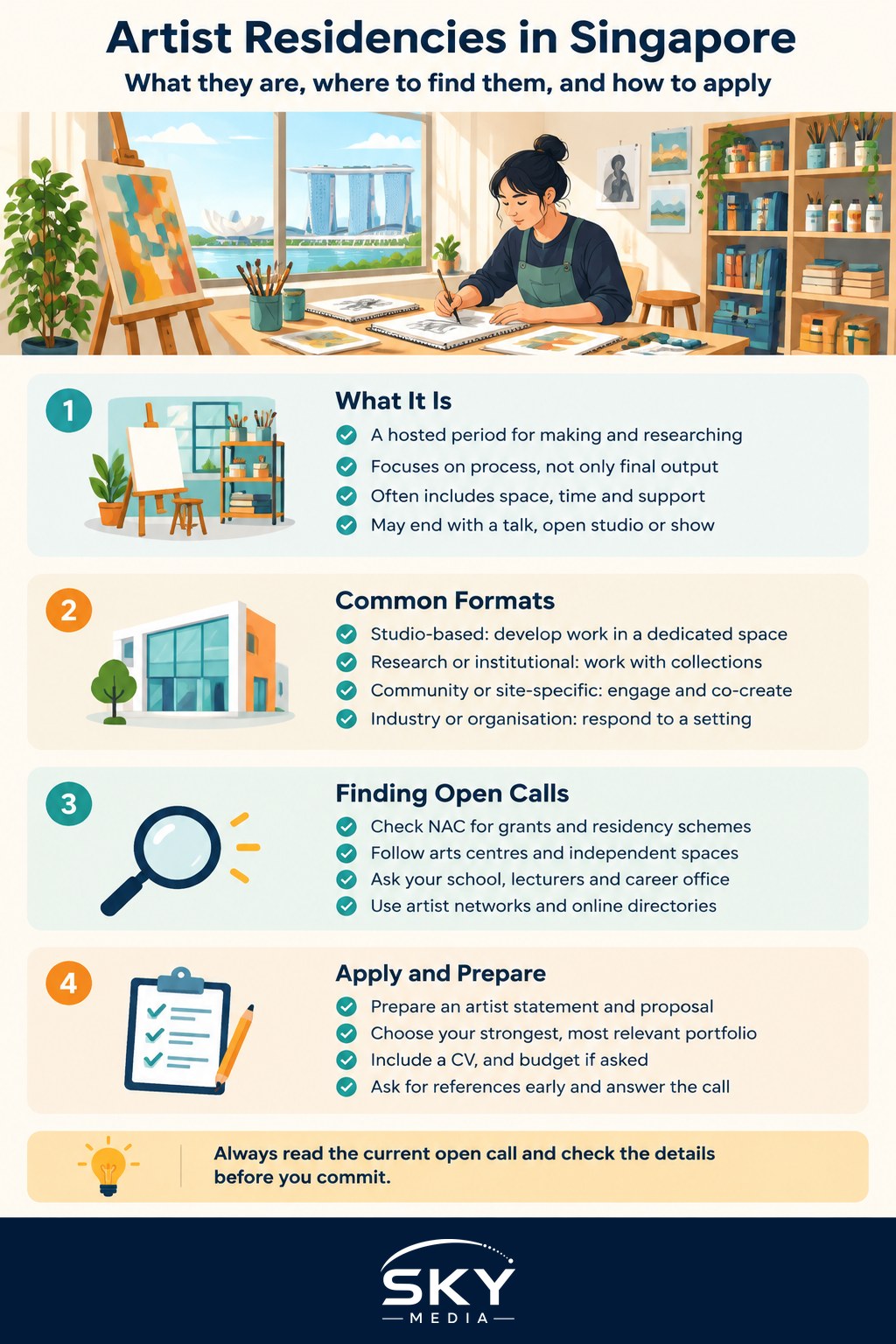
At its simplest, a residency is a structured period where an artist is hosted by an organisation. The host might be an arts centre, a gallery, a museum, a university, a print workshop, a community space or even a company or public institution that wants an artist to respond to its work.
Residencies commonly offer some combination of:
- Studio or work space, sometimes with specialised equipment such as printmaking presses, kilns, sound or digital facilities.
- Time, which is often the most valuable part for artists juggling studies or jobs.
- A stipend, fee or materials budget, though not all residencies are paid.
- Mentorship or curatorial support, including studio visits and feedback.
- Public engagement, such as an open studio day, talk, workshop or final exhibition.
- Accommodation, mostly for international residencies, and less common for local ones in Singapore.
In return, the host usually expects you to be present for a minimum amount of time, share your process in some way, and credit the residency in future presentations of the work.
Common Types of Residencies in Singapore
Singapore’s residency landscape is small but varied. You will generally see these formats:
Studio-based residencies
The artist gets a studio for a few weeks to several months and develops a body of work. These are often run by arts centres, independent art spaces and print or craft workshops.
Research and institutional residencies
Museums, libraries, archives and universities may invite artists to work with collections, research materials or academic departments. The outcome might be a new work, a publication or a series of talks.
Community and site-specific residencies
Here the artist works with a neighbourhood, a group of residents, a school or a public space. The emphasis is on engagement and co-creation, so communication skills matter as much as studio skills.
Industry or organisation residencies
Some companies, hospitals, nature sites or government agencies host artists to bring a fresh perspective to their work. These can involve unusual settings and require respecting confidentiality or safety rules.
Overseas and exchange residencies
Singapore-based artists may apply to programmes abroad, sometimes with support from Singapore funding bodies, and local hosts may welcome international artists through exchange arrangements.
Comparing Residency Formats
| Format | Typical focus | Good fit for |
|---|---|---|
| Studio-based | Developing a body of work in a dedicated space | Artists who need time and equipment |
| Research or institutional | Working with collections, archives or academic ideas | Research-driven or conceptual practices |
| Community or site-specific | Engagement, workshops and co-created work | Socially engaged artists, good communicators |
| Overseas exchange | New context, networks and cultural exchange | Artists ready to travel and adapt |
Where to Find Open Calls
Residencies are usually announced through an “open call”, which sets out who can apply, what is offered and what the host expects. To keep track:
- National Arts Council (NAC). The NAC is the government agency that supports the arts in Singapore. Its website lists grants and schemes, some of which can support residencies locally or overseas. Check current schemes and eligibility directly with the NAC.
- Arts centres and independent spaces. Follow the websites, newsletters and social accounts of local art spaces, as many announce calls there first.
- Your school. Art schools and university arts faculties often share residency and exhibition opportunities with students and alumni. Ask your lecturers and career office.
- Artist networks and collectives. Fellow artists are often the quickest source of news about upcoming calls.
- International residency directories. Online databases list residencies worldwide, including some in Southeast Asia.
Set calendar reminders, as deadlines can be weeks or months before the residency begins.
Writing a Strong Application
Most applications ask for similar materials. Prepare them in advance so you can respond quickly:
- An artist statement. A short, clear description of what your practice is about. Avoid jargon.
- A residency proposal. Explain what you plan to do during the residency, why this host and this period suit the project, and what the outcome might be. Be specific but leave room for experimentation.
- A portfolio. Choose your strongest, most relevant works, with titles, dates, media and short descriptions. Quality matters more than quantity.
- A CV. List exhibitions, education, awards and relevant experience. Students can include school shows and group projects.
- A budget, if asked. Be realistic about materials, transport and any equipment.
- References, if requested. Ask lecturers or mentors early and give them context.
Read the open call carefully and answer what it asks. Generic applications sent to many programmes usually stand out for the wrong reasons.
Practical Questions to Ask Before Accepting
A residency is a commitment, so check the details:
- Time. Can you be present for the required hours alongside school or work?
- Money. Is there a fee, stipend or materials budget, and when is it paid? Are you expected to cover any costs yourself?
- Ownership and rights. Who owns the work produced, and how can the host use images of it? Read any agreement before signing.
- Outcomes. Is a final exhibition or public programme required, and who pays for installation?
- Space and access. What are the studio hours, and is there storage or security for your work?
- Taxes. If you receive a stipend or fee, it may count as income. Check how it is treated on the IRAS website.
International artists coming to Singapore for a residency should confirm visa and pass requirements with the relevant authorities well ahead of time, and the host should be able to advise on this.
Building Toward a Residency as a Student
You do not need a long CV to start. Build experience by joining student shows, collaborating with peers, documenting your work well and getting to know the local art community. Attending open studios is a good way to see how resident artists work and to ask them about their experience. Our guide to visiting artist studios and open studios explains how to make the most of those visits. Understanding the wider ecosystem also helps, and our piece on supporting local artists in Singapore looks at how audiences and institutions sustain artists’ careers.
A first residency can be a turning point, offering focus, feedback and connections. Start small, apply thoughtfully, and treat each application as practice for the next.
Frequently Asked Questions
Do artist residencies in Singapore pay artists a stipend? Some do, but not all. A residency may offer a stipend, fee or materials budget, or only space and time. Read each open call to see what is paid and when, and ask what costs you must cover yourself.
Can a student with no exhibition history apply for a residency? Yes, you do not need a long CV to begin. Student shows, collaborations and well-documented work count, and school shows can go on your CV. Start with smaller programmes and read each call for eligibility.
Does the host own the artwork I make during a residency? Not necessarily, so read the agreement before signing. Check who owns the work produced and how the host can use images of it. Ask for clarification in writing if anything is unclear.
Are there residencies in Singapore for foreign artists? Yes, hosts may welcome international artists through exchange arrangements. Visa and pass requirements apply, so confirm them with the relevant authorities well ahead of time, and ask the host to advise.
Is stipend money from a residency taxable? It may count as income. Check how it is treated on the IRAS website, or speak to a tax adviser, and keep records of the payment.
Further reading: Finding Open Calls and Art Competitions in Singapore · Applying for a National Arts Council Grant as an Individual Artist