

Every year, a steady stream of Singapore students heads to British universities, and almost all of them go through the same door: UCAS, the Universities and Colleges Admissions Service. A UCAS application from Singapore is not hard, but it runs on a UK calendar, uses UK vocabulary and asks for a personal statement that feels very different from local admissions essays. This guide walks through the timeline step by step, explains the personal statement, and shows how offers work for Singapore-Cambridge A-level and International Baccalaureate (IB) students.
Dates, formats and requirements change from cycle to cycle, so always confirm the current details on the official UCAS website and each university’s admissions pages before you rely on them.
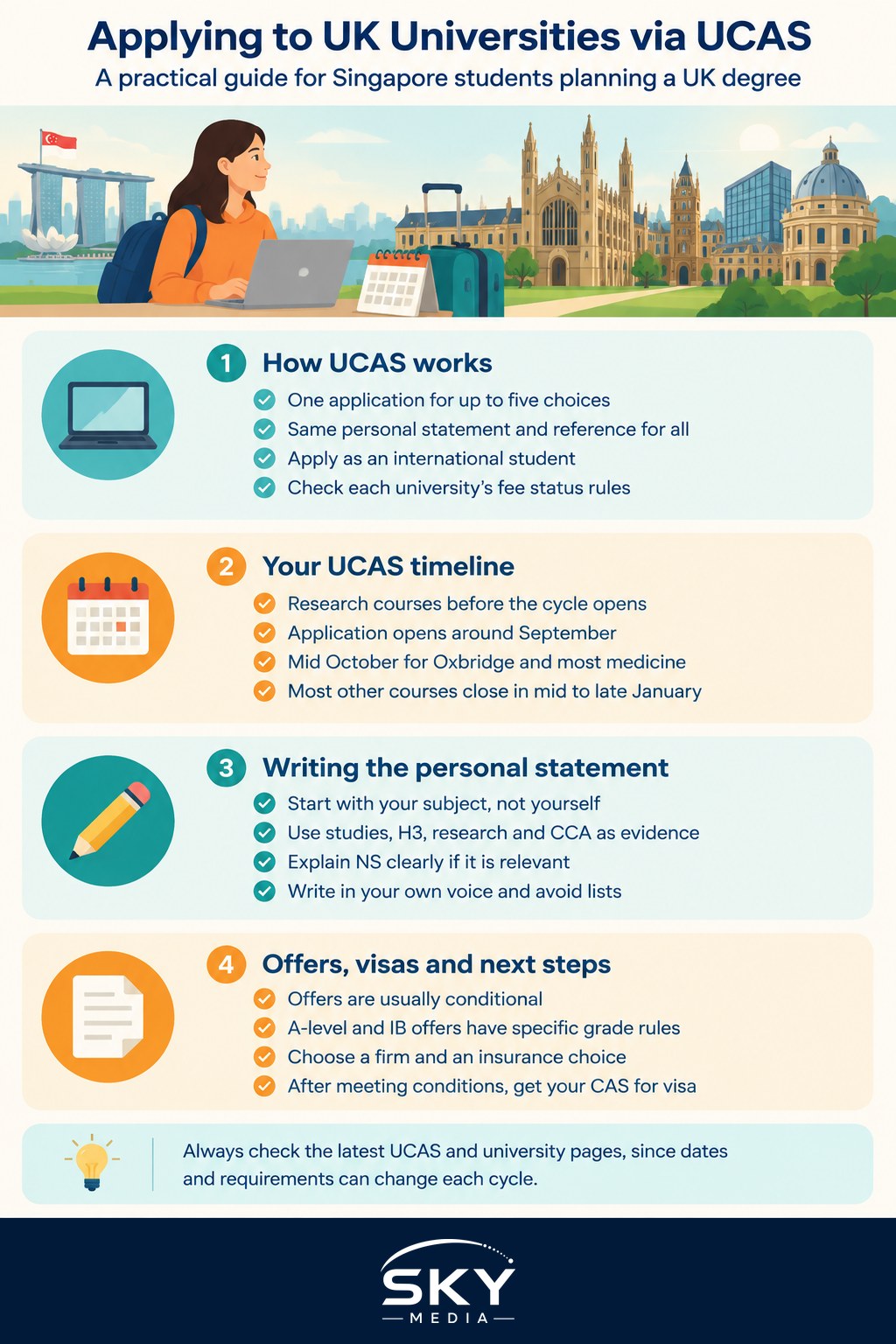
How UCAS Works for Singapore Applicants
UCAS is the single online portal for undergraduate study in the UK. Instead of applying to each university separately, you submit one application that goes to up to five course choices. All five choices see the same personal statement and reference, so your choices should be in the same or closely related subjects.
A few points matter especially for students here:
- You apply as an international student. For fees and funding, Singaporeans are usually classed as overseas students, which means higher tuition than UK students pay. Check each university’s fee status rules.
- You can apply with results in hand. Many Singapore students apply after receiving their A-level or IB results, often during National Service (NS) or a gap year. Others apply in their final school year with predicted grades. Both routes work.
- Your school or a referee writes a reference. If you have left school, ask a former teacher or your school’s university guidance office early, as they handle many requests.
- Deferred entry is common. Male students serving NS often apply for deferred entry, or apply in their final year of NS for the following intake. State your situation clearly so admissions teams understand any gap.
If you are weighing the UK against staying home, compare this process with applying to local universities, which runs on a different timetable and puts more weight on aptitude tests and interviews for some courses.
The UCAS Timeline, Step by Step
The UK academic year starts around September or October, and UCAS cycles run roughly a year ahead of that. Here is how a typical cycle unfolds. The exact deadline dates are published by UCAS each year.
| Stage | Roughly when | What you do |
|---|---|---|
| Research and shortlist | Months before the cycle opens | Compare courses, entry requirements and admissions tests, then narrow to five choices |
| Application opens | Around September of the year before entry | Register on UCAS, complete sections, draft the personal statement |
| Early deadline | Mid October | Oxford, Cambridge and most medicine, dentistry and veterinary courses close |
| Main deadline | Mid to late January | Most other courses close for equal consideration |
| Offers and interviews | Late autumn to spring | Attend interviews if invited, track offers in your UCAS Hub |
| Reply to offers | Usually by a date set in late spring or early summer | Choose a firm choice and an insurance choice |
| Results and confirmation | After results are released | Conditional offers become unconditional if you meet them |
International students can technically apply after the main January deadline, but popular courses may already be full. Treat January as your real deadline, and October if you are aiming for Oxbridge or medicine.
The Oxbridge and medicine track
The October deadline arrives quickly, especially for students who just finished their A-levels or IB the year before. Many of these courses also require an admissions test and an interview. Test names and formats have changed in recent years, so check each university’s current requirements and registration dates. Interviews may be online for overseas applicants, but confirm this with the college or university.
Writing the UCAS Personal Statement
The personal statement is your chance to show genuine interest in your subject. UCAS has moved to a structured format built around three questions, roughly covering:
- Why you want to study this course or subject.
- How your qualifications and studies have helped you prepare.
- What else you have done outside education to prepare.
There is a total character limit across the three answers, and a minimum length for each. Check the UCAS website for the current limits, then write in a plain document first and paste in when you are happy.
Tips that work well for Singapore applicants:
- Lead with the subject, not yourself. UK tutors want evidence you think about the subject. Discuss a book, problem or idea that pulled you in, and what you did next.
- Turn school activities into evidence. H3 subjects, research programmes, Olympiads, project work and CCA leadership all count if you explain what you learned that relates to the course.
- Use NS thoughtfully. NS is unfamiliar to many UK tutors. Explain briefly what your role involved and draw a clear link to skills relevant to your course, such as responsibility, teamwork or technical skills.
- Avoid lists of achievements. One activity explored in depth beats ten listed.
- Write in your own voice. UCAS uses similarity checks, and tutors notice generic statements quickly.
How A-Level and IB Offers Work
Most UK offers are conditional, meaning you get a place if you achieve set grades. If you already have results, you may receive an unconditional offer instead.
Singapore-Cambridge A-levels
UK universities are familiar with the Singapore-Cambridge GCE A-level. Offers are usually expressed in A-level grades, such as three subjects at specified grades, and they are generally applied to your H2 subjects. Some universities also mention H1 subjects, H3 subjects or particular grades in a required subject, such as H2 Mathematics for economics or engineering. Each university sets its own approach, so read the international entry requirements page for your course rather than assuming.
International Baccalaureate
IB offers are usually expressed as a total points score plus specific Higher Level (HL) grades, for example a minimum score in HL Mathematics for a science course. Some courses also set conditions on Standard Level subjects.
English language requirements
Many universities accept Singapore A-level General Paper or IB English results as proof of English, but some courses ask for a separate test. Check the English language section for each university.
After the Offers Arrive
Once your offers are in, you choose:
- A firm choice, your first preference.
- An insurance choice, ideally with lower grade requirements, as a backup.
You decline the rest. If you hold no offers, UCAS Extra and Clearing let you find remaining places later in the cycle.
After you accept a firm offer and meet its conditions, the university issues a Confirmation of Acceptance for Studies (CAS), which you need for a UK Student visa. Visa rules, fees and processing are set by the UK government, so follow the official GOV.UK guidance.
You should also think about accommodation early, since first-year halls often have their own deadlines. Many of the same principles in our guide to university hostel and hall accommodation apply when comparing UK halls.
Common Mistakes to Avoid
- Picking five courses with different subjects, so your statement cannot fit any of them well.
- Missing that a course needs an admissions test with an earlier registration date.
- Leaving your reference to the last week before the deadline.
- Assuming your H1 subjects will count towards an offer.
- Not checking whether your firm and insurance choices both suit you, since you are committed if you meet the conditions.
Explore more: Private Universities in Singapore and Transferring Universities or Courses.
Further reading: Applying to US Colleges From Singapore: SAT and Common App