

Getting an offer from a Singapore university is only half the job. The next question for many students is where to live, and for anyone heading to NUS, the NUS hostel application is often the first deadline after accepting a place. Campus housing is popular, places are limited and each university runs its own system, so it pays to understand how it works before the application window opens.
This guide covers the main types of on-campus housing, how applications and points systems generally work, and what your options are if you do not get a room. It focuses on NUS but also explains how NTU, SMU and the other autonomous universities tend to differ. Rules, dates and fees change each academic year, so always confirm details on your university’s housing office website.
The Types of On-Campus Housing You Can Apply For
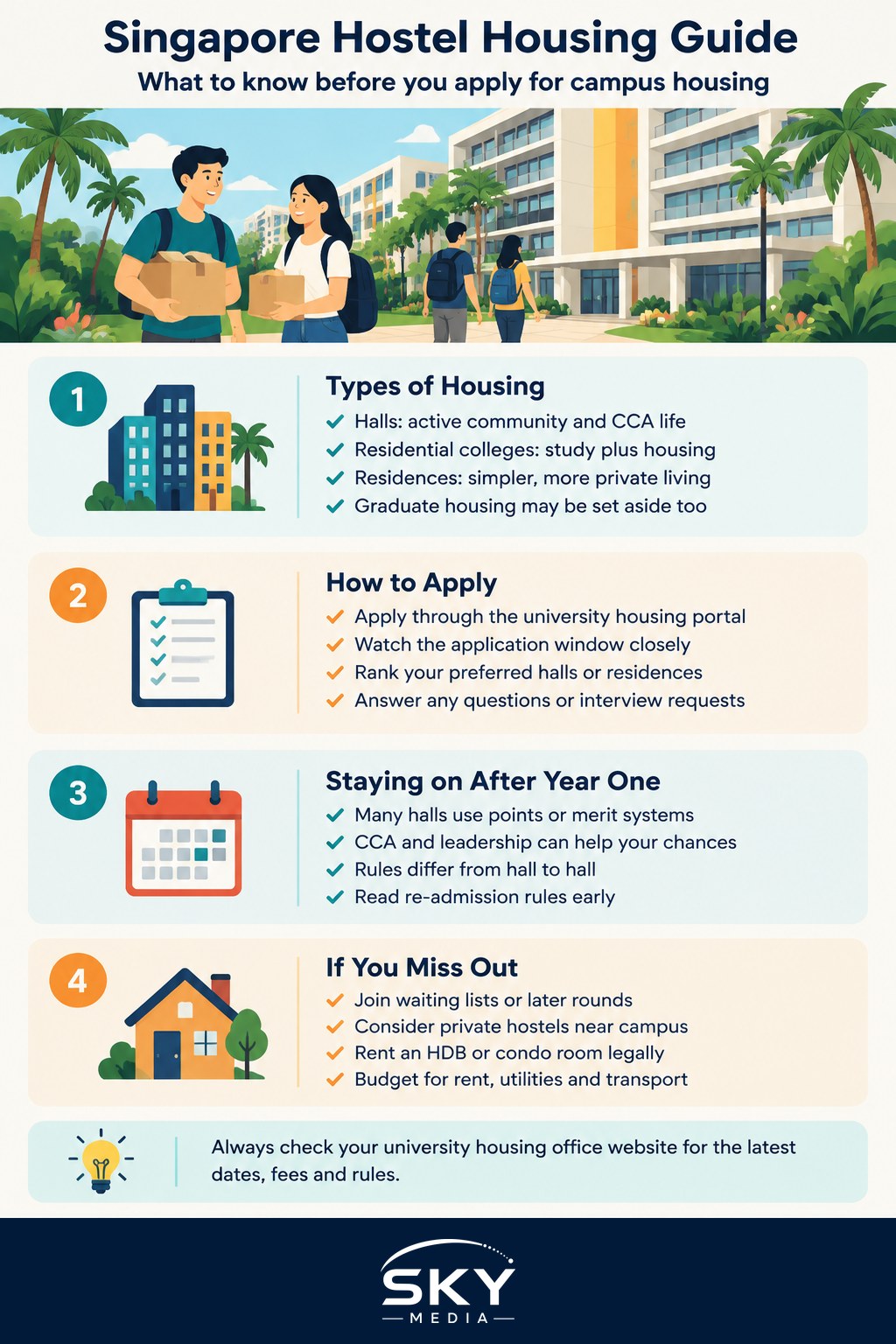
Singapore’s universities offer several kinds of housing, and they are not interchangeable. Knowing the difference helps you rank your choices sensibly.
- Halls of residence. Traditional halls with a strong community and co-curricular activity (CCA) culture. Residents are often expected to take part in sports, performing arts, committees or hall events.
- Residential colleges. Found at NUS, these combine housing with an academic programme, such as seminars or modules taken with fellow residents. Living there usually means committing to that programme.
- Student residences and houses. Apartment or suite-style blocks with fewer participation expectations. They suit students who mainly want a room near class.
- Graduate housing. Some universities set aside rooms for postgraduate students, sometimes with separate application rounds.
| Housing type | What it suits | What is usually expected |
|---|---|---|
| Hall of residence | Students who want an active community life | Ongoing CCA involvement, which can affect whether you stay next year |
| Residential college | Students keen on a live-and-learn programme | Taking part in the college’s academic programme |
| Student residence | Students who want convenience and privacy | Following house rules, with lighter participation demands |
| Off-campus rental | Students who miss out or prefer independence | Managing your own lease, deposit and commute |
How the NUS Hostel Application Process Generally Works
Each university runs housing applications through its student affairs or housing office, usually via an online portal you can access once you have an offer or a student account. While the exact steps change from year to year, the process usually looks like this:
- Watch for the application window. Freshmen applications tend to open around the time offers are accepted. Missing the window can push you to a later round where fewer rooms remain.
- Rank your preferences. You may be asked to list several halls, colleges or residences in order. Read about each one before ranking.
- Write any required statements. Halls and colleges may ask about your interests, CCA plans or why you want to join. Be honest and specific.
- Attend interviews if invited. Some halls interview applicants, either online or in person.
- Accept your offer and pay on time. Housing offers usually come with an acceptance deadline and a payment. If you miss it, the room may go to someone else.
If you are still in the middle of your university application itself, our guides on applying to local universities and writing a standout university application cover that earlier stage.
Understanding Hall Points and Re-Admission Systems
The part that confuses most new students is what happens after the first year. Many halls do not guarantee you a room for your whole degree. Instead, they use some form of points or merit system to decide who can stay on.
In broad terms, these systems reward residents who contribute to hall life. Points or credit may come from joining sports teams, performing in productions, serving on committees, organising events or holding leadership roles. At the end of the year, residents with stronger records are more likely to be offered a room again, while others may need to look elsewhere.
A few practical points to keep in mind:
- The rules differ by hall. Two halls at the same university can weigh activities very differently. Ask seniors or check the hall’s own guidance.
- Plan your workload. Hall activities can be time-consuming. Balance them against your studies, especially in heavy semesters.
- Residential colleges and residences may work differently. Some offer a set length of stay or have their own re-application rules rather than CCA points.
- NTU and other universities have their own schemes. NTU halls have historically used a points-based approach for continued stay too, while SMU, SUTD, SIT and SUSS each handle housing in their own way, sometimes with far fewer rooms available.
The key message: do not assume your first-year room is yours for four years. Read your hall’s re-admission rules early.
Tips to Strengthen Your Housing Application
Popular halls are competitive. A few habits help:
- Apply as early as possible within the window, and double-check every field before submitting.
- Show genuine interest. If a hall is known for a particular sport or arts group, say what you would actually join and why.
- Spread your preferences. Ranking only the most popular halls is risky. Include a mix of halls, colleges and residences you would be happy with.
- Check eligibility categories. Some rounds prioritise freshmen, international students, students living far from campus or those with particular needs. Read the criteria carefully.
Notes for International and China Students
For students arriving from overseas, on-campus housing is often the easiest landing option. You avoid signing a private lease before you have even seen Singapore, and you join a ready-made community.
If you come from mainland China, the setup may feel familiar in some ways and different in others. Chinese university dormitories are often assigned automatically. In Singapore, you usually apply and compete for a place, and rooms are not always guaranteed beyond the first year. You may also find more single rooms, and halls expect more involvement in activities than many Chinese dorms do.
A few extra steps help:
- Sort your Student’s Pass first. Your housing offer does not replace your immigration paperwork, which is handled through ICA (Immigration and Checkpoints Authority) and your university.
- Check arrival dates. If your room is not ready when you land, you may need a short stay elsewhere. Our guide on finding temporary accommodation on arrival explains the options.
- Read our admissions guide on applying to NUS and NTU as a student from China if you are still preparing your application.
What to Do If You Do Not Get a Room
Missing out on campus housing is common. The usual alternatives:
- Join the waiting list or later rounds. Rooms can open up as other students decline offers. Keep checking the housing portal.
- Private student hostels. Several private operators run student accommodation near campuses. Visit or video-call before paying, and read the contract terms on deposits and early termination.
- Renting a room in an HDB flat or condominium. Common near NUS in areas along the West Coast and Clementi corridor. Make sure the arrangement is legitimate and that your landlord follows HDB or URA rules on renting out rooms.
- Sharing a whole unit with classmates. This can work out cheaper per person but needs clear agreements on bills and chores.
- Living at home. For local students, staying with family and commuting is the most affordable choice, even if travel is longer.
Whichever route you take, budget for more than rent. Utilities, internet, transport and food add up. Once you move in, our guide on choosing a tech setup for a student hostel room helps you settle in without overspending.
Key Takeaways
Campus housing in Singapore is something you apply for, not something you are simply given. Learn the difference between halls, residential colleges and residences, rank your preferences carefully, meet every deadline, and understand how your hall decides who stays the following year. If you miss out, there are solid alternatives, as long as you check contracts and budget properly. For current dates, fees and rules, the university’s own housing office remains the authority.
Further reading: University Orientation Camps in Singapore: What to Expect